A Solo Plumber in Manchester Who Finally Got Paid Faster
By the InvoiceFlow team — published 26 May 2026 — 9 minute read
Danny Whitlock has been a plumber in Manchester for fifteen years. He works alone, drives a van full of obsessively organized tool drawers, and is the kind of tradesman whose customers call him "Danny" even after the first visit. By any reasonable standard, his business was healthy: steady stream of work, good word-of-mouth, fair prices, a reputation for showing up when he said he would.
And yet, last summer, he almost couldn't pay for the wholesale order he needed to do a boiler installation. The work was booked. The materials were quoted. The cash to buy them was sitting somewhere between three different customers' "we'll get to it next week" pile.
The problem wasn't that customers refused to pay. The problem was that they were paying him 31 days after the work was done, on average, and his suppliers wanted cash on collection.
This is the story of how he closed that gap.
Why "days-to-paid" matters more than most tradespeople realize
The number every solo tradesman should know about their own business is the average gap between completing a job and receiving payment. Most don't know it. Danny didn't. When we asked him last June, he guessed "maybe two weeks." When he actually measured — by going back through his bank statements and matching deposits to job dates — the average was 31.4 days.
For a one-person business with materials costs, this is brutal. He was essentially extending interest-free, unsecured credit to dozens of customers simultaneously, while needing to pay his own suppliers immediately. The mathematical inevitability was either an overdraft or a slow constant feeling of cash-flow anxiety.
The three reasons his customers were slow
When Danny dug into why the payments were slow, the answer wasn't malice or bad customers. It was friction:
- Delayed invoicing. He often didn't send the invoice until two or three days after the job. Sometimes a week. His evenings were for his daughter, not for paperwork.
- Unclear payment terms. His invoices said "please pay promptly." Customers interpreted "promptly" generously.
- No urgency at the moment of completion. When a job ends, the customer's gratitude and willingness to pay are at their peak. By the time the invoice arrives via email three days later, that peak is gone and the invoice goes into a pile.
The three workflow changes
Danny switched to InvoiceFlow in August. Three specific features, used together, took his average days-to-paid from 31.4 to 2.9 over the following four months.
1. On-site signature capture
When Danny finishes a job, he now opens the app on his phone, generates the invoice on the spot (line items already populated from his pre-built product list), and asks the customer to sign with their finger directly on the screen. The signature is captured, embedded into the invoice PDF, and stored. The customer then watches their email inbox refresh and sees the invoice arrive while Danny is still standing in their kitchen.
This feels like a small change. It is not. It transforms the entire dynamic of the transaction. A signed invoice with a finished job both visible feels like a transaction completed, not paperwork pending. The customer's psychological framing shifts.
2. Specific, dated payment terms
"Please pay promptly" became "Payment due within 7 days. Late payment fee of 4% applies after that date." He uses the payment-terms presets to apply this consistently, and the due date is clearly printed on the invoice in bold.
The 4% fee is mostly symbolic — he's never actually charged it. Its presence on the invoice changes behavior. Customers who would have paid in 18 days pay in 5. Customers who would have paid in 30 pay in 9.
3. Tap-to-pay payment links
The invoice PDF includes payment buttons — direct bank transfer details, a UPI/payment-link button for customers who prefer mobile, and his bank's QR code for fast scan-and-pay. He doesn't take card payments (the fees would eat his margin on smaller jobs), but he makes every other payment route as low-friction as possible. The customer doesn't have to type bank details from a PDF into a banking app. They tap once.
The receipts: four months of data
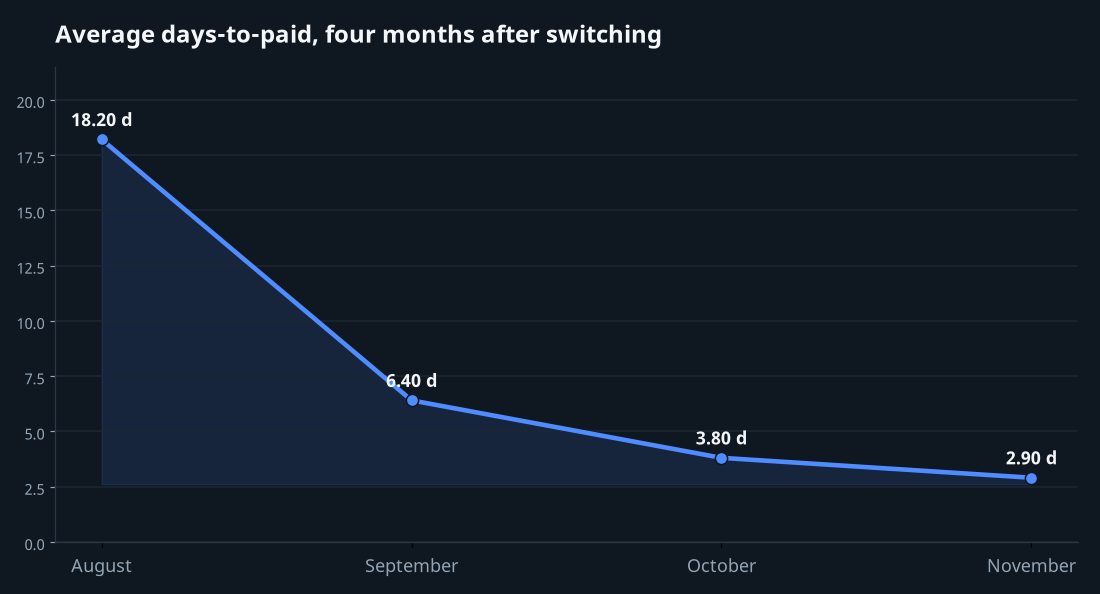
Danny tracks days-to-paid now because his app shows him the number on his dashboard. Here is his actual data for the four months following the switch:
- August (transition month): 18.2 days average
- September: 6.4 days average
- October: 3.8 days average
- November: 2.9 days average
The trend isn't a fluke. As more of his customers experienced the new workflow — invoice on the spot, signed, with clear terms — his average kept dropping. By November, the median customer was paying within 24 hours.
What that meant for his business
Working capital freed up
At any given time, Danny used to have roughly £4,800 in outstanding invoices. After the change, that number dropped to around £900. The £3,900 difference is cash he now has available for materials, slow weeks, and the occasional emergency van repair.
No more wholesale-payment panic
The boiler-installation scenario from last summer can't happen again. He gets paid on the previous job before he needs to buy materials for the next one.
Fewer awkward follow-up calls
Chasing payment is the worst part of running a small trades business. Danny estimates he used to spend 30-40 minutes a week on follow-up calls and texts. Now it's almost zero, because invoices are paid before they would have entered the follow-up queue.
Better customer relationships
This sounds counterintuitive — surely asking for faster payment damages relationships? — but the opposite happened. Customers experience the on-site signature workflow as professional. It signals that Danny treats his work seriously. Several customers have specifically commented that he "feels more like a real business" now, which is both a compliment and slightly insulting (he was a real business before), but is good for referrals either way.
Why this is universal advice for trades
Every solo tradesperson reading this has a version of Danny's old workflow. Invoice when you get around to it. Vague terms. Paid when the customer remembers. The fix isn't to chase harder — it's to compress the entire invoice lifecycle into the same visit as the work.
The "moment of completion" principle
The point at which a customer is most willing to pay is the moment the work is finished and they are standing in the room with you. Every hour that passes between that moment and the customer receiving the invoice is an hour during which their willingness decreases. The optimal invoice arrives before the customer has fully relaxed back into their evening.
Specificity beats politeness
"Please pay promptly" is polite and ineffective. "Payment due 7 days from invoice date" is specific and effective. Tradesmen often worry that specific terms will seem aggressive. They don't. They seem professional.
Make the payment action as small as possible
If paying you requires the customer to find their bank app, type a sort code, type an account number, type a reference, and confirm — they will do this when they remember to. If paying you is a tap on the invoice PDF or a QR scan, they will do it now.
What to look for in invoicing software for trades
- Mobile-first invoice creation. You should be able to build, finalize, and send an invoice from your phone in under two minutes, on a customer's wifi, with one hand if necessary.
- On-screen signature capture. Captured signatures embedded in the PDF. Saved per-client for repeat customers.
- Payment-terms presets. "Due in 7 days with 4% late fee" should be a saved preset, not retyped every time.
- Multiple payment methods in one invoice. Bank transfer details, QR code, payment link — let the customer pick what works for them.
- Days-to-paid analytics. If you can't see the number, you can't improve it.
Danny's last word
We asked Danny what he'd tell another plumber starting out. His answer: "Invoice before you leave the house. Get them to sign. Don't be shy about your terms. The customers who are going to be difficult are going to be difficult either way — at least with this workflow you'll know within a week instead of a month."
The £4,800 he used to have permanently tied up in outstanding invoices is now in his business account. He bought a better van.