The Buenos Aires Designer Who Invoices in Dollars Because the Peso Won't Stop Moving
By the InvoiceFlow team — published 26 May 2026 — 11 minute read
Sofía Romero quoted a logo project on a Tuesday for ARS 380,000. She delivered the work on a Friday twelve days later. By the time the client paid — another nine days after that — the same amount of pesos bought roughly 17% less than it had on the day she quoted. She had effectively given the client a discount neither of them had agreed to.
She told us this story sitting at a café in Palermo Hollywood, with the air of someone describing a recurring nightmare she had finally stopped having. Three months earlier, she had stopped quoting in pesos. Her playbook for invoicing through Argentine inflation has now become her business's most strategic asset — more valuable, she insists, than any portfolio piece.
This article is that playbook.
The unique problem of hyperinflationary invoicing
In stable economies, an invoice is a static document. ARS 380,000 today is ARS 380,000 in three weeks. In Argentina, Turkey, Lebanon, Venezuela, and a handful of other economies, this assumption breaks. The same nominal number represents progressively less value as time passes between quote and settlement.
The naïve responses freelancers try, in order of how badly each fails:
- "I'll quote higher to compensate." Works for one week, fails the next. Inflation accelerates and decelerates unpredictably; over-quoting becomes under-quoting overnight.
- "I'll require payment up front." Loses you 60% of clients. Most won't pay before delivery.
- "I'll switch to dollars." Closer to right. But Argentine clients pay in pesos. You can't actually receive dollars from a domestic client through normal channels.
The working answer is hybrid: denominate in dollars, settle in pesos at the rate on the day of payment. Both sides know what the obligation is. The risk of FX movement shifts from you (where it was destroying you) to the client (who is dealing with peso prices every day and is structurally adapted to them).
The dual-currency invoice setup
Sofía's invoices now look like this:
- Total in USD: the primary number. $980 for a logo project, for example.
- Peso equivalent at today's rate, for reference: a smaller line showing what that would be in ARS as of the invoice date. "Equivalente al día de emisión: ARS 1,176,000 (TC: 1,200)."
- Payment clause: "Pagadero en pesos al tipo de cambio del Banco Nación del día efectivo de pago." Payable in pesos at the official rate of Banco Nación on the actual payment date.
- Final settlement note added on payment: when payment lands, she records the actual rate used and the actual pesos received.
The dollar amount is the obligation. The peso amount is the mechanism. The rate on payment day is the bridge.
Why the official rate, not the parallel rate
Argentina has multiple exchange rates — the official rate, the blue rate (parallel/grey market), the MEP rate, the CCL rate. Each is different, sometimes dramatically so. For invoicing purposes, Sofía uses Banco Nación's official rate because:
- It's publicly verifiable.
- It's defensible to AFIP (the Argentine tax authority).
- Clients can't dispute it.
- It's the rate their accountants will use.
The official rate moves slower than reality — which actually works in her favor, because clients tend to pay closer to the invoice date when they know the rate could move against them.
The tax dimension
Argentine tax authority AFIP requires invoices to be issued in pesos for tax purposes. Sofía solves this by treating the dollar-denominated amount as a commercial reference and the peso amount on the invoice as the official tax amount, updated to current rate at issuance.
For domestic Argentine clients, she issues an electronic invoice (Factura A or C, depending on her tax category) in pesos. The peso amount is the dollar amount converted at the day's official rate. The contract referencing the dollar obligation lives separately.
For international clients (about 40% of her work), she issues invoices directly in USD using the export-invoice category. AFIP allows this. The settlement is straightforward.
The client conversation
This setup only works if clients agree to it. Sofía's pitch — refined over a year of slightly awkward conversations — is now smooth:
"I quote in dollars because the peso moves too fast to maintain stable pricing. You pay in pesos at the official rate on the day you actually pay — so you have certainty in your own currency right up to the moment you transfer. It protects you from rate spikes between contract and delivery, and it protects me from the rate moving over the course of a project. Most of my clients prefer it once they think about it."
Roughly 90% of her clients accept the framing without pushback. The 10% who refuse are clients she had reservations about anyway — usually small companies with cash-flow problems who were hoping to delay payment and hope the peso did the discounting for them.
The discipline of locked-rate invoicing
Sofía's invoicing app handles the heavy lifting:
- Per-invoice currency lock: USD is fixed on the invoice; ARS reference is computed at issuance.
- Settlement tracking: when payment lands, both the USD-equivalent paid and the actual ARS received are recorded.
- FX gain/loss line: if the rate moved between invoice and payment, the difference is automatically tracked as gain or loss for accounting purposes.
- Reports in dollars: her business dashboard shows revenue, growth, and trends in USD, which is the only meaningful unit of measure over time in this economy.
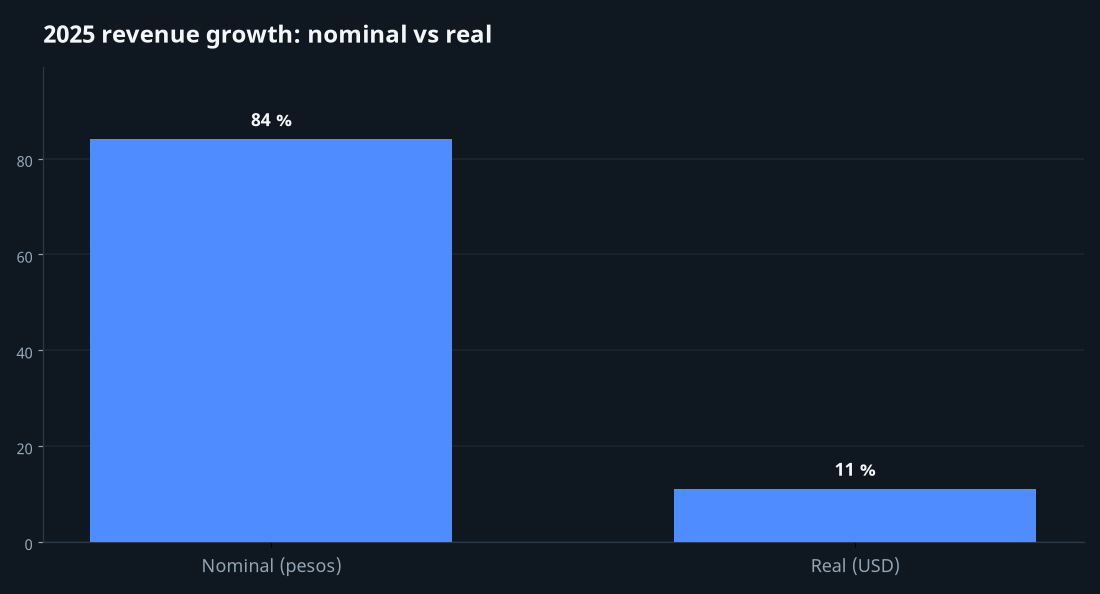
This last point matters more than it sounds. In peso-denominated reporting, her revenue looks like it's growing 80%+ per year — almost all of which is inflation, not real growth. In USD-denominated reporting, she can actually see what's happening to her business.
The receivables question
Receivables are particularly dangerous in inflationary economies. An invoice issued at ARS 1,176,000 and paid 45 days later is paid in nominal pesos worth dramatically less than the original obligation. The dollar-denominated approach solves this for the principal, but Sofía also adds:
- Late payment indexed to USD/ARS movement, not a flat rate. "Late payment after 14 days is recalculated at the day-of-payment rate, with a 2% additional surcharge."
- Aggressive payment terms: net-7 instead of net-30, with deposits standard on anything over $500.
- Receivables aging report watched weekly, not monthly. In a 4%-per-week inflation environment, a 30-day-old receivable is meaningfully worth less than the same number on a 7-day-old one.
What this means beyond Argentina
Inflation isn't unique to Argentina. Turkish freelancers face similar dynamics with the lira. Lebanese designers learned this five years ago and most now invoice in dollars. Venezuelan small businesses operate almost entirely in USD informally. Egyptian and Pakistani freelancers face occasional crisis periods. Even "stable" economies experience occasional inflationary stretches that punish slow-paying invoices.
The principles are universal:
1. Denominate in the more stable currency where possible
If your domestic currency is unstable and your work has any international comparison, quote in dollars (or euros, or whatever is locally accepted as the stable reference).
2. Use day-of-payment FX rate for settlement
This shifts FX risk to the party best positioned to bear it — typically the client, who handles the currency every day. It also incentivizes faster payment.
3. Use official rates only
Even when parallel rates are tempting, official rates are defensible. Don't put yourself in a position where you can't justify your invoice to your tax authority.
4. Report in stable-currency terms internally
Your dashboard should show USD (or equivalent) numbers so you can see real performance, not inflated nominal growth.
5. Squeeze your receivables
Inflation makes slow-pay clients into bad clients automatically. Push for net-7, take deposits, follow up aggressively.
Sofía's annual numbers
She showed us her dashboard. In peso-denominated terms, her 2025 revenue was up 84% from 2024. In USD-denominated terms, it was up 11%. The 11% is real growth. The other 73% was inflation she would have eaten if she hadn't switched her invoicing model.
"The Argentine economy teaches you, eventually, that pesos are a unit of measure that lies to you," she said. "If you want to know how your business is actually doing, you have to measure it in something that doesn't lie."
The wider lesson
Stable-economy freelancers occasionally encounter brief inflationary periods. Unstable-economy freelancers live with this dynamic permanently. Both benefit from the same toolkit: dual-currency invoicing, day-of-payment settlement, official-rate discipline, USD-denominated internal reporting.
The toolkit isn't a hack. It's the appropriate response to an environment where the unit of measure moves. Use it.