How a Mumbai Chartered Accountant Runs 80 Small Clients From Her Phone
By the InvoiceFlow team — published 26 May 2026 — 11 minute read
Priya Iyer works out of a small office in Andheri East, but ninety percent of her work happens on her phone in the back seat of an Uber. She is a chartered accountant whose practice serves 80 small clients — mostly Mumbai-based traders, e-commerce sellers, small manufacturers, and a handful of expats running consulting setups out of India. Her work for each client is mostly the same shape: monthly GST returns, quarterly TDS filings, annual income tax returns, and ad-hoc advisory.
Her billing is, predictably, complex. Eighty annual retainers, each broken into a monthly billing schedule. Three or four ad-hoc invoices per client per year for advisory work. GST compliance on every invoice she issues. Different invoice formats for B2B clients (with GSTIN) versus B2C ones. Monthly GSTR-1 returns to file based on her own outgoing invoices.
For five years, she ran this with a desktop accounting program installed on her office PC. The phone was for WhatsApp. Then her PC died on a Tuesday in March 2025, three days before GST return deadline, and she lost an afternoon trying to recover access while clients called.
That experience changed her workflow. Six months later, she runs the entire practice from her phone, with the desktop as a backup rather than a primary. The setup is worth describing.
The Indian invoicing problem (in brief)
Indian invoicing has compliance requirements that catch most generic billing tools off-guard:
GST invoice format
For B2B invoices to GST-registered clients (above ₹20 lakh turnover for service businesses), the invoice must include:
- Supplier's GSTIN.
- Recipient's GSTIN.
- HSN/SAC code for each line item.
- Tax breakdown showing CGST + SGST (for intra-state) or IGST (for inter-state).
- Place of supply.
- Sequential invoice number with mandatory format.
Reverse charge mechanism
Some service categories require the recipient (not the supplier) to pay GST. The invoice must clearly indicate this.
E-invoicing
Above ₹5 crore aggregate turnover, businesses must use the government's e-invoicing portal — generating an IRN (Invoice Reference Number) and QR code that must appear on the printed invoice.
GSTR-1 reconciliation
Every invoice issued must reconcile to the monthly GSTR-1 return. Mismatches trigger queries and penalties.
Priya's clients are mostly small enough to be below the e-invoicing threshold, but she herself isn't — she crossed ₹5 crore in 2024 — so her own outgoing invoices to her clients require IRN generation. This puts her in the rare position of being both a service provider who must comply with full e-invoicing AND a CA who advises her clients on the same.
The setup
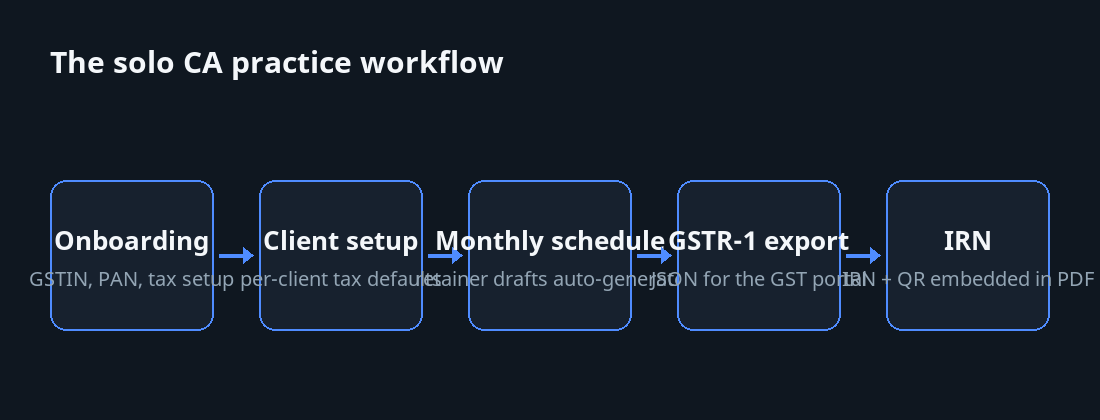
Client structure with full tax setup
Each client record stores:
- Legal name and trade name.
- GSTIN (if applicable) and PAN.
- State and place of supply (drives CGST/SGST vs IGST selection).
- Reverse-charge applicability per service.
- Default services and their HSN/SAC codes.
- Annual retainer amount and monthly breakdown.
When she creates a new invoice for that client, the entire tax setup is pre-applied. She doesn't think about it.
Recurring schedules for retainers
Each retainer client has a monthly recurring schedule. Schedules run from April to March (matching India's financial year) and auto-end after 12 invoices. The amount is the agreed monthly portion of the annual retainer.
At month-end, all 80 schedules generate drafts. She reviews them on her phone — usually during her morning chai — and one-taps "send all." About 12-15 minutes total.
Ad-hoc advisory invoices
For one-off advisory work (responding to a tax notice, advising on a specific transaction, drafting an opinion), she creates a separate invoice from a saved "advisory services" product list. Each has its own SAC code, default description, and standard hourly or fixed-fee rate.
GSTR-1 export
At month-end she exports her outgoing invoices as a GSTR-1-compatible JSON for upload to the GST portal. The export categorizes by B2B / B2C / Export / Reverse-Charge as required. She uploads, files, and her monthly compliance is done in 20 minutes instead of an afternoon.
IRN integration
For her own e-invoicing requirement, each invoice she generates is sent to the IRN portal automatically. The returned IRN and QR code are embedded in the PDF before send. She doesn't manually visit the portal anymore.
The TDS overlay
Many of her corporate clients withhold TDS on her invoices — typically 10% under Section 194J for professional services. Each of those invoices needs to show:
- Gross amount.
- TDS deducted by client.
- Net amount payable.
And later, she needs to reconcile her Form 26AS (showing TDS deposited against her PAN) with what her clients actually withheld. Discrepancies are common and need following up.
Her invoicing setup tracks this per-invoice and produces a TDS reconciliation report quarterly. Annual Form 26AS reconciliation, which used to take a full Saturday, now takes 90 minutes.
What the phone workflow looks like
Priya's day, in invoicing terms:
- Morning chai: review month-end drafts if applicable. Send if it's billing day.
- Commute: handle WhatsApp queries from clients, often pulling up invoice details from the app to answer questions like "kab paid kiya tha?" ("when did I pay?").
- Between client meetings: create ad-hoc advisory invoices for work just completed. Send before leaving the meeting.
- Office: deeper work — drafting opinions, reviewing tax notices, filing returns.
- Evening: sometimes nothing. Sometimes a five-minute review of what came in.
The phone isn't a backup for the desktop. The phone is the primary tool. The desktop is for when she needs a larger screen for spreadsheet work, which is roughly twice a week.
What scaled, and what didn't
What scaled
The 80 clients became manageable specifically because:
- Recurring schedules removed monthly billing labor entirely.
- Per-client tax setup eliminated the cognitive load of "is this B2B or B2C? Intra-state or inter-state?"
- GSTR-1 export automated her own monthly compliance.
- Per-client dashboards let her quickly answer client queries without searching.
What didn't
Some things still require attention:
- Tax notices to clients — these require human judgment and detailed work. No automation helps.
- Client onboarding — collecting GSTIN, PAN, and other documents requires actual conversations.
- Year-end audit support for the larger clients — still requires meetings, document review, and discussions she can't outsource to automation.
The point of automating the billing is to free up attention for the work that actually requires it.
What every Indian CA solo practice should set up
1. Per-client full tax setup at onboarding
Get the GSTIN, PAN, state, place-of-supply rules, and applicable service codes captured the first day. Don't ad-hoc this per invoice.
2. April-to-March annual retainer schedules
Match your billing year to the Indian financial year. Auto-generate monthly drafts.
3. GSTR-1-ready invoice numbering
Sequential, gap-free, with a clear scheme. The tax portal expects this.
4. IRN integration if you're above the e-invoicing threshold
Don't manually visit the portal for every invoice. Use a tool that integrates.
5. TDS tracking per-invoice
Make 26AS reconciliation possible without forensic work.
6. Mobile-first workflow
India's small-business culture is mobile-first. Your practice management should match.
The wider lesson
Indian CA practice is one of the most administratively complex small-business categories in the world. The combination of GST, TDS, e-invoicing, multiple compliance deadlines, and Indian client expectations produces enormous operational overhead.
Most solo CAs accept this overhead as the cost of practicing. They don't have to. The same complexity, handled by a properly set up system, becomes background infrastructure rather than daily friction.
Priya has not added staff. She has 80 clients, an annual revenue figure she modestly declined to share, and a practice that runs largely from her phone. Her PC dying turned out to be the best thing that happened to her business last year.