The Lagos Creative Agency Partner Who Split Her Billing in Two
By the InvoiceFlow team — published 26 May 2026 — 10 minute read
Adunni Okeke is one of two partners in a four-person creative agency in Lagos's Lekki area. They do brand identity, packaging design, and a strange but profitable specialty in launch campaigns for African food and beverage startups. The work is good. The cash flow, until last year, was lurching.
The pattern was familiar to anyone who has ever run a small agency: feast-or-famine, projects bunched in clusters, two months of revenue followed by two months of nothing, payroll always slightly stressful, the constant nagging feeling that growth required something they hadn't figured out yet.
The thing they hadn't figured out was that they had been treating two fundamentally different kinds of business as one — and billing them the same way.
Last year they split them apart. Six months later, the lurching stopped. Here is what they did.
The two businesses inside one agency
Most creative agencies, on closer inspection, are running two parallel businesses:
The retainer business
Monthly creative work for ongoing clients. Brand maintenance. Social content. Small campaign updates. Predictable hours, predictable revenue. The retainer business pays the rent.
The project business
Large one-off engagements. A full rebrand. A product launch. A packaging system overhaul. Big revenue events, but unpredictable timing. The project business pays for growth.
Adunni's agency had been treating both as project work — every engagement got a quote, a contract, milestone payments. This worked fine for the project business, where milestones map naturally to deliverables. It failed catastrophically for the retainer business, where there are no clean deliverables (some weeks are heavier than others, some lighter, the work shapes itself around what the brand needs).
The result was confused billing on the retainer side: clients arguing about what was "in scope," partners scrambling to itemize work that should have been a single monthly fee, hours of admin per month spent explaining bills.
The split
The change they made was simple in concept and slightly painful in execution:
Retainers became flat monthly fees
Each retainer client signed a new engagement letter specifying:
- A flat monthly fee, in Nigerian Naira or USD depending on the client.
- A defined "fair use" scope — examples of what's included, examples of what's not.
- An overage rate for work outside the fair-use scope.
- Quarterly review for fee renegotiation.
The invoicing for retainers became automated. A recurring monthly schedule generates the same invoice each month. No itemizing. No "what counts as scope" arguments. If a client requests significantly out-of-scope work, it becomes a small project with its own quote.
Projects kept the milestone structure
Project work continued as before: quote, contract, deposit, milestones, final payment. The 30/40/30 model from our split-payment guide is their default. For larger projects (over ₦15M), they use 25/25/25/25.
Two separate business profiles
They created two business profiles in their invoicing app — one for retainers, one for projects. Same legal entity underneath, but separate invoice numbering schemes (RET-2026-XXX vs PRJ-2026-XXX), separate dashboards, separate templates.
The dashboards now tell two different stories. The retainer dashboard shows MRR (monthly recurring revenue), churn risk, fair-use overage trends. The project dashboard shows pipeline value, milestone completion, days-to-paid by project type. The combined picture is the agency; the separated pictures are how they actually run it.
What changed financially
Cash flow predictability
Retainer MRR became their fixed base. Before the split, it was conceptually fixed but operationally lumpy — clients delayed payment when arguments arose. Now it's actually fixed; clean monthly invoices for fixed amounts get paid quickly.
Their working capital requirement dropped because they could finally predict revenue floor month-to-month.
Project revenue became upside, not survival
This is the conceptual change that mattered most. Before the split, project revenue had to cover both project costs and base operating expenses. Project revenue was therefore "must-win" — they took projects they shouldn't have, priced them too low to win them, and over-promised on timelines.
After the split, retainers covered base operating expenses entirely. Project revenue became the layer that funded growth (hiring, new equipment, marketing, partner draw). They could turn down projects that didn't fit. They could price aggressively. They could say no to the wrong clients without panic.
The turn-down ratio
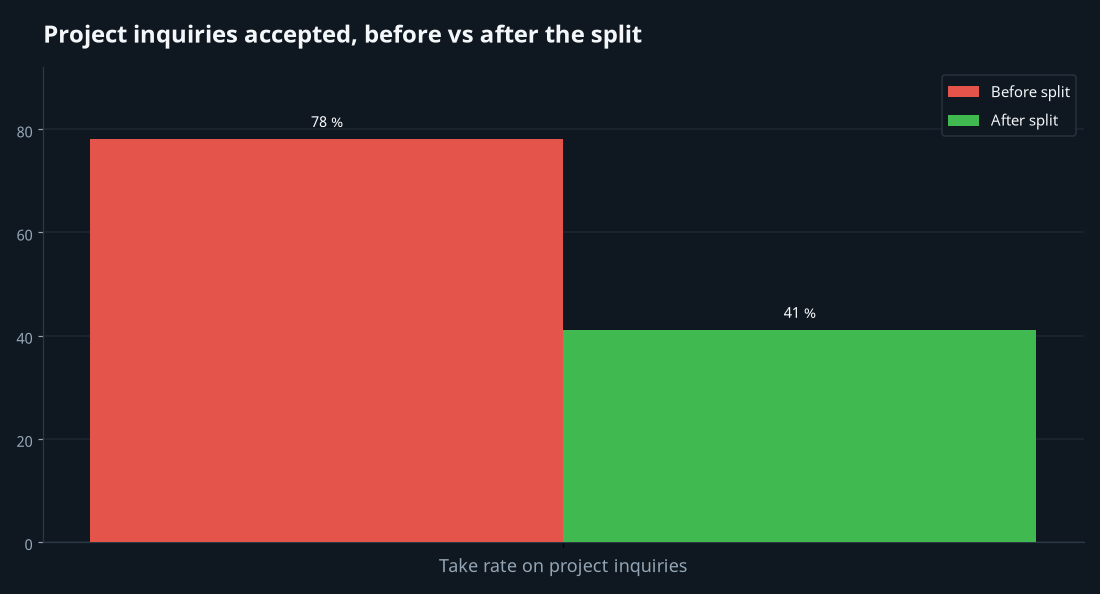
In the year before the split, they took 78% of project inquiries that came their way. In the six months after, they took 41%. Their actual project revenue grew, because the projects they took were larger and better-fit. The smaller, awkward ones — which had been a real revenue drain — went elsewhere.
What changed operationally
Retainer billing labor
Before: 2-3 hours per month per retainer client, between itemizing, fielding scope questions, and chasing payment.
After: 0 minutes per retainer client (the schedule generates and sends automatically). Total monthly retainer admin: maybe 15 minutes for the partner who watches the dashboard.
Quarterly retainer reviews
The trade-off for flat fees is that scope drifts over time. Every quarter, the partner who owns each client account reviews fair-use overage and adjusts the next quarter's fee if necessary. This conversation is now scheduled and structured, not ad-hoc and confrontational.
Project pricing discipline
With retainers covering base costs, project pricing became a margin decision rather than a survival decision. They added a baseline 35% margin floor to all project quotes. Projects below this margin get repriced or declined.
The wider lesson for small agencies
The pattern Adunni's agency was stuck in is the default for most small creative agencies. They treat all client work as "client work," manage it through projects, and find themselves in the cash-flow lurch that the model produces.
The fix isn't to do less project work. It's to separate the retainer business from the project business operationally, even when both happen inside the same agency. Different cadences. Different invoicing. Different psychology with the client. Different metrics on the dashboard.
Some agency owners resist this because it feels like creating bureaucracy. It is the opposite — it removes hidden bureaucracy by making the structures explicit. The hidden version, where retainer and project work mix uncomfortably, is what was producing the friction.
What every small agency partner should do this quarter
1. Audit your client base
List every client. Mark each as "retainer" or "project" based on actual revenue pattern, not how you've labeled them in your head.
2. Convert retainers to flat fees if they aren't already
With clearly defined fair-use scope and overage rates. Send a clean new engagement letter.
3. Set up automated retainer billing
Recurring monthly schedule per client. Same invoice each month.
4. Quote projects with margin discipline
Calculate your baseline operating cost. Cover it with retainers. Price projects to margin above that.
5. Separate dashboards
Track retainer MRR and project pipeline as different numbers. Both matter; neither tells the whole story alone.
6. Quarterly retainer reviews
Structured conversation, not ad-hoc. Adjust fees based on actual fair-use behavior.
Adunni's last word
"We were running two businesses without realizing it. The day we started running them as two businesses, both got easier."
Their agency is still four people. Their revenue is up roughly 35% year-on-year. Their partner draw — the most honest measure of a small agency's health — is up substantially more, because the lurching that used to produce stress and bad decisions stopped.
The split was the lever. The split is the lever for most agencies in the same position.