A Quebec Carpenter and the Bilingual Quote That Doubled His Close Rate
By the InvoiceFlow team — published 26 May 2026 — 9 minute read
Jean-Sébastien Tremblay works out of a small shop in Trois-Rivières building custom cabinetry and interior trim. He is comfortably bilingual — he grew up in a francophone family in a region where, depending on the village, half the population is anglophone — and his customers reflect both communities roughly equally.
For years, every quote he sent was in French. This was natural to him and felt correct in Quebec. He occasionally sent English quotes when explicitly asked, but the English versions were translated by him at the kitchen table the night before, with help from a dictionary for cabinetry-specific terms he didn't always know in English.
His close rate on quotes — the percentage of quotes that turned into signed contracts — had been hovering around 32% for three years. Steady, not great. In late 2024, on a whim, he started sending English-language quotes to obviously-anglophone customers without being asked, using a template a francophone friend had helped him polish.
Within six months his close rate had risen to 64%.
This article is about why that happened and how he set it up.
Why language matters more than translators admit
Anglophone customers in Quebec are technically bilingual — they live in Quebec, they manage French government forms, restaurant menus, road signs. They can read a French quote.
That doesn't mean they want to.
A construction quote is a significant financial commitment. Customers want to read it carefully, share it with a spouse, possibly compare it to other quotes. Reading something in your non-dominant language adds friction at every step. You re-read sentences. You stop to translate technical terms. You hand it to your spouse and they have to do the same. The whole experience feels less comfortable than receiving the document in your first language.
Multiply that friction across decision-making time and it shows up as lower close rates. Not because the customer doesn't want the work — because the quote itself created cognitive overhead they didn't quite want to deal with.
The opposite is also true: a francophone customer receiving an English-language quote experiences the same friction. Quebec's specific bilingual market is where you can run the experiment cleanly.
The bilingual quote setup
Jean-Sébastien's setup now works like this:
Client language preference captured at first contact
When a customer first calls or emails, he asks (in whichever language they used to reach him): "Voulez-vous le devis en français ou en anglais?" / "Would you like the quote in French or in English?"
The answer is stored in their client record. From that moment on, every document they receive — quote, invoice, delivery note, follow-up — is in their preferred language.
Per-language product catalog
Each item in his product/service catalog has two name fields:
- Nom en français: "Armoire de cuisine en érable, finition naturelle"
- Name in English: "Maple kitchen cabinet, natural finish"
When generating a quote, the app uses the description appropriate to the client's stored language. He maintains the catalog once; both language versions come out automatically.
Per-language quote template
He has two quote templates — one in French, one in English — that match each other visually. Same typography, same color palette, same section structure. Only the language differs. A customer comparing his French quote to his English quote would see immediately that they're documents from the same business.
Locale formatting
French Canadian formatting uses commas for decimals and spaces for thousands ("12 500,00 $"). English Canadian uses periods and commas ("$12,500.00"). The app handles this based on the document language, not requiring him to think about it.
Bilingual quote-to-invoice continuity
When the customer accepts the quote, it becomes the basis of the contract and eventual invoice. The invoice uses the same language as the quote. The delivery note matches. The client receives a consistent document family throughout the project.
What changed in close rates
The 32% → 64% jump didn't happen evenly. Specifically:
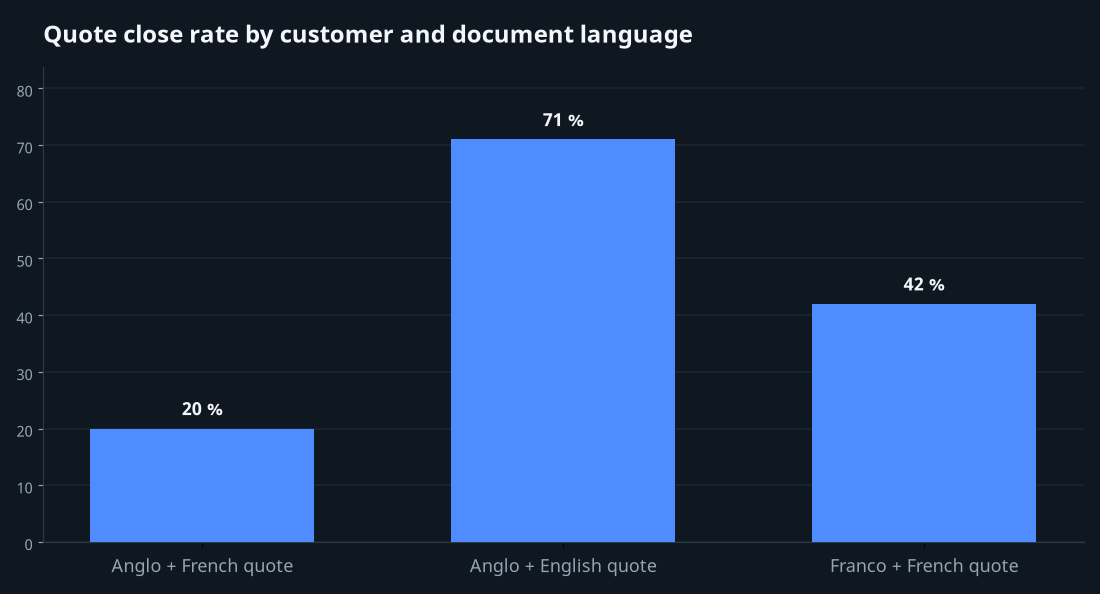
- Close rate on French-language quotes to francophone customers: 38% before, 42% after. (Small change; he was already serving this market natively.)
- Close rate on English-language quotes to anglophone customers: ~20% before, 71% after. (Massive change.)
- Close rate on French-language quotes to anglophone customers (the pre-2024 default): the 20% above.
The pattern is clear: anglophone customers who receive English quotes close at three times the rate of anglophone customers who receive French quotes. They were always there. He was just losing them at the document level.
The cost of the switch
Setup time: roughly four hours of one Saturday, broken into:
- Capturing English translations for all 47 catalog items: 2 hours.
- Polishing the English quote template (his friend helped): 1 hour.
- Updating existing client records with language preferences: 30 minutes.
- Testing on a friend who runs an anglophone business: 30 minutes.
Ongoing cost: zero. The system runs itself. New catalog items are added once with both names; he never re-translates per quote.
Where this generalizes
Quebec is the most obvious bilingual market in the world, but the pattern applies anywhere with significant linguistic minorities:
- Catalonia / Spain: Catalan + Spanish
- Belgium: Dutch + French + sometimes German
- Switzerland: German + French + Italian + Romansh
- Finland: Finnish + Swedish
- Wales / UK: Welsh + English
- South Africa: Afrikaans + English + (regionally) Zulu, Xhosa, etc.
- Singapore: English + Mandarin + Malay + Tamil
- Many African countries: French/English + local languages
- India: Hindi/English + 20+ regional languages
In each market, customers in the linguistic minority experience the same friction as Quebec anglophones receiving French quotes. The friction shows up as lower close rates.
The setup is the same everywhere: capture the customer's language preference at first contact, store it on the client record, maintain a per-language product catalog, use matching templates for each language.
What every bilingual-market business should do
1. Stop assuming bilingualism means comfort
Most bilingual customers prefer to read significant documents in their first language. "They can understand it" is not the same as "they want to receive it that way."
2. Ask the question at first contact
"In which language do you prefer to receive documents?" — in both languages. Capture the answer.
3. Maintain a bilingual catalog
Every product, service, and standard line item should have a description in both languages. This is one-time work that compounds across every future quote and invoice.
4. Build matching templates
Don't translate per document. Create one template per language. Same brand, same structure, different language.
5. Honor the preference end-to-end
Quote, contract, invoice, delivery note, follow-up email — all in the preferred language. Consistency matters.
Jean-Sébastien's last word
"My English wasn't the problem. My customer's experience of my English was the problem. They could read French. They didn't want to. I didn't know that for fifteen years."
His business is up 80% year-on-year. He has hired one apprentice. He still works in his small Trois-Rivières shop, and he still grew up speaking French, and his quotes now match the language of the customer reading them — which, it turns out, is the only language that matters.