The Auckland Personal Trainer Who Turned Cancellations Into Revenue
By the InvoiceFlow team — published 26 May 2026 — 9 minute read
Marcus Williams trains 22 personal-training clients out of a small studio in Mount Eden, Auckland. His contract has always included a 24-hour cancellation policy — any session cancelled with less than 24 hours' notice is billed in full. He had this clause on every contract he signed. For five years, he almost never enforced it.
"I'd send a message to the client saying 'I'll let it slide this time,'" he told us. "Then I'd let it slide again. Then I'd grumble at home about how much money I was leaving on the table and never invoice them."
In June last year he added up the unenforced cancellations from the previous twelve months. The number was, by his count, between 87 and 110 late cancellations — call it roughly 100 — at his standard rate of NZ$110 per session. Somewhere between $9,500 and $12,000 of revenue he had simply not collected.
He decided this was untenable. The fix took one afternoon. In the eleven months since, he has recovered $11,200 in cancellation-fee revenue — money that was always contractually his, just never billed.
This is what he did.
The reason small-business owners don't enforce their own policies
Marcus's reasons for not enforcing the cancellation policy were specific:
1. Conflict avoidance
Asking a client to pay for a session they didn't attend feels confrontational. Especially when you'll see that client again in three days for their next session.
2. The "good client" problem
His clients were people he liked. Friends, almost. Charging them for missed sessions felt mercenary.
3. Ambiguous notice
What counts as 24 hours? Exactly 24? Calendar day? Business day? The lack of clarity made enforcement feel arbitrary.
4. The "this time only" trap
Once you've waived a fee once, it's easier to waive it again. Each waiver erodes the policy further.
5. The friction of remembering and invoicing
Even when he intended to charge, he had to remember to create the invoice, type the line item, send it. By the time he got home, he'd forgotten. By the next morning, it felt too late.
None of these are individually unreasonable. Together they meant the policy might as well not have existed.
The structural fix
Marcus's solution had three parts. The combination is what made it work.
1. Crystal-clear policy language
He rewrote his contract clause to remove ambiguity:
Cancellation policy: Sessions cancelled less than 24 hours before the scheduled start time are billed at 100% of the session fee. Sessions cancelled between 24 and 48 hours before start time may be rescheduled at no charge. The 24-hour cutoff is enforced strictly and tracked from the scheduled session start time.
Every new client signs this. Every existing client received a polite "I'm tightening up my admin" message with the updated clause. None of his existing clients pushed back.
2. Auto-invoicing trigger
When a client cancels within 24 hours, Marcus opens his app, taps "create cancellation invoice," picks the client, and the rest is prefilled — current date, the standard "Late cancellation fee" line item, the agreed amount, and the cancellation policy referenced in the line description. He sends it within minutes of the cancellation, often while still standing in the studio waiting for them to not arrive.
This timing matters. Sending the invoice immediately removes the "I'll do it later and then forget" failure mode.
3. Saved language in the invoice email
The email body is a saved template he'd refined to be polite but firm:
Hi [name], confirming the late cancellation for today's session. As per our agreement, late cancellations are billed at the full session rate. Invoice attached, payment terms as usual. Looking forward to next week's session.
The tone is matter-of-fact, not aggressive. The reference to the next session signals the relationship continues. The invoice itself does the firmness.
What happened to his client relationships
The thing Marcus was most worried about was relationship damage. He had told himself for years that the policy was "nominal" — there to be referenced if needed, not actually enforced. His worry was that enforcing it would lose clients.
The reality, eleven months in:
- Zero clients quit over the policy. Not one.
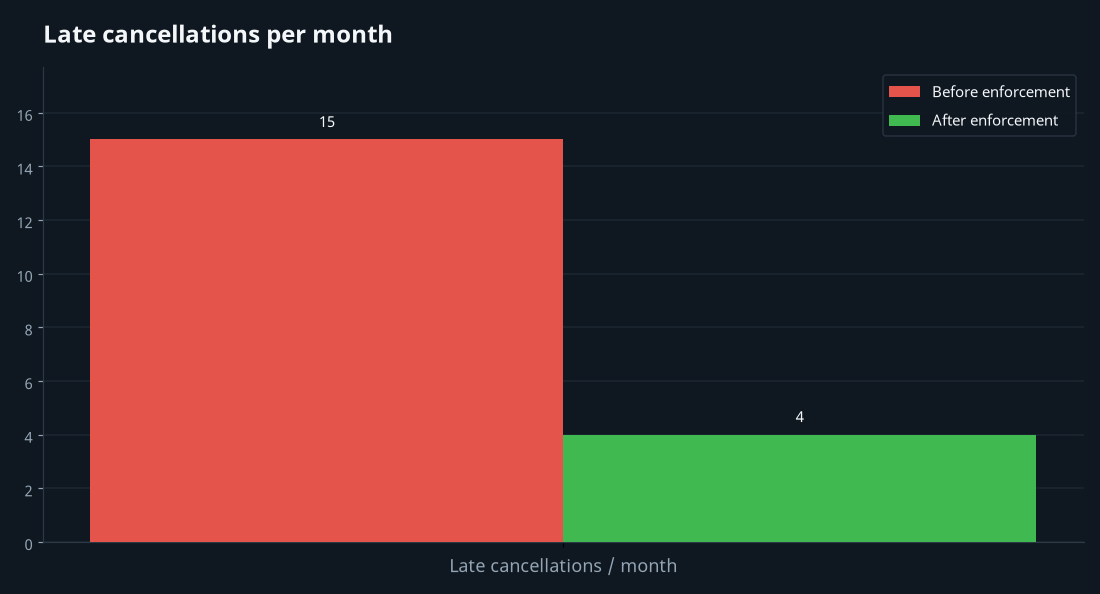
- The cancellation rate dropped substantially. Before enforcement: 14-16 late cancellations per month across the client base. After: 3-5 per month. People who knew they'd be charged simply didn't cancel as often.
- Several clients explicitly respected the change. Two told him that they'd taken him more seriously since he started running his business more professionally.
- One client tested the policy. Cancelled three sessions in two months with under 24 hours' notice. Got charged for all three. Stopped cancelling.
The fear of relationship damage was a story Marcus had been telling himself. The actual response was different.
Why this generalizes to most service businesses
The same dynamic — having a policy you don't enforce — exists in:
- Hair salons (no-show fees rarely charged).
- Restaurants (deposit forfeiture rarely enforced on no-shows).
- Tutoring and music lessons (cancellation policies often soft).
- Massage therapy and bodywork (same).
- Wedding photography (rescheduling without fee despite policy).
- Consultancy (last-minute meeting cancellations).
- Coaching (missed sessions not charged).
- Pet sitting and dog walking (last-minute cancellations absorbed).
In each, the structural fix is the same: clear language, immediate invoicing, saved email templates. The friction that was preventing enforcement disappears, and the policy starts protecting the business as intended.
The deeper point about policies
A policy you don't enforce is worse than no policy. No policy is honest — your clients know what to expect. An unenforced policy is dishonest — you've said one thing and done another, which trains your clients to ignore your stated terms generally.
Marcus's clients now know that when he says something is the policy, it's the policy. The 24-hour rule is the obvious example. The broader effect is that they take all his terms seriously — session pricing, session length, payment due dates, package terms. The cumulative gain is far larger than the $11,200 in cancellation fees.
What every service-business owner should do this week
1. List every policy you have but don't enforce
Cancellation fees, no-show fees, late payment fees, scope-change fees. Be honest.
2. Pick the most important one
The one costing you the most money or relationship clarity.
3. Rewrite it crisply
Remove ambiguity. Specify the exact trigger and the exact consequence.
4. Set up immediate invoicing
Saved line item, saved email template, single-tap workflow.
5. Notify existing clients politely
"Tightening up my admin" framing. Most accept without comment.
6. Enforce consistently for 90 days
After 90 days the policy is real. Before then, every waiver weakens it.
Marcus's last word
"The money was always mine. I just wasn't asking for it. Asking for it didn't damage anything. The story I told myself was wrong. Most of the stories we tell ourselves about why we can't enforce our own policies are wrong."
Eleven thousand dollars. One afternoon of setup. One slightly nervous month of follow-through. Then a permanent shift in how seriously his business gets taken.
Most business policies fail at the enforcement step, not the writing step. The fix isn't a better policy. It's the system that makes enforcement effortless.