How a Tbilisi Software Developer Invoices US Clients From Georgia
By the InvoiceFlow team — published 26 May 2026 — 10 minute read
Davit Kavtaradze is a backend developer who works exclusively for US-based clients from his apartment in Tbilisi's Vake district. He is a Georgian citizen, a Georgian tax resident, registered as an Individual Entrepreneur under Georgia's favorable 1% small-business regime, billing in USD, paid via Wise and Payoneer, and responsible to no tax authority other than Georgia's.
This setup is increasingly common among developers, designers, and consultants from Eastern Europe, Latin America, South Asia, and South-East Asia who serve US and Western European clients. It is also relentlessly misunderstood — by clients, by would-be imitators, and sometimes by the freelancers themselves.
This article documents Davit's complete invoicing stack as a reference architecture. The details are specific to Georgia, but the structure applies to any cross-border arrangement of this shape.
The legal and tax foundation
Davit is registered in Georgia as an Individual Entrepreneur (ინდივიდუალური მეწარმე) with Small Business Status — a regime that taxes turnover under 500,000 GEL annually at a flat 1%, with no VAT obligation on exported services. This is favorable enough that it draws freelancers to Georgia specifically for the tax setup.
Importantly: his US clients have no tax obligation to him beyond paying his invoices. He is not a US tax resident. He is not a 1099 contractor in any meaningful sense. He does not collect US sales tax. He is a foreign vendor providing services from abroad.
His invoices need to reflect this clearly, because US clients' accounts payable systems often default to treating him as a US contractor and try to apply withholding or request a W-9 form. Both are inappropriate. Pre-empting this saves weeks of friction.
The invoice format that works for US clients
Invoice header essentials
- "Invoice" prominently displayed.
- His business name (matching his Georgian IE registration).
- His Georgian Personal Number and IE registration number.
- Tbilisi address.
- The phrase "Foreign vendor — no US tax withholding required" in a small but visible spot.
Client billing block
The US client's legal name and address, as registered. US AP teams need this to match their records exactly. Davit captures it at contract time and stores it on the client record.
Currency and rate clarity
Invoices are in USD throughout. No Georgian Lari conversion shown. US clients want to see USD; Davit converts to GEL on his side after receipt.
Payment instructions block
Multiple payment options listed clearly:
- Wise: his Wise USD account (with US routing/account numbers — Wise provides these, which makes him look like a US-domestic vendor to ACH).
- Payoneer: for clients whose AP systems require traditional international wire setup.
- Direct international wire: backup, rarely used.
The Wise option matters disproportionately. US clients can ACH-pay to Davit's Wise USD account using domestic US payment rails, with no international wire fees on their side. This is the most common reason US clients now agree to engage with non-US developers without fee complaints.
Tax clarity
"No applicable VAT or sales tax. Services provided from Georgia under Small Business Status. Foreign vendor exempt from US tax withholding under [client's local tax interpretation]."
The exact language he uses came from feedback over time. The first few US clients tried to apply 30% withholding under the assumption he was a foreign contractor subject to US tax. He had to explain repeatedly. Now the invoice explains for him.
The Wise/Payoneer reality
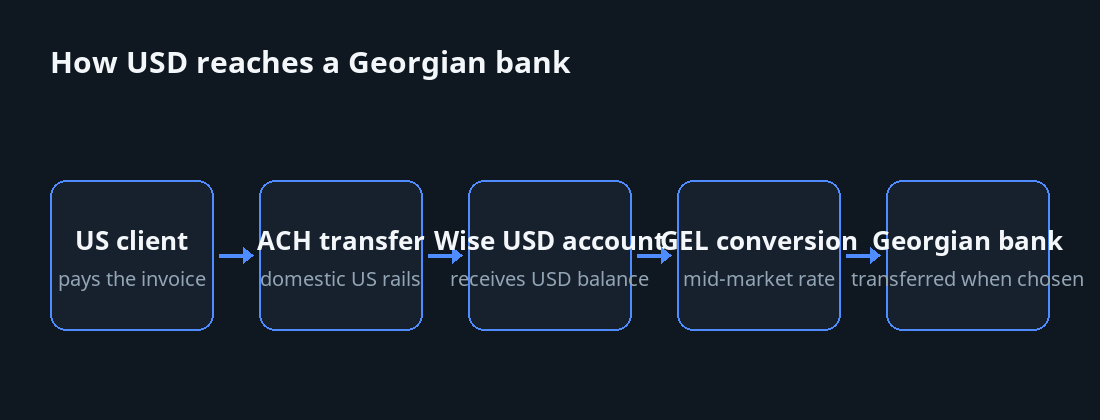
Wise (formerly TransferWise) provides USD account details that look like a normal US bank account from the payer's perspective. This means:
- US clients can pay via standard ACH transfer.
- No international wire fees on the client side.
- Davit receives USD into his Wise USD balance.
- He converts to GEL at Wise's mid-market rate (small spread) and transfers to his Georgian bank when he chooses.
Payoneer offers a similar service. Davit keeps both because some US enterprises have AP systems that whitelist Payoneer but not Wise (or vice versa) for compliance reasons.
Neither setup is offshore, illegal, or unusual. Both are entirely standard global infrastructure for cross-border B2B payments.
The invoicing workflow
Per-client setup
Each US client has a stored record with:
- Legal entity name and US address.
- Default currency (USD).
- Standard payment terms (Net-15 or Net-30 depending on contract).
- Preferred payment rail (Wise or Payoneer based on what they've used).
- The contract's hourly or fixed rates.
Time tracking for hourly engagements
For hourly clients (about 60% of his work), he tracks time live in the same app, with descriptions detailed enough to satisfy US client expectations (15-minute granularity, specific task descriptions). At billing date, time entries aggregate into the invoice automatically.
Fixed-fee invoicing for milestone work
For fixed-fee project work, the invoice is a single line item ("Phase 2 deliverable: API integration") at the agreed price. The 30/40/30 milestone structure is his default for projects over $10,000.
Monthly cadence
Most US clients prefer monthly invoicing. He sends on the 1st of each month for the previous month's work. Net-15 means payment lands around the 15th-20th, which gives him predictable cash flow.
What goes wrong, and how he handles it
The W-9 request
About 1 in 3 new US clients initially ask him to fill out a W-9 form. This form is for US contractors. He doesn't have a Tax Identification Number that fits the W-9. The correct alternative — a W-8BEN — establishes his foreign vendor status and confirms no US tax withholding applies.
His response is a saved email template explaining this with a pre-filled W-8BEN attached. Most clients' AP teams know what to do once they see it.
The 30% withholding attempt
Occasionally an AP team applies 30% US tax withholding to an invoice from a foreign vendor by reflex. This is incorrect for services performed entirely outside the US by a non-resident. He has a saved cite-the-IRS-publication response that resolves this within a week.
The currency conversion surprise
Some smaller US clients pay via Zelle or Venmo by reflex. Davit can't receive these in Georgia. He guides them to ACH-via-Wise upfront in the contract.
The annual Georgian compliance
Once a year, in March, Davit submits his Georgian small-business return — declaring his annual gross revenue, paying 1% on it, and confirming he stayed under the 500,000 GEL threshold. The work takes about three hours, mostly because his invoicing app exports the year's data in a format his Georgian accountant accepts directly.
His total tax burden as a percentage of revenue is the lowest of any developer he's compared notes with internationally. The combination of Georgian regime + cross-border B2B services + clean invoicing is, mathematically, hard to beat.
The reference architecture, generalized
For any freelancer running cross-border with US clients from a non-US tax residence, the structural pieces are:
- A friendly local tax regime (Georgia 1%, Estonia e-Residency, Cyprus non-dom, UAE freelance license, etc. — varies by personal circumstance).
- USD-denominated invoicing with multi-rail payment options (Wise, Payoneer, occasionally direct wire).
- Pre-emptive tax clarity language in the invoice to head off W-9 and withholding requests.
- Client records with full legal-entity details matching US AP records.
- Time-tracking discipline for hourly work, aligned with US client expectations.
- Annual export compatible with your local tax filing.
The specifics vary by country. The pattern doesn't.
Davit's last word
"My setup looks complicated when explained. It is actually very simple to use day-to-day. Invoice goes out monthly. Money lands. Once a year I pay tax. I write code. That is the entirety of my business."
Cross-border freelancing has a reputation for legal and operational complexity. The reputation is partly warranted — at setup time, there's a lot to get right. After that, run-time complexity is low if the setup is right. The architecture above is what most successful cross-border freelancers converge on.