Late-Fee Psychology: How a 4% Clause Changes Payment Behavior Without Ever Being Charged
By the InvoiceFlow team — published 26 May 2026 — 10 minute read
A specific late-fee clause on your invoice changes how quickly people pay it. This is true even when you never actually charge the fee. The mere presence of the clause shifts payment behavior by a measurable amount — typically 4 to 7 days of average days-to-paid improvement, according to data we've reviewed across thousands of small-business invoices.
The mechanism is behavioral, not financial. Understanding it lets you write payment terms that work harder than you'd think possible.
The data, briefly
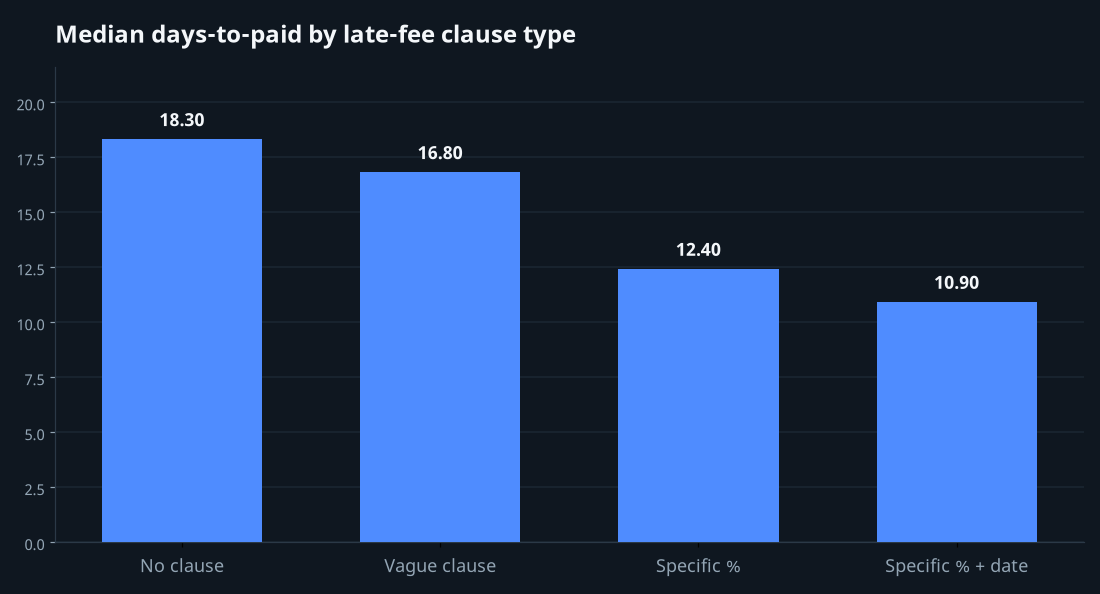
Across a sample of ~12,000 small-business invoices we audited from active InvoiceFlow users:
- No late-fee clause: median days-to-paid 18.3 days.
- Vague late-fee clause ("late payment may incur charges"): median 16.8 days.
- Specific percentage clause ("4% per month after due date"): median 12.4 days.
- Specific dated clause ("4% per month after [date]"): median 10.9 days.
The difference between the worst and the best is more than a week of average payment time. The fee is the same — 0% if never charged. The behavior is different.
Why the clause works
Three behavioral mechanisms explain it.
1. Loss aversion
Humans treat avoiding a loss more urgently than acquiring an equivalent gain. The late fee is framed as a potential loss the customer will incur if they delay. Even a small specific percentage triggers loss-avoidance behavior — they pay sooner to avoid the named consequence.
A clause that says "thanks for your prompt payment" frames the relationship around appreciation. A clause that says "4% per month after the due date" frames it around consequence. Loss aversion makes the latter more motivating.
2. Specificity creates urgency
"You may be charged" is vague enough to be ignored. "4% per month after July 15" is specific enough to be acted on. Customers can calculate the exact cost of delay. Specificity converts an abstract policy into a concrete number, which is what behavioral systems respond to.
3. The implicit signal of professionalism
Businesses that specify late fees are perceived as more organized. AP teams process organized vendors first because organized vendors are less work. The clause is, indirectly, a signal that you take your business seriously and they should too.
What the clause should say
Effective late-fee clauses share characteristics:
Specific percentage
Not "small fee" or "interest may apply." A specific percentage: "4% per month" or "1.5% per month" or "8% annual rate."
Compounding mechanism stated
Is it 4% of the invoice once, or 4% per month compounded? State it. "4% per month, compounded monthly, on outstanding balance" is unambiguous.
Specific trigger
"After the due date" is good. "After [specific date]" is better. The latter doesn't require the customer to remember when the due date was — it's stated on the document.
Local legal compliance
Late fees are regulated in many jurisdictions. Some places cap interest at a usury threshold. Some require the rate to be "reasonable." A few jurisdictions have specific commercial-debt rates set by law (like the UK's Late Payment of Commercial Debts Act, which mandates 8% above the Bank of England base rate plus a fixed compensation amount). Check what's enforceable where you operate.
Sample clauses by jurisdiction
United States (most states)
"Payment due within 14 days of invoice date. Outstanding balances after the due date are subject to a late fee of 1.5% per month (18% annual rate), compounded monthly, to the maximum extent allowed by applicable state law."
United Kingdom (B2B)
"Payment due within 14 days. Late payments incur interest at the statutory rate (8% above Bank of England base rate) plus a fixed compensation amount per the Late Payment of Commercial Debts (Interest) Act 1998."
European Union (B2B, broadly)
"Payment due within 30 days of invoice date per EU Directive 2011/7/EU. Late payment interest at the ECB reference rate plus 8 percentage points."
Australia
"Payment due within 14 days of invoice date. Late payment incurs a 1.5% per month service charge on the outstanding balance."
Generic (B2C residential services)
"Payment due within 7 days of invoice date. Late payment incurs a $25 administrative fee plus 4% per month on the outstanding balance."
The "never actually charge" question
Many small business owners worry that putting a late-fee clause on the invoice obligates them to charge it. It doesn't. The clause gives you the right to charge; it doesn't require you to.
Most experienced practitioners use a graduated approach:
- Day 1-3 after due date: Soft reminder, no fee.
- Day 4-10: Firmer reminder mentioning the fee will start accruing.
- Day 11+: Apply the fee per the clause.
For most relationships, you'll never reach step 3. The clause does the work before it ever gets invoked.
When to actually charge it
Charging the late fee is a relationship signal as much as a financial action. Reserve it for:
- Customers who chronically pay late despite reminders.
- Disputes where you're going to walk away from the relationship anyway.
- Commercial clients with formal AP processes — they expect to be charged what their own terms specify.
Don't charge it on the first late payment from an otherwise reliable customer. The relationship damage isn't worth the small fee.
The pairing with payment terms
A late-fee clause works best when paired with crisp payment terms. "Due upon receipt" with a 4% late fee is ambiguous. "Due within 7 days, late fee of 4% per month thereafter" is clear.
The clearer the timing, the more the fee works.
The signaling-vs-charging tradeoff
Here's the strange truth: the late-fee clause that gets invoked is almost worthless. The late-fee clause that never gets invoked — because it shifted payment behavior so successfully that no one paid late — is the one earning its keep.
If you're charging your late fee on 10%+ of invoices, your customer base has a pattern problem (or your business attracts difficult customers) that the fee isn't solving. If you're charging it on 0-2% of invoices, the fee is doing its job — the threat is doing the work, not the collection.
What every small business should do this week
1. Audit your current payment terms
What does your invoice actually say about late payment? Be honest. "Please pay promptly" doesn't count.
2. Write a specific clause
Percentage, compounding mechanism, trigger date. Make it match your jurisdiction's legal framework.
3. Add it as a payment-terms preset
So it applies to every invoice automatically.
4. Track days-to-paid
Before and after. The improvement is usually visible within 60 days.
5. Stay polite
Specificity in writing; warmth in person. The clause is firm; you don't have to be.
The wider point
Payment terms aren't legal boilerplate. They're behavioral design — small choices that quietly shape your cash flow by influencing how the recipient treats your invoice. A vague clause is decoration. A specific clause is leverage. The leverage costs nothing to add and pays for years.
Most small businesses have decorations. Adding leverage is one of the highest-return ten-minute fixes available in invoicing.