What to Do When a Client Doesn't Pay: The Polite-to-Firm Escalation Ladder
By the InvoiceFlow team — published 26 May 2026 — 11 minute read
Sooner or later, every freelancer and small business has the same experience: an invoice goes past due, the client goes quiet, and you start the uncomfortable internal dialogue about how to ask for what you're owed without damaging the relationship. The mistake almost everyone makes is being too soft for too long, then suddenly too hard when patience runs out — a pattern that produces worse outcomes than a structured escalation would.
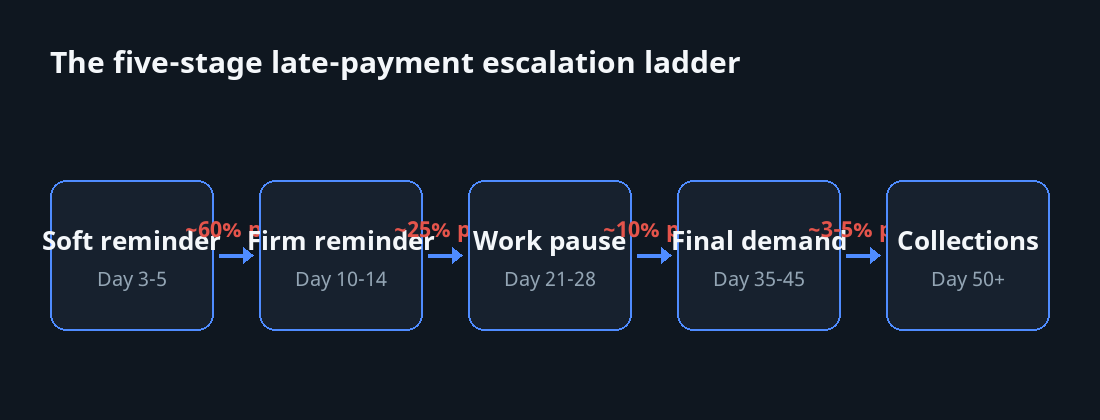
This article is the structured escalation ladder for unpaid invoices: five stages, each with a clear trigger, action, and template. Used consistently, it gets most invoices paid without ever reaching the final stages, and provides clarity for the few that do.
The principles behind the ladder
Consistency over intensity
Slow-and-consistent follow-up gets more invoices paid than dramatic-and-occasional confrontation. The ladder is a sequence, not a one-shot.
Tone shifts by stage
The tone at stage 1 is light and forgiving. The tone at stage 5 is unambiguous. The shift happens because the situation has shifted, not because you've gotten angry.
Document everything
From stage 2 onward, you're building a paper trail in case the situation reaches collections or court. Email, not phone calls, for that reason. Phone calls are fine — but always follow up with a written summary.
Pause work where applicable
If the unpaid invoice is from an ongoing engagement, work pauses at stage 3. Don't continue producing value while not being paid for previous value.
Stage 1: Soft reminder (Day 3-5 after due date)
Trigger
Invoice is 3-5 days past due. No prior communication.
Action
Send a friendly, short reminder. Assume good faith — most late payments are oversights, not refusals.
Template
Subject: Quick reminder: invoice {{invoice_number}}
Hi {{client_first_name}},
Just a friendly reminder that invoice {{invoice_number}} for {{amount}} was due on {{due_date}}. If it's already paid and crossed in the mail, please ignore — otherwise, a quick note confirming it's in the pipeline would be appreciated.
Thanks,
{{your_name}}
Expected outcome
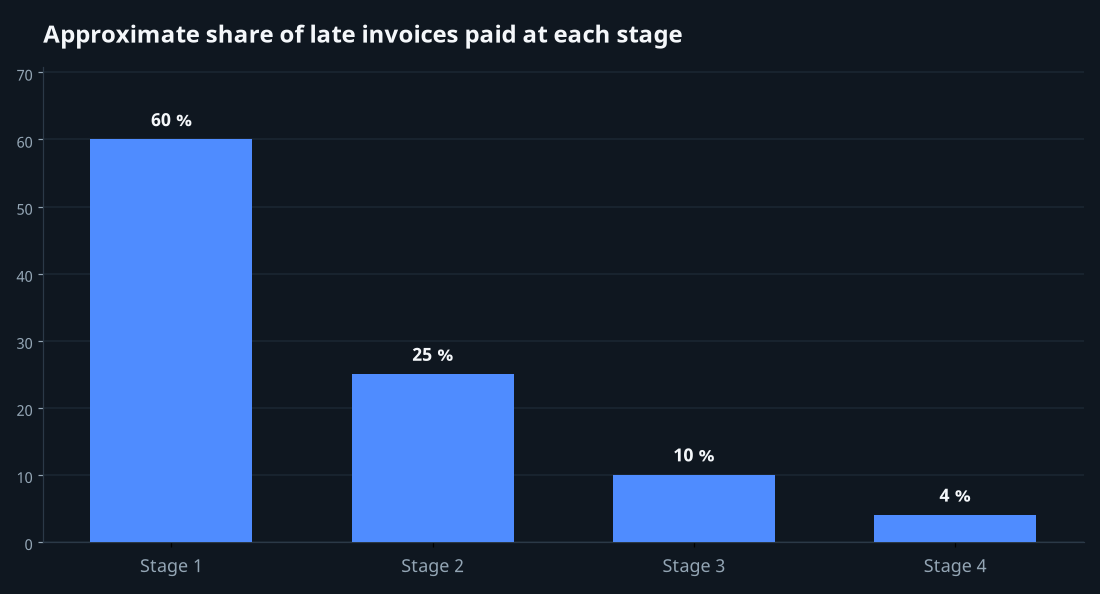
~60% of late invoices get paid within a week of this email. Most cases never need to escalate.
Stage 2: Firm reminder (Day 10-14 after due date)
Trigger
Soft reminder ignored or hasn't produced payment within a week. Invoice is now 10-14 days past due.
Action
Send a more direct reminder. Reference the original due date. Mention the late-fee policy (if you have one). Ask for a specific response.
Template
Subject: Second reminder: invoice {{invoice_number}} now {{days_late}} days overdue
Hi {{client_first_name}},
I sent a reminder last week about invoice {{invoice_number}} for {{amount}}, which was due {{due_date}}. As of today it's {{days_late}} days overdue.
Per our agreement, a late fee of {{late_fee_pct}}% per month applies on outstanding balances. I'd much rather not apply it — could you let me know when payment will be processed?
If there's an issue with the invoice itself, please let me know what needs to be clarified.
Best,
{{your_name}}
Expected outcome
Another ~25% pay at this stage. The mention of the late fee usually does the work without you needing to actually apply it.
Stage 3: Work pause and final warning (Day 21-28 after due date)
Trigger
Two reminders sent, no payment, no satisfactory response. Invoice is now 3-4 weeks past due.
Action
If the client has ongoing work with you, pause it. Send a clear notice that:
- Work has paused pending payment.
- The late fee is now being applied (or will be applied if not resolved by a specific date).
- You expect resolution within 7 days.
Template
Subject: Work paused — invoice {{invoice_number}} unpaid
Hi {{client_first_name}},
I've now sent two reminders about invoice {{invoice_number}} ({{amount}}, due {{due_date}}, now {{days_late}} days overdue) without resolution.
Effective today, work on {{project_name}} is paused pending payment of the outstanding invoice. The late fee of {{late_fee_pct}}% per month is now accruing as per our agreement.
I'd like to resolve this rather than escalate further. If you can confirm payment by {{deadline}}, work can resume immediately. If there's a specific issue with the invoice that we need to discuss, please let me know.
{{your_name}}
Expected outcome
Another ~10% pay at this stage. The work pause is often the wake-up call. The mention of an actual deadline forces a decision rather than continued silence.
Stage 4: Final demand (Day 35-45 after due date)
Trigger
Stage 3 deadline passed. Invoice is now 5-6 weeks past due. No resolution.
Action
Send a formal final demand. State the consequences clearly: failure to resolve will result in collections referral or legal action. Reference the contract clause that supports your position.
Template
Subject: Final demand: invoice {{invoice_number}}
{{client_full_name}},
Despite multiple reminders, invoice {{invoice_number}} for {{amount}}, due on {{due_date}}, remains unpaid. As of today the balance is {{total_with_late_fees}} including accrued late fees, and the invoice is {{days_late}} days overdue.
This is a final demand for payment. Unless full payment is received by {{final_deadline}}, this matter will be referred to {{collections_agency_or_attorney}} for collection per the terms of our agreement dated {{contract_date}}.
I would prefer to resolve this directly. Please respond by {{final_deadline}}.
{{your_full_name}}
{{your_business_name}}
Expected outcome
Another ~3-5% pay at this stage. The formal tone often produces a sudden resolution from clients who had been ignoring previous emails.
Stage 5: External collections or legal action (Day 50+)
Trigger
Final demand ignored.
Action
Options depend on the amount and your jurisdiction:
- Small claims court for amounts under the threshold (varies by jurisdiction).
- Collections agency takes a cut (typically 20-40% of recovered amount) but they pursue it.
- Attorney letter sometimes produces payment immediately; if not, leads to formal legal action.
- Write-off if the amount doesn't justify the recovery cost.
Expected outcome
Roughly half of cases that reach stage 5 result in some recovery; half are write-offs.
What never to do
Don't go silent yourself
Inconsistent follow-up tells the client your follow-up is unsystematic. Each stage triggers on schedule, regardless of how you feel.
Don't issue public threats
Posting about the client on social media is satisfying for ten minutes and damaging for your business indefinitely. Keep disputes private.
Don't continue work past stage 3
Continuing to produce value while not being paid trains the client that you don't mean it. Pause.
Don't accept partial payment without a payment plan
"I can pay $500 this week and the rest later" — only accept if "later" is a specific date in writing. Otherwise it's a delay tactic.
Don't burn the bridge over small amounts
For amounts under your write-off threshold, sometimes the cleanest move is to write the invoice off and stop working with the client. Time spent recovering small amounts often costs more than the amounts themselves.
Prevention
Most of this ladder never needs to be used if you:
- Take deposits on projects.
- Have specific dated payment terms.
- Use late-fee clauses.
- Send invoices promptly.
- Vet new clients carefully (red flags: vague payment behavior, complicated approval chains, "we don't really do contracts").
The ladder exists for the cases prevention didn't cover. Most freelancers will encounter this 1-3 times in their career.
The wider lesson
Late payment is uncomfortable. Avoiding the discomfort makes it worse. A structured escalation ladder removes the emotional decision-making from each step — you know what comes next, you know when it comes, you know what it says. The clarity makes the situation easier on both you and the client.
The clients who pay at stage 1 appreciate the gentle reminder. The clients who pay at stage 3 needed the work-pause to take it seriously. The clients who reach stage 5 were never going to pay easily. The system surfaces each type quickly.
Build the ladder. Use it. Stop dreading late-payment situations.