Digital Signatures On the Spot: Get the Yes Before You Leave
By the InvoiceFlow team — published 16 June 2026 — 9 minute read
There is a precise, expensive moment in every job that most people let slip away: the moment the customer says yes. You're standing in their kitchen, or their driveway, or their office. You've walked the work, talked through the price, and they've nodded — "Yeah, let's do it." And then you say, "Great, I'll email you the quote to sign," and you leave. That sentence is where deals go to die. The quote sits unopened for a week. The customer talks to their spouse, gets a second number, cools off. By the time you follow up, the certainty you both felt in that kitchen has evaporated, and you're chasing a signature instead of doing the work.
The fix is to capture the yes while you're still standing in it. With a phone in your hand, you can get the quote or contract signed on the spot — right there, before you pack up the van. InvoiceFlow's Signature tool lets you capture a signature on-screen, and contracts support a digital signature, so the document the customer just agreed to becomes a signed document in the same breath. This article is about why on-the-spot signing is worth building into your routine, what to get signed and when, and how it quietly protects you from the disputes that eat into field-service margins.
The cost of "I'll send it over to sign"
Every hour between the yes and the signature is risk. It's not that customers are dishonest — most aren't — it's that enthusiasm has a half-life. The longer the gap, the more room there is for second thoughts, competing quotes, schedule conflicts, and plain forgetfulness. A signature taken in the moment of agreement locks in a decision the customer has already made, while they still feel good about making it.
The delay also costs you concretely. An unsigned quote can't reliably hold your slot in the schedule. You can't order materials against a maybe. You hesitate to start, because starting unsigned work is how you end up half-finished on a job the customer now claims they "never fully agreed to." So the work waits, your week gets lumpy, and the payment that should have started its clock today starts it next week instead — if at all. Closing the signature loop on-site doesn't just feel better; it pulls your whole cash-flow timeline forward.
The Signature tool: capture a yes in seconds
InvoiceFlow's Signature tool — one of the eleven tools in the app — lets you capture a signature directly on the screen. The customer signs with a finger or a stylus, right on your phone, and that captured signature can be placed on the document. There's no printer, no scanner, no "let me find a pen," and no second device. You hold out the phone, they sign, done.
What makes this practical in the field is that it removes every excuse for delay. The classic stalls — "I don't have a printer," "send it and I'll sign when I'm at my computer," "let me check with the office" — all assume the signature is a separate, later step. When signing takes ten seconds on the device already in your hand, those stalls don't get a chance to form. You've turned signing from a future errand into a present formality.
Used well, the Signature tool also raises the perceived professionalism of a small operation. A sole-trader plumber who produces a clean quote on a phone and captures a signature on the spot reads as more organized and more serious than one who promises to "email something over." The customer's confidence in the moment is part of what you're protecting, and a smooth, on-device signature reinforces it rather than puncturing it.
Contracts with a digital signature: when the job is bigger than a quote
For smaller jobs, a signed quote is often enough to confirm scope and price. For larger or longer work, you want a contract — and InvoiceFlow's contracts support a digital signature. A contract does what a quote can't: it spells out scope, terms, payment schedule, what happens if things change, and the boundaries of the job. When that contract is signed digitally, on the spot, you've converted a conversation into an agreement with teeth.
This matters most exactly where field work tends to go wrong: scope creep and "that's not what we discussed." A contract that the customer signed — with the scope and the price right there above their signature — is the single best defense against the slow expansion of a job into unpaid extra work. It's not about distrust. It's about both of you having the same understanding written down and agreed, so that when the customer later says "while you're here, could you also...", you both know that's a new line, not a freebie folded into the original yes.
Think of the quote and the contract as two tools for two sizes of commitment. A signed quote confirms a discrete, well-understood job — replace the tap, paint the fence, do the seasonal service. A signed contract frames a project where scope, stages, and money need defining up front — a bathroom refit, a multi-visit install, a retainer arrangement. Both can be signed on the spot; you choose the instrument that matches the size of the promise.
The trades and field-service case: a yes that pays faster
Nowhere does on-site signing pay off more than in the trades and mobile services — electricians, plumbers, mechanics, cleaners, landscapers, mobile beauty, anyone who shows up at a location, agrees the work face to face, and then leaves. For these businesses, the gap between the visit and the signed agreement is the single biggest leak in the pipeline.
Consider a mobile mechanic. He's at a customer's house, diagnoses the problem, and quotes £480 for the part and labor. The customer agrees. If he says "I'll text you the quote," he's now hoping the customer signs before the next garage offers a cheaper number — and hoping they don't get cold feet about a sum they verbally accepted but never committed to. If instead he turns his phone around, shows the line items, and the customer signs right there, the job is locked. He can order the part with confidence, schedule the return visit, and the invoice that follows lands against a signed agreement nobody can wave away.
The same pattern repeats across every on-site trade. The landscaper who gets a seasonal-maintenance contract signed at the first visit has the whole season committed. The cleaner who captures a signature on the agreed scope avoids the "but you didn't do the windows" argument later. The electrician who gets a signature on the quote before ordering the consumer unit isn't gambling materials money on a verbal maybe. In each case the signature does two jobs at once: it commits the customer, and it starts the payment timeline sooner, because signed work is work you can confidently begin and bill.
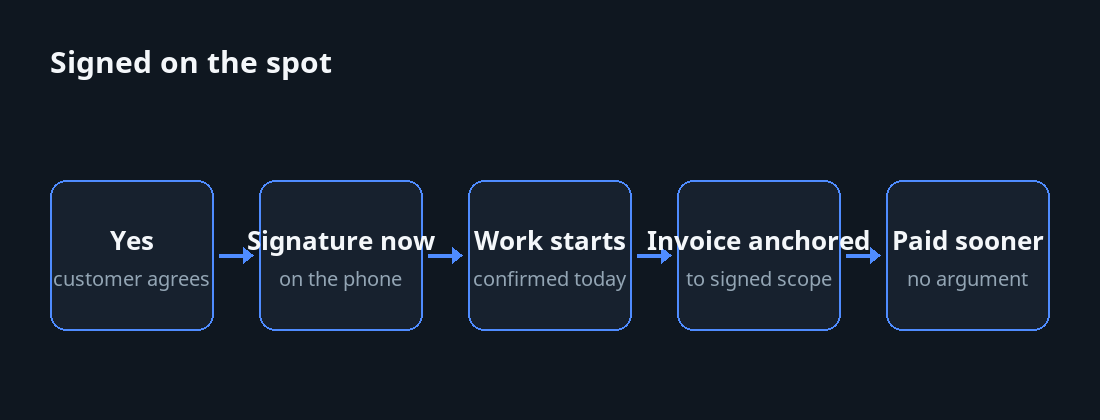
How on-site signatures speed payment
The link between signing and getting paid is more direct than it looks:
- Signed work starts sooner. You don't sit on a job waiting for confirmation; the confirmation is already in your hand, so the clock on the whole project starts today.
- Signed scope shortens the end. Disputes at the end — over what was agreed — are what delay final payment. A signature at the start removes most of them, so the closing invoice gets paid instead of argued.
- A signed document anchors the invoice. When the invoice references work the customer signed off on, there's nothing to renegotiate. You're collecting on an agreement, not reopening one.
What to get signed, and when
Not every interaction needs a signature, and over-papering small jobs can feel heavy. Here's a sensible default for when to capture one.
At the quote, for any job you'd hesitate to start unsigned
If the job involves ordering materials, holding a slot, or any sum large enough that a misunderstanding would hurt, get the quote signed before you leave. The signature converts the estimate into a committed go-ahead.
On the contract, for projects with stages or real money
For anything multi-visit, multi-stage, or above a threshold you set for yourself, use a contract and get the digital signature on it. This is where you define the payment schedule (a deposit, milestones, or a final balance), the scope boundaries, and the change process — all the things that prevent the expensive arguments later.
On completion sign-off, where it fits
For some field work, a signature at completion — "yes, this was done to my satisfaction" — is as valuable as one at the start, because it closes the door on after-the-fact complaints before you send the final invoice. The Signature tool makes this a ten-second step on the way out the door, while the customer is standing in the finished work and visibly happy with it.
How it reduces disputes
Disputes thrive in the gap between what one person remembers agreeing to and what the other does. On-the-spot signing collapses that gap. Both parties looked at the same document, at the same scope and the same price, at the same moment — and the customer signed it. There's no "I thought you said," because what was said is on the screen they signed.
This protects the customer too, which is part of why it works. They're not signing a mystery; they're signing the exact quote or contract you just walked through together, with the numbers visible. That transparency is disarming. A customer who hesitates to sign on the spot is often a customer who wasn't actually ready to commit — and finding that out now, while you can still talk it through, is far better than discovering it after you've ordered materials and blocked out three days.
When you do issue the invoice or contract as a PDF, it carries the agreement cleanly. InvoiceFlow's documents render correctly across scripts and use professional templates, so the signed quote or contract looks like the work of a real business, not a scribble on a notepad. And because the whole flow lives on your phone, offline-first, you can capture a signature in a basement, a rural driveway, or a parking garage with no signal — the data is on your device, and it syncs when you're back in range.
Building it into your routine
- Prepare the quote or contract on your phone before or during the visit, so it's ready the moment the customer says yes.
- Walk the customer through the line items and the price out loud — agreement is easier to sign when it was just spoken.
- For a discrete job, get the quote signed; for staged or larger work, use a contract with a digital signature and define the payment schedule on it.
- Hand over the phone and capture the signature with the Signature tool — finger or stylus, ten seconds.
- Where it fits, capture a completion sign-off on the way out, so the final invoice meets no resistance.
- Send the signed PDF and invoice from the app; the agreement is now the anchor for getting paid.
The discipline is simple: never leave a yes uncaptured. The customer has already decided; your only job is to make signing so frictionless that there's no reason to defer it. Turn the phone around, let them sign, and walk out with a commitment instead of a maybe. The work starts sooner, the disputes mostly don't happen, and the payment timeline begins the day the job was agreed — which is exactly where it should begin.