The Lyon Wedding Photographer Who Stopped Losing Money Between the Deposit and the Album
By the InvoiceFlow team — published 16 June 2026 — 10 minute read
Élodie Marchand photographs weddings in and around Lyon — vineyard ceremonies up in the Beaujolais hills, riverside receptions along the Saône, the occasional elopement in a courtyard in Vieux Lyon. She is very good at the part of the job that involves a camera. For her first three seasons she was quietly terrible at the part that involves money, and it nearly convinced her the business wasn't working when in fact only the billing was broken.
"A wedding is not one payment," she told us, in the matter-of-fact way of someone who learned this the expensive way. "It's a deposit to hold the date — sometimes booked eighteen months ahead — then a balance, then the album, then maybe parents' prints. Every couple is at a different point in that sequence. I had forty couples on the books last summer, and I genuinely could not have told you, on any given Tuesday, who still owed me money."
That sentence — I could not have told you who still owed me money — is the entire problem of running a deposit-and-milestone business without a system. Let's walk through how Élodie fixed it, because her fix generalizes to anyone who takes money in stages: photographers, planners, designers, anyone who holds a date with a deposit and collects the rest later.
The shape of the problem: money arrives in pieces, over months
A typical Lyon wedding for Élodie runs €2,800 for the day-of coverage, with an album package on top. The cash, though, never arrives as €2,800. It arrives like this:
- The booking deposit — €840, paid when the couple signs, often a year or more before the wedding. This holds the date; without it she won't block her calendar.
- The balance — €1,960, due two weeks before the wedding, because chasing a balance after the event is a fight nobody enjoys.
- The album — typically €600 to €1,200, billed after the couple chooses their photos, often three or four months later.
So a single €2,800-plus engagement is really three or four separate moments of money, spread across half a year, with a different couple at a different stage every single week of the season. Multiply by forty bookings and the "system" she'd been using — a notebook, her memory, and a sinking feeling — simply collapsed.
What "broken billing" actually cost her
The failures were specific and they all cost money or goodwill:
- Dates held for free. Twice she pencilled in a wedding on a verbal "we'll send the deposit this week," turned down another inquiry for the same date, and then the deposit never came. A held date that evaporates is pure lost revenue.
- Balances chased at the worst possible time. She once realized the morning of a wedding that the balance hadn't been paid. You cannot have that conversation in a bridal suite. She shot the day for free and sorted it out — awkwardly — afterwards.
- Albums quietly forgotten. Album invoices were the easiest to lose, because they came months after the emotional high of the wedding. She estimates she simply never billed three or four albums a year. At roughly €900 each, that's real money walking out the door.
Step one: the estimate that becomes the contract becomes the invoice
The first thing Élodie changed was the very front of the process. Instead of a casual email with a number in it, every couple now gets a proper estimate in InvoiceFlow — the day-of coverage, the album options, taxes shown the way French clients expect, all on a clean PDF that looks like the work of someone who takes their business seriously.
This matters for more than appearances. The estimate is where the whole money sequence gets defined and agreed before anyone is emotionally invested. When the couple says yes, she doesn't retype anything: InvoiceFlow converts the estimate into an invoice. The line items, the amounts, the client details — all carried straight across. And because some couples book only the coverage now and decide on the album later, she uses partial conversion: convert the day-of coverage into an invoice now, leave the album lines on the estimate to convert when they're ready.
For couples who want it formalized, the same scope can ride on a contract, which in InvoiceFlow supports a digital signature — so the booking terms are signed, not just implied. Estimate, contract, invoice: the same numbers flow through all three without re-keying, which is exactly how you avoid the "wait, did we say €2,800 or €2,900?" conversation six months later.
Step two: the deposit, done as a split-payment schedule
Here is the change that ended the free-held-date problem. Rather than treating the deposit as a vague promise, Élodie issues one invoice for the full engagement and breaks it into a split payment schedule — a planned installment structure with defined amounts and due dates, rendered cleanly on the PDF using InvoiceFlow's installment template.
So the couple receives a single, professional document that shows:
- €840 deposit — due on signing, to hold the date.
- €1,960 balance — due two weeks before the wedding.
- Album balance — due after photo selection (added when the album is chosen).
The total is visible, the breakdown is visible, and the due dates are visible — all on the page, agreed in advance. The psychological effect on couples is real: a printed schedule reads as "this is how professionals do it," not "she's nervous about getting paid."
Showing them how to pay — without becoming a bank
It's worth being precise here, because it's where a lot of people misunderstand what an invoicing app does. InvoiceFlow is not a payment processor. It doesn't take the couple's card or move the money. What it does is put the payment instructions right on the invoice — Élodie's bank details, or a payment link, or a QR code — so the couple knows exactly where to send the deposit. They pay through their own bank. Then Élodie does the other half: when the €840 lands, she records the payment and the invoice flips to Partially Paid, with the remaining balance calculated automatically.
That single discipline — record the deposit the day it arrives — is what killed the held-for-free problem. A date is only blocked in her calendar once the deposit shows as received. No deposit recorded, no date held. Simple, and it has not failed her since.
Step three: milestone billing as the season unfolds
With the schedule in place, the rest of the engagement becomes a series of milestones rather than a memory test. Think of each wedding as a tiny project with three checkpoints — deposit, pre-wedding balance, album delivery — and the invoice tracks exactly where each one stands.
Walk through one couple, Camille and Théo, married last September:
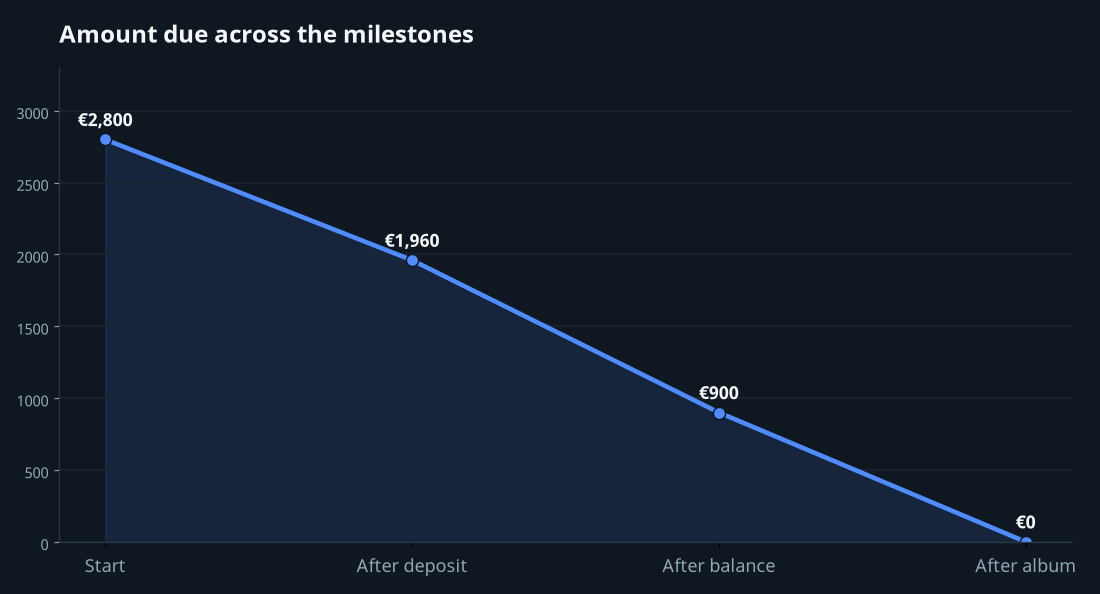
- March: they sign. Élodie records the €840 deposit. Invoice status: Partially Paid, amount due €1,960 plus album to come.
- Late August (two weeks out): the balance is due. Because the schedule put the date on the invoice, she isn't relying on memory — and InvoiceFlow's reminders and late-fee tools mean a balance that drifts past its due date doesn't just sit there silently. Théo pays the €1,960. She records it. Amount due drops to the album line.
- December: the couple picks their photos and chooses the €900 album. She adds the album to the schedule, the invoice updates, they pay, she records it, and the invoice closes as Paid with an amount due of zero.
At every point in those nine months, Élodie could open the invoice and see precisely what had been received and what was still owed. No notebook, no mental arithmetic, no 6 a.m. realization on a wedding morning.
Why one invoice beats three
A tempting mistake is to cut a fresh invoice for each stage — one for the deposit, one for the balance, one for the album. Élodie tried that early on and it fragmented everything: three documents per couple, no single place that answered "what does this wedding total and what's left?" Keeping one invoice with multiple recorded payments means the whole financial story of a wedding lives in one document. When a couple emails in February asking for "the invoice," there is exactly one to send, and its payment history tells the truth.
Keeping forty couples straight
Volume is the other half of the problem. Forty live engagements, each at a different milestone, would be chaos in a notebook. Two InvoiceFlow features carry the weight here.
First, client organization. Élodie groups her clients — couples for the current season, couples for next season already booked, plus a separate category for the corporate and editorial shoots she does in the off-months. Client groups and categories, with filters, let her pull up "this year's weddings with a balance still outstanding" in seconds instead of flipping pages.
Second, the Analytics view. Because every deposit and balance she records updates the numbers, she can see paid versus outstanding across the whole season at a glance — and crucially, which specific couples carry the biggest open balances heading into the busy weeks. That's how the forgotten-album problem disappeared: an album that hasn't been billed shows up as an open balance, and open balances don't hide in the dashboard the way they hid in her memory.
What changed, in plain numbers
Élodie's craft didn't change at all this season. Her billing did, and the difference showed up immediately:
- Zero dates held for free. Deposits are recorded before the calendar is blocked, full stop.
- Zero balances discovered on the wedding morning. The schedule's due dates plus reminders surface a balance two weeks out, every time.
- Every album billed. Open balances are visible, so nothing months-delayed slips through. She reckons that alone recovered three to four albums — call it €3,000 — over a season.
- Calmer client conversations. When a couple asks where things stand, she reads it off one invoice in real time instead of promising to "check and get back to you."
The wider lesson for anyone who bills in stages
Élodie's business looks specific — vineyards, ceremonies, albums — but the underlying shape is everywhere. Anyone who holds a slot with a deposit and collects the rest later is running the same sequence: a quote that has to be agreed up front, a deposit that has to actually arrive before you commit your time, a balance that has to be collected at the right moment, and a final stage that's easy to forget once the exciting part is over.
The system that fixes it isn't complicated. Define the whole sequence on an estimate and convert it (in part or in full) to an invoice. Put the stages on a split payment schedule so the deposit, balance, and final milestone are agreed in writing. Show the client how to pay, then record each payment the day it lands so your amount-due figure is always honest. And lean on client groups and Analytics so forty engagements never become forty things to remember.
"The cameras were never the problem," Élodie said. "The problem was the gap between the handshake and the album, and now there isn't one." This season she shot more weddings than ever and, for the first time, knew on every Tuesday exactly who still owed her money.