The Mobile Mechanic Who Never Leaves a Driveway Unpaid
By the InvoiceFlow team — published 16 June 2026 — 9 minute read
Marcus Okafor's office is a Ford Transit. It is parked, on a typical Tuesday, on a residential street in Bordesley Green, Birmingham, while he replaces a wheel bearing on a Vauxhall Astra whose owner is watching from the doorstep with a cup of tea. By half past three he'll be on a dual carriageway slip road near Solihull jump-starting a delivery van. Marcus is a mobile mechanic. He fixes cars where the cars are — driveways, kerbsides, supermarket car parks, the occasional petrol station forecourt. He has no premises, no front desk, no receptionist, and crucially, no second chance to collect.
That last point is the whole story. When the work happens at someone's home and you then drive off into the rest of your day, the moment to get paid is now — before you pull away. Every minute that passes after you've left the kerb, the probability of clean, prompt payment quietly drops. The customer who watched you work and shook your hand is a very different payer from the customer reading an invoice in their inbox three days later, when the car is running fine and the memory of the problem has faded.
The trade's oldest cash-flow leak
Mobile and field trades have a structural disadvantage compared to anyone with a shop. A garage with a forecourt holds the car hostage until the bill is settled — you don't get your keys back until you've paid. Marcus has no such leverage. He's done the work, the car is fixed, and he is standing on a stranger's drive hoping the conversation about money goes smoothly.
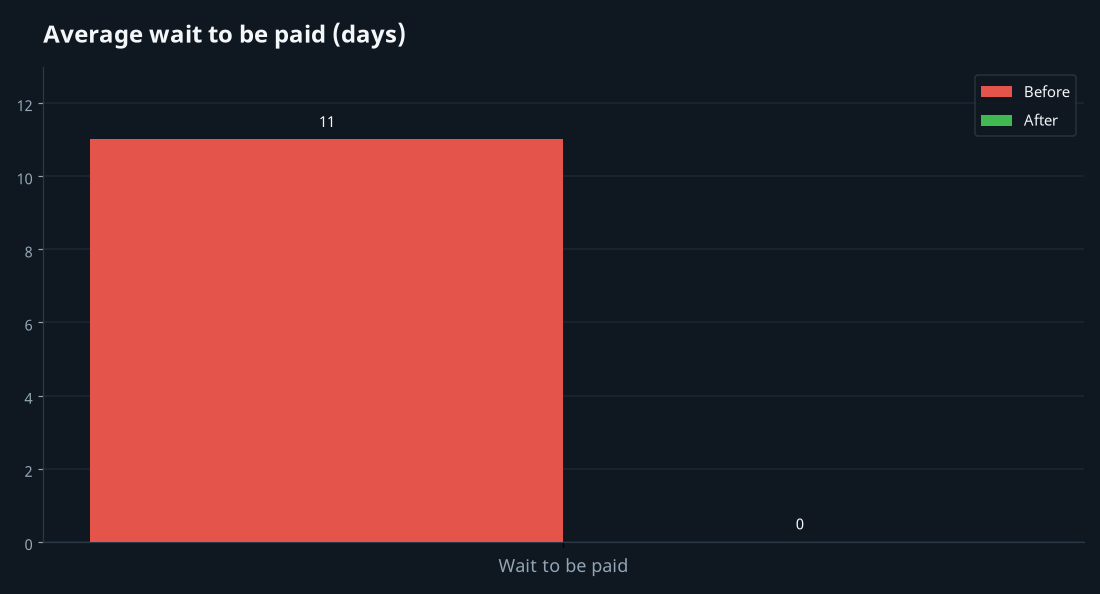
For his first year, it usually didn't. His "system" was a paper duplicate book, a calculator on his phone, and a vague "I'll send you my bank details later." Later meant evenings spent typing up jobs from a grease-smudged carbon copy he could half-read, working out totals he should have worked out on-site, and then chasing. He estimated, conservatively, that he was waiting an average of eleven days to be paid, and that something like one job in twelve required a second or third nudge. A handful each year quietly evaporated entirely — small amounts, £60 here, £90 there, not worth the aggravation of pursuing, but adding up to a real number by Christmas.
The fix was not a better debt-collection technique. The fix was to never create the debt in the first place. Invoice on the spot, get it acknowledged on the spot, get paid on the spot, and drive away with the job genuinely closed.
The driveway workflow
Here is how a job closes now, with InvoiceFlow on the phone in his overall pocket.
1. Build the invoice while the engine cools
The bearing is in, the wheel is back on, and while the customer is finding their card Marcus is already building the invoice on his phone. The customer's a regular, so they're saved with their details and their car; for a new customer it's thirty seconds to add them. He adds the line items — parts and labour, separately, because people want to see that breakdown — and the total calculates itself, VAT handled the way he's configured it. The thing that used to be an evening chore done badly from memory is now a sixty-second job done accurately while the facts are fresh.
2. Use a template that looks like a tradesman's invoice
Marcus uses the contractor template — one of the twelve built-in PDF designs, built for exactly this kind of trades work. It puts parts and labour where people expect to see them, carries his logo, and reads like a document from a real business rather than a number scrawled on a receipt. That matters more than it sounds. A clean, professional invoice handed over on the spot does quiet work: it signals that this is a proper transaction, that records are kept, that there's nothing casual about expecting to be paid now. Customers reach for their cards faster when the paperwork looks like it means it.
3. Get it signed off — on the spot
Before any money changes hands, Marcus turns the phone around and has the customer sign. InvoiceFlow's Signature tool captures a signature directly on the screen with a fingertip, and places it on the document. For Marcus this is the single most valuable thirty seconds of the whole job.
The signature isn't bureaucratic theatre. It's the moment the customer formally agrees: yes, this is the work, yes, this is the price, yes, I'm happy. Once someone has signed to confirm the job and the total, the entire category of dispute that used to eat his evenings — "I don't remember agreeing to that," "I thought the part was included," "that seems like a lot for half an hour" — simply doesn't happen. The conversation that needs to happen at the kerb has happened at the kerb, with a signature to show for it, rather than three weeks later by text.
4. Show them exactly how to pay — right there on the invoice
Now the important part. InvoiceFlow is not a payment processor — it doesn't take the card itself. What it does is put the payment instructions directly on the invoice, so paying is frictionless. Marcus shows his bank details, a payment link, and a QR code on the document. The customer opens their banking app, scans the QR or follows the link, and sends the bank transfer while Marcus packs up his tools. No card terminal to maintain, no processing fees nibbling each job, no "I'll do it when I'm back at my laptop." The instructions are on the document the customer is literally holding.
This is the bit that converts a fixed car into money in the account. The signature establishes agreement; the on-document payment instructions remove every excuse to delay. A QR code that drops the exact amount into the customer's banking app is about as low-friction as a bank transfer gets.
5. Mark it Paid before you turn the key
The transfer lands — or the customer shows Marcus the "payment sent" confirmation — and he marks the invoice Paid in the app, on the spot. The job is now genuinely closed. There is no entry in a mental list of "people who still owe me," no carbon copy to type up tonight, no follow-up to schedule. He gets in the van and drives to Solihull with one fewer open loop in his head than he'd have had a year ago. Multiply that across six or eight jobs a day and the cumulative reduction in low-grade administrative dread is enormous.
Occasionally a customer genuinely can't pay the full amount on the day — a big, unexpected repair on a tight week. Marcus can take what they can manage and record a partial payment; the app tracks the remaining balance so the outstanding amount is precise and visible rather than a guess. But that's the exception. The default, now, is paid-in-full-before-departure.
What this does to the numbers
The headline change is the one that matters to any business: the gap between doing the work and holding the money collapsed from an eleven-day average to roughly zero. Cash flow for a sole trader living job-to-job is not an abstraction — it's whether you can buy the parts for tomorrow's jobs without dipping into an overdraft. Getting paid on the day means the money for the next set of parts is already in the account.
The second change is the disappearance of the chase. Marcus used to spend two or three evenings a week reconstructing jobs and sending payment reminders. That time is now his. The work that generates no income — the typing-up, the nudging, the spreadsheet reconciliation — shrank to almost nothing, because the invoice is created, signed, paid and marked closed before he's left the customer's street.
The third change is subtler and arguably the most valuable: the near-elimination of disputes. An invoice signed on-site, with the work fresh and the customer present, is extraordinarily hard to argue with later. The arguments that used to cost him both money and goodwill mostly stopped happening, because the agreement was nailed down at the only moment when everyone genuinely agreed.
The estimate-first variation
For bigger jobs — a clutch, a timing belt, anything where the price would make someone wince — Marcus doesn't lead with an invoice. He leads with an estimate. He builds the quote on the phone, shows the customer the number before he touches a spanner, and only proceeds once they've agreed. When the job's done, the estimate converts into the invoice, so he isn't re-typing anything and the figures match what was quoted exactly. The customer signs, pays, and there's a clean documentary trail from "here's what it'll cost" to "here's your paid invoice" — all from the same phone, all at the same kerb.
This estimate-then-invoice flow is also his best defence against the most awkward conversation in the trade: the one where the price is higher than the customer was bracing for. Having agreed the number in advance, in writing, means the moment of payment is calm. Nobody's surprised. Surprise is what turns a routine transaction into an argument.
The setup, for any field trade
Marcus is a mechanic, but the workflow belongs to every trade that does the work at the customer's location and then leaves: mobile valeting, locksmiths, appliance repair, gardeners, mobile groomers, tyre fitters, electricians and plumbers doing call-outs. If that's you, the pattern is the same:
- Invoice on your phone, on-site, while the details are fresh — not from memory that evening.
- Use a template built for trades (the contractor design) so parts and labour are clear and the document looks like a real business.
- Capture a signature on the spot so the customer formally agrees to the work and the price — your best protection against later disputes.
- Put payment instructions on the invoice itself — bank details, a link, a QR code — so there's no friction and no "later."
- Mark it Paid before you drive away, recording a partial payment if that's genuinely all they can do today, so nothing becomes a debt to chase.
- For the big jobs, quote first and convert the estimate to the invoice, so the price is never a surprise.
The principle underneath all of it is simple, and Marcus puts it more bluntly than any business coach would: "The driveway is the cash register. Once I've driven off, I've left the till open. So I close it before I leave." He fixes the same number of cars he always did. He just doesn't drive away from any of them with the money still sitting in someone else's bank.