The Event Planner Who Stopped Losing Track of the Money
By the InvoiceFlow team — published 16 June 2026 — 10 minute read
Núria Vidal plans events in Barcelona. On a given week she might be standing in a Gothic Quarter courtyard with a couple deciding where the band will set up, on a video call with a Hamburg company about their offsite conference dinner, and at a flower market in the early morning negotiating peonies for a vineyard wedding in the Penedès. She runs it all from a planner's classic toolkit — a phone, a laptop, a folder of supplier contacts built over eight years, and an almost supernatural memory for who promised what. The memory was the problem.
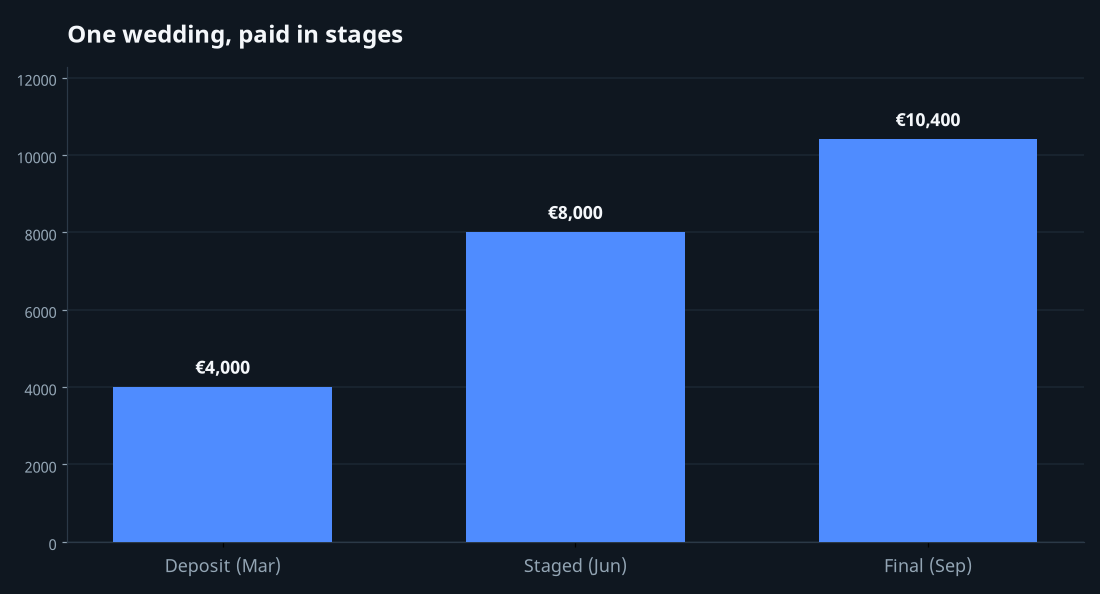
Because an event is not one transaction. It is dozens of them, spread over months, owed in both directions. A single September wedding might involve a €4,000 deposit from the couple to hold the date in March, a second staged payment in June, a final balance two weeks before the day — and, going the other way, payments she owes a florist, a caterer, a band, a photographer and the venue, each on their own schedule. Multiply that by the eight or ten events she runs at once, all at different stages, and you have a money map of genuine complexity. For years that map lived mostly in her head, propped up by a spreadsheet she didn't fully trust and a worrying number of "I think they've paid the deposit" moments.
The shape of the problem
Event planning has a cash-flow structure that almost no other small business shares, and it punishes anyone who treats each booking as a single invoice sent at the end. Three things make it hard.
The deposit secures something scarce. A wedding date, a particular venue, a sought-after band — these are finite. You can only sell one Saturday in June once. So the deposit isn't a goodwill gesture; it's the thing that takes the date off the market. If a couple hasn't paid it, they haven't really booked, and Núria has learned the hard way that "we'll send it next week" and "the date is yours" are not the same sentence. She needs to know, at a glance, exactly which deposits have landed and which dates are therefore truly committed.
The money arrives in stages, over months. Almost no client pays for a €22,000 wedding in one transfer. The norm is a deposit to book, one or two staged payments as the date approaches, and a final balance just before the event. Each of those is a date she has to hit, a figure she has to track, and a payment she has to confirm actually arrived. Miss a staged payment and she's funding suppliers out of her own pocket; lose track of what's been paid and she either under-bills (and eats the gap) or over-bills (and looks careless to a client who is, that month, extremely emotionally invested).
Every event is a stack of sub-costs. Florist, caterer, band, photographer, venue, transport, stationery, the late-night taco cart the couple insisted on. Each line has its own price, its own supplier, its own deposit and balance. Keeping one event's costs from bleeding into another's mental ledger — and being able to say, cleanly, "this wedding's total is €22,400 and here's exactly what it's made of" — is the difference between a business and a very stressful hobby.
One workspace per event
The first thing that changed was structural. Instead of letting each event scatter itself across her memory, her inbox and a spreadsheet, Núria now opens a Project for every event in InvoiceFlow and treats it as that event's single home. The Penedès vineyard wedding is a project. The Hamburg corporate dinner is a project. Inside each one she builds out Milestones — the natural stages every event already has — so the work and the money line up with how the event actually unfolds.
For the vineyard wedding the milestones read almost like a countdown: Date secured (deposit), Vendors confirmed, Final headcount & menu locked, Event delivered (final balance). This is the Notion-style client workspace doing exactly what it's for — grouping everything about one event in one place and letting her bill by milestone rather than guessing when to ask for what. When a stage is reached, there's an obvious, pre-agreed moment to invoice. Nothing is improvised, and nothing is forgotten, because the structure of the event is the structure of the billing.
The quieter benefit is that eight simultaneous events stop competing for the same anxious corner of her brain. Each one has a container. When the florist for the Hamburg job calls, she opens that project and everything about the event — milestones, numbers, documents — is right there, not tangled up with the three weddings the same month.
Quote the whole event, convert as it's confirmed
Núria's relationship with a couple starts long before any money moves. It starts with a proposal — and in InvoiceFlow that proposal is an estimate. She builds the full event quote as a single document: venue, catering, flowers, music, photography, planning fee, the lot, each as its own line so the couple can see precisely where €22,400 goes. A clear, itemised quote does a lot of quiet selling on its own; vague round numbers make people nervous, while an honest breakdown makes them feel they're dealing with a professional.
What makes the estimate more than a fancy PDF is that it converts into invoices — including partial conversion. Núria doesn't turn the whole €22,400 quote into one invoice. As each part of the event is confirmed, she converts just that portion. The couple commits to the venue and the deposit? She converts the deposit and the date-securing amount into an invoice now, and leaves the rest sitting in the estimate. Two months later they lock the caterer and the band; she converts those lines too. The quote becomes the spine of the whole job, and each invoice is carved from it, so the figures the client sees in March are the exact figures they agreed to in the proposal. No re-typing, no drift, no awkward "wait, that's not the number you quoted me."
For her occasional international corporate clients — the Hamburg company pays in euros, but she's had a London client who wanted to be billed in pounds — she simply issues that client's invoices in their own currency, formatted correctly. (InvoiceFlow isn't doing live exchange-rate conversion; it's just letting each invoice carry the right currency for the client it's going to, which is exactly what a cross-border client expects to see.)
The deposit, done properly
The deposit is the hinge the whole booking turns on, so it gets handled deliberately. When a couple is ready to book, Núria issues the deposit invoice — say €4,000 to hold a prime September Saturday — with the payment instructions printed right on the document: her bank details and a payment link, so the couple can pay by transfer without a back-and-forth. InvoiceFlow doesn't take the payment itself (it's not a payment processor); it shows the client exactly how to pay, and then she marks the invoice Paid the moment the transfer lands.
That single action — marking the deposit Paid — is what flips the date from "pencilled in" to "yours." Now when Núria looks at her events, she isn't relying on memory or a half-remembered email. The date is secured because the deposit is recorded as paid, full stop. And if a couple pays a deposit in two pieces, or pays part of a staged payment now and the rest next week, she records the partial payment and the app tracks the remaining balance automatically. She always knows, per event, exactly what's been received and exactly what's still due — not approximately, not "around four thousand," but the real number.
Staging the balance with a payment schedule
Here's where the months-long nature of an event gets tamed. Rather than chasing the couple with three separate ad-hoc requests as the wedding approaches, Núria can lay the whole thing out as a split-payment schedule — an installment plan that breaks the total into a sequence of dated amounts. The installment template renders that schedule cleanly on the PDF, so the couple sees the entire payment journey on one page: deposit now, second payment by a date in June, final balance two weeks before the wedding. Each amount, each due date, all in black and white.
This does something subtle and valuable for the relationship. Money conversations are the part of wedding planning nobody enjoys, and surprise is what makes them tense. When the full schedule is agreed up front and printed on the invoice, there are no surprises left to have. The couple knows in March exactly what they'll owe in June and what they'll owe in August. Núria isn't the person who keeps appearing to ask for more money; she's the professional who told them the plan once, in writing, and is simply following it. As each installment is paid she records it, the balance ticks down, and the schedule stays accurate to the cent.
For the corporate side it's the same machinery with a different rhythm — a deposit to confirm and a balance on completion, or a milestone-tied schedule for a multi-day event. The point is that the payment plan is a document the client agreed to, not a series of reminders they have to tolerate.
Keeping every vendor cost straight
The other half of an event planner's money map is everything she owes. A wedding isn't profitable because the couple paid €22,400; it's profitable because of the gap between that and what the florist, caterer, band, photographer and venue cost. If those sub-costs blur together across events, the margin becomes a mystery.
Because each event lives in its own Project, its costs stay attached to it. Núria can see a given wedding as a self-contained unit — what was quoted, what's been invoiced and collected so far, and what it's actually composed of — rather than as a few lines lost in a giant undifferentiated list. When she records the expense side of the business, those costs belong to a recognisable event rather than floating free. The result is that she can answer the only question that ultimately matters per event — did this one make money, and how much? — without a forensic evening of spreadsheet archaeology. And across the whole business, her analytics show paid versus outstanding, her collection rate and which clients drive the most revenue, so she's steering with numbers instead of nerves.
What changed for Núria
The headline change is that she stopped carrying the money map in her head. Eight events at eight different stages used to mean a permanent low hum of "have they paid the deposit, did the June payment come in, what's left on the Hamburg job." Now each of those answers is a glance away, attached to the right project, accurate to the cent. The mental load didn't shrink because she got better at remembering; it shrank because she stopped needing to remember.
The second change is that deposits stopped slipping. A date is now secured when, and only when, the deposit shows as paid — so the dangerous limbo of "I think they've committed" is gone. She no longer turns away a Saturday on the strength of a verbal yes that never turns into a transfer.
The third is that the staged payments run themselves. The schedule is agreed once and printed on the invoice; the couple knows the plan; each installment gets recorded as it arrives and the balance stays exact. The awkward conversations didn't get easier to have — they mostly stopped needing to happen.
The pattern, for anyone who bills in stages
Núria plans weddings, but the workflow belongs to anyone whose work is large, runs over months, and gets paid in pieces — caterers, photographers, designers, builders, agencies, consultants on long engagements. The shape is the same:
- Give every job its own Project so its money, milestones and documents live in one place instead of competing for space in your memory.
- Build milestones that match the real stages of the work, then bill by milestone so there's always a pre-agreed moment to invoice.
- Quote the whole thing as an estimate, itemised, and convert it to invoices a piece at a time as each part is confirmed — so the numbers never drift from the proposal.
- Treat the deposit as the thing that secures the booking. Show payment instructions on the invoice, and only count the date as held once it's marked Paid.
- Lay the balance out as a split-payment schedule with the installment template, so the client sees the entire payment plan up front and there are no surprises left.
- Record every partial payment so the remaining balance per job is always exact, and keep each job's costs attached to its project so you actually know what each one earned.
Núria puts it more simply than that. "A wedding isn't one bill," she says. "It's a relationship with a schedule. My job is to make the money part of it feel as calm and inevitable as everything else I'm planning." The events are as elaborate as ever. She's just no longer the only place the numbers are written down.