From Craft Fairs to Wholesale Accounts: How a Portland Maker Invoices B2B
By the InvoiceFlow team — published 16 June 2026 — 10 minute read
Mara Ellison makes candles and small ceramics out of a studio in a converted machine shop in Southeast Portland, the kind of building where three other makers share the loading dock and someone is always firing a kiln. She started the way a lot of makers do: a folding table at the Portland Saturday Market, a card reader clipped to her phone, and a hand-lettered price list. For two years that was the whole business. Someone admired a candle, handed her twenty dollars, walked away happy. No invoice, no account, no terms. Just craft fairs and cash.
Then a boutique on Mississippi Avenue asked if she'd sell them a dozen candles at wholesale to stock on their shelves. She said yes before she'd thought through what "wholesale" actually meant, and within a year she had eight wholesale accounts — boutiques, two gift shops, a florist who wanted her ceramics for arrangements, and a hotel gift counter. The retail table still happened on Saturdays, but the real growth, and the real money, was now business-to-business. And B2B turned out to need a completely different kind of paperwork than a folding table ever did.
Why wholesale breaks a craft-fair workflow
At a craft fair, the document is the transaction and the transaction is over in ten seconds. There's no need for a record of who bought what; the buyer is a stranger you'll likely never see again, and the money is in your pocket before they've left the stall.
A wholesale buyer is the opposite in every way. A gift-shop owner doesn't pay at the table — they place an order, expect an itemized invoice in their shop's registered business name, pay on terms (Net-30 is common), and reorder when the shelf runs low. They want a delivery note packed in the box so their staff can check the shipment against what was ordered. They sometimes ask for a quote before committing, especially on a first or seasonal order. And they buy the same things again and again, which means the relationship — not the single sale — is the asset.
For Mara's first wholesale year, all of this lived in a tangle of text messages, a notes app, and a spreadsheet she updated when she remembered. Orders got packed without a packing slip, so a shop would email asking which candles were in the box. Reorders meant re-typing the same line items from scratch every time. And twice she shipped product she didn't actually have enough of, because nothing was tracking her stock — she was guessing from the shelf in the studio. A craft-fair workflow doesn't scale into wholesale. It just gets more frantic.
Step one: know what's in the studio
The first thing Mara fixed was the thing that had embarrassed her: promising stock she didn't have. She set up her products in InvoiceFlow's Inventory, building a real catalogue — each candle scent, each ceramic form, each size — with stock levels and low-stock awareness.
This did two things at once. First, when she builds a wholesale order now, she's pulling from a product list with known prices and known stock, not improvising from memory. The line items are consistent: "Cedar & Smoke 8oz candle" every time, not "candle" one week and "the dark one" the next. That consistency is what makes a shop's bookkeeper treat her like a supplier rather than a stall.
Second, the low-stock awareness stops the expensive mistake. When the Cedar & Smoke stock dips toward the line she's set, she sees it before she promises forty units to a hotel gift counter she can't fulfil. A maker's batch production has lead time — wax, wicks, a pour, a cure — so knowing you're running low before you've committed is the difference between a calm production schedule and a panicked all-nighter. The inventory isn't there to run her studio for her; it's there to stop her selling what she can't make in time.
Step two: quote first, then convert
Wholesale buyers, especially new ones and seasonal ones, often want to see numbers before they commit. A gift shop planning a holiday order wants a quote for "thirty assorted candles and a dozen small bowls" so they can check it against their buying budget. Mara used to answer these with a number in a text message, which looked exactly as unprofessional as it sounds.
Now she sends an estimate. She builds it from her product catalogue — real items, real prices — and sends a clean, itemized quote the buyer can take to whoever approves their spending. It looks like dealing with a company, because it is one.
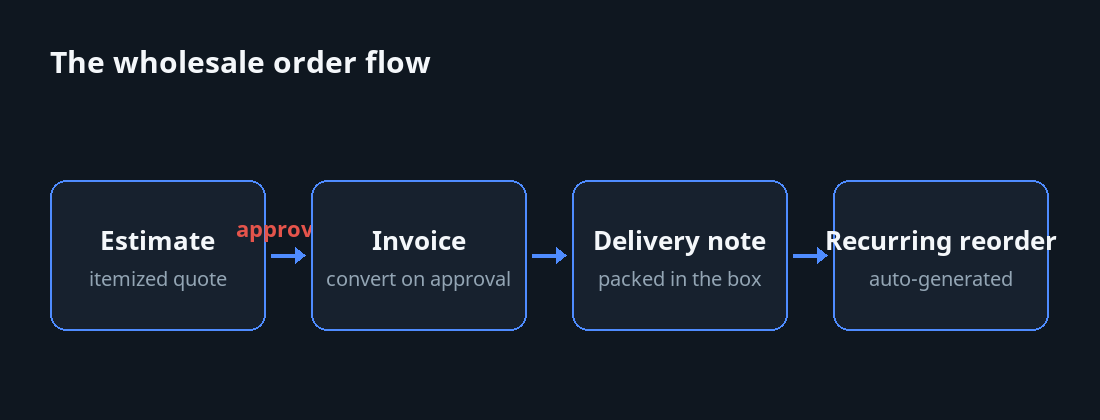
The part that saves her the most time comes next. When the buyer says yes, she doesn't rebuild the order as an invoice from scratch. The estimate converts to an invoice directly, carrying the line items across, so there's no re-typing and no risk of the invoice not matching the quote the buyer approved. And when a shop approves only part of a quote — "we'll take the candles now, hold the bowls" — she can do a partial conversion, invoicing the candles immediately and keeping the rest of the estimate live for later. The quote and the invoice stay in lockstep, which is exactly what a buyer's bookkeeper wants to see.
Step three: the delivery note in the box
Here is the document a craft-fair seller never needs and a wholesale supplier can't live without: the delivery note. When Mara ships a box of candles to the boutique on Mississippi, she packs a delivery note listing exactly what's inside — every item, every quantity — so the shop's staff can check the shipment in against the order without hunting for the invoice or emailing her to ask.
This sounds like a small courtesy. It's actually the thing that makes wholesale relationships run smoothly. A delivery note separates the physical question ("did everything we ordered actually arrive?") from the financial question ("what do we owe and when?"). The shop's receiving person checks the box against the delivery note on the day it lands; the bookkeeper handles the invoice on Net-30 terms separately. Nobody has to be both people at once. When a shipment is short a unit because a candle cracked in transit, the delivery note is the shared reference that makes the conversation quick and friendly instead of a he-said-she-said.
InvoiceFlow treats delivery notes as a first-class document type alongside invoices, estimates, and contracts, so Mara generates one from the same order rather than rebuilding it in a separate tool. Same products, same client, different document — the packing slip and the invoice are two faces of one transaction.
Step four: organize accounts as accounts
Once you have eight wholesale buyers who each reorder on their own rhythm, a flat list of names stops being useful. Mara uses client groups to organize her wholesale accounts the way she actually thinks about them. Her structure looks like this:
- Wholesale (group) → Boutiques, Gift shops, and Hospitality (sub-categories)
- Retail — the Saturday Market and her occasional online direct sales
This isn't filing for the sake of filing. When she wants to send a new seasonal line sheet to every boutique, she filters to Wholesale → Boutiques and sees exactly those accounts, without the retail noise. The app's advanced filters let her narrow further — by attributes and by relationships — so during a busy reorder week she can pull up just the wholesale accounts with an outstanding balance and follow up, instead of scrolling her whole contact list. A dedicated client-groups management screen is where she maintains the whole structure, and when she lands a new account it inherits the way she already thinks about that segment.
Per-client settings carry their weight here too. Each wholesale account holds its own details — its registered business name, its terms, its currency — so Mara isn't re-deciding any of that every time she invoices. The boutique is Net-30; the hotel counter, which pays slowly, is on stricter terms with a late-fee policy attached to the client. She set each account up properly once, and that was the last time she had to think about its boilerplate.
Step five: the reorders should write themselves
The single biggest lever in Mara's wholesale business is the standing order. Several of her accounts reorder the same core products on a predictable cadence: the boutique restocks its best-selling three candle scents every month, the gift shop takes a standard ceramics assortment every six weeks, the hotel counter wants a fixed monthly delivery.
These are textbook recurring schedules. Mara sets each standing order up once — the products, the quantities, the price, the right account, the right terms — and tells the app the cadence. The invoices then auto-generate on schedule with correct sequential numbering, so her invoice numbers stay clean and gap-free even though a chunk of her billing now happens without her lifting a finger. The boutique's monthly restock invoice exists before she's even decided what to make that week.
What this buys her is reliability under load. Portland's holiday season is brutal for makers — craft-fair weekends, online orders, and wholesale reorders all spiking at once. The recurring wholesale invoices keep firing on their normal cadence in the background while she's pouring candles at midnight for the December rush. The predictable spine of the business handles itself; she spends her attention on the seasonal extras and the new accounts, not on re-typing an order she's sent the same shop eleven times before.
Recurring plus exceptions
Recurring schedules cover the reliable repeat orders. The variable part — a shop wanting double for the holidays, a new account's first trial order — Mara handles ad hoc, but against the same well-organized client record. Because the account already exists with its terms and the products are already in her catalogue, raising an extra invoice or a quote is fast: pick the account, add the products, send. The recurring engine handles the heartbeat; she handles the spikes and the new business.
What the numbers tell her
Because retail and wholesale are separated into groups and every recurring invoice is properly attributed, Mara can finally look at her two channels as two channels. The Analytics view shows her revenue, paid versus outstanding, and her collection rate. The lesson it taught her was uncomfortable and clarifying: the Saturday Market is a joy and it pays today, but the eight wholesale accounts — quietly reordering, mostly on autopilot — produce more revenue across the year with a fraction of the standing-around. The craft fair is the soul of the business; wholesale is the spine.
She still does the documents up properly, because they go to businesses that judge her by them. She uses one of the 12 built-in PDF templates — the clean one suits her brand — with her studio's logo placed automatically by the two-logo system. Everything's billed in US dollars with correct formatting and sales tax handled where it applies. A wholesale relationship is a long series of small touchpoints — a quote, an invoice, a delivery note, a reorder — and every one of them either reinforces "this is a real supplier" or undercuts it.
The setup, generalized
If you're a maker growing from direct sales into wholesale, Mara's path transfers directly:
- Put your products in inventory with stock levels. Consistent line items make you look like a supplier, and low-stock awareness stops you promising what you can't make in time.
- Quote with estimates, then convert. Send a professional itemized quote, and when it's approved, convert it straight to an invoice — partial conversion when the buyer takes only part of it — so the numbers always match.
- Pack a delivery note in every box. Separate "did it arrive?" from "what's owed?" and your wholesale shipments stop generating email.
- Organize accounts into groups. Wholesale and retail are different species; sub-categorize wholesale by channel, and push terms onto each client record so you're not re-deciding them.
- Automate the reorders. Anything a shop takes on a cadence should invoice itself, with clean sequential numbering, so the holiday rush doesn't bury you in re-typing.
Mara still sets up the folding table on Saturdays, still likes handing a stranger a candle and watching their face. But Ellison & Co. is a steady business rather than a craft-fair gamble because the wholesale half — the quotes, the delivery notes, the Net-30 invoices, the monthly reorders — now runs like a supplier's should. "The making was never the hard part," she says. "Looking like a real company to the shops that buy from me — that was the hard part. The day I stopped running wholesale off text messages, I stopped feeling like a hobbyist who got lucky."