How Much Deposit to Ask For (and When): A Practical Guide to Advance Payments
By the InvoiceFlow team — published 16 June 2026 — 11 minute read
A deposit is the most underused tool in small-business finance. Plenty of freelancers and trades will agonize over their day rate, polish their portfolio, and chase late payments for weeks — but never ask for a penny up front. Then a client ghosts after the work is delivered, or cancels the week before a booked job, and there's nothing to show for the time already committed. A sensible deposit policy prevents most of that, and it does something quieter too: it filters out the clients who were never going to pay anyway.
This guide is about the two practical questions that actually matter: how much to ask for, and when. We'll go industry by industry, look at the psychology that makes deposits work for both sides, cover the contract terms that keep them clean, and show how to track the deposit-then-balance flow so you always know exactly what's still owed.
Why a deposit changes the whole relationship
A deposit does three jobs at once, and it helps to see them separately.
It funds the work. If a job needs materials, subcontractors, or weeks of your time before any deliverable exists, the deposit covers the gap. You shouldn't be financing a client's project out of your own pocket — that's a loan you never agreed to make.
It signals commitment. This is the psychological half, and it's the more important one. A client who has paid you money is a client who has decided to go ahead. Before the deposit, you are one of several options they're weighing. After it, you are the choice, and they're now invested in making the project succeed. The deposit converts a maybe into a yes — for both of you.
It protects against cancellation. If a client backs out, the deposit compensates you for the slot you held and turned other work away for. This is why event and booking businesses live or die on their deposit terms: the cost of a cancelled wedding date isn't the lost wedding, it's the three other couples you said no to.
There's a fourth, unspoken benefit. Asking for a deposit is a confidence signal. Businesses that don't ask read as either desperate or amateur. A calm "we take a 40% deposit to confirm the booking" tells a client they're dealing with a professional who does this all the time — which makes them more, not less, likely to say yes.
Typical deposit percentages by industry
There's no universal number, but there are well-worn norms. Use these as starting points and adjust for your risk and your cash needs.
Creative work (design, photography, writing, video)
The standard here is 50% up front, 50% on delivery. It's simple, it's expected, and clients in creative fields rarely blink at it. The logic is clean: the upfront half covers your time during production, when there's nothing yet to show, and the balance falls due when the finished work changes hands. For larger projects — a brand identity, a long video edit — many studios split it into thirds: a third to start, a third at an agreed midpoint, a third on delivery.
Photographers and videographers who book dates (weddings, events) often treat the upfront portion explicitly as a booking deposit — frequently 25–50% — that secures the date and is non-refundable past a certain point, with the balance due shortly before or after the shoot.
Trades and construction
For a small job (a day or two of labor, modest materials), 30–50% up front to cover materials is normal and reasonable. For larger jobs, deposits usually flatten into progress billing: a deposit to start, then staged payments tied to milestones — foundation poured, framing complete, first fix done, final sign-off. The deposit on a big build is rarely more than what's needed to buy the first round of materials and mobilize, because the client (rightly) doesn't want to hand over half the value of their kitchen before a single cabinet is hung.
A word of caution that protects your reputation: don't ask for a deposit so large it implies you can't fund your own first week. On a £20,000 job, demanding £15,000 up front frightens good clients away. £4,000–£6,000 to mobilize, then staged payments, reads as competent.
Events and bookings
This is the highest-deposit category, and for good reason — you're selling a date you can only sell once. Event planners, caterers, venues and entertainers commonly take 25–50% to book, often non-refundable, with a tiered cancellation schedule (more refundable far out, less refundable as the date approaches) and the balance due a set number of days before the event — never after. Collecting the final balance after a one-off event has happened is a recipe for being stiffed; the leverage is gone the moment the cake is cut.
Consulting and professional services
Consultants split into two camps. Project consultants often take a deposit or first-milestone payment — 25–50% — before kickoff. Ongoing advisors usually move to a retainer: a fixed monthly fee paid in advance for a block of availability or hours. The retainer is the deposit, renewed every month, and it's the cleanest cash-flow model in professional services. If you do per-project consulting, a deposit before the first workshop or discovery phase is standard and rarely questioned.
When to ask: timing the request
The deposit request should land at the moment of decision — when the client says yes but before any work begins. The sequence that works almost everywhere:
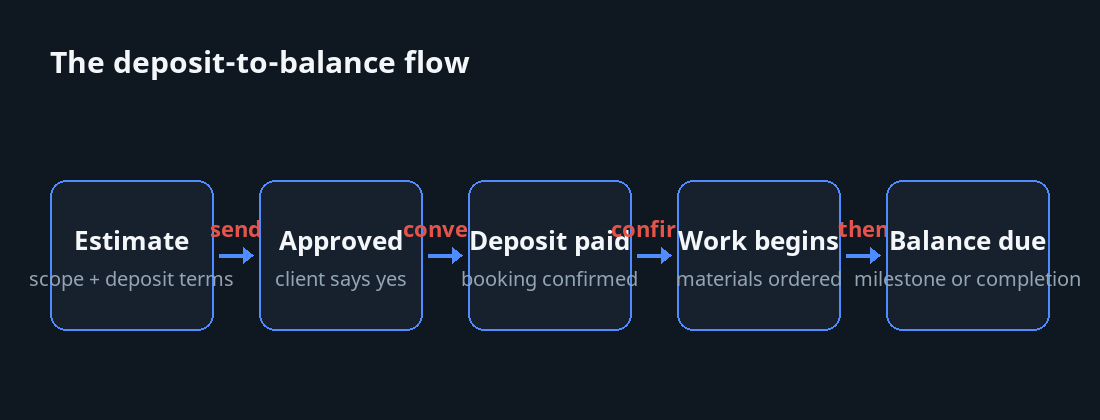
- You send an estimate or quote with the scope, the price, and your deposit terms stated plainly.
- The client approves it.
- You issue a deposit invoice (or the deposit portion of the full invoice) and the booking is confirmed once that deposit is paid, not before.
- Work begins. Milestones or the final balance fall due per the schedule.
The order matters. "Confirmed on receipt of deposit" is the single most useful clause you can adopt. It moves the risk of a no-show off your books and onto the client's decision, where it belongs. Never hold a date or start ordering materials on a verbal yes; hold them on a paid deposit.
In InvoiceFlow this maps cleanly onto the document flow. You create an estimate with the full scope and price, send it for approval, and once the client says yes you convert it to an invoice — including a partial conversion when you only want to bill the deposit portion now and the balance later. The estimate is your quote-with-terms; the invoice is the thing that gets paid.
Structuring deposits and the balance
How you structure the money after the deposit depends on the length and shape of the job.
Deposit, then balance
The simplest pattern, and the right one for short jobs: a deposit up front, the balance on completion. You take a partial payment now and the remainder when the work is delivered. InvoiceFlow's partial payments / amount due tracking is built exactly for this — you record the deposit against the invoice, and the app shows the remaining balance still owed, so a glance tells you who has paid their deposit but not their balance. No mental arithmetic, no spreadsheet.
Milestone-linked advances
For longer projects, tie payments to deliverables rather than dates. Each milestone — a phase completed, a stage signed off — triggers the next payment. This protects both sides: the client only pays for progress they can see, and you're never more than one milestone "ahead" on unpaid work. InvoiceFlow's Projects and Milestones let you group a long engagement and bill by milestone, so a six-month build or a multi-phase design project stays organized and each advance is clearly tied to what it's paying for.
Split payment schedules / installments
Sometimes the client wants to spread the cost rather than pay against milestones — a deposit plus three equal monthly payments, say. InvoiceFlow lets you break a single invoice into a split payment schedule, and the installment template renders the full plan on the PDF so the client sees exactly what's due and when. This is the friendly face of a deposit: "30% now, then three payments of X" feels far more manageable to a client than one large number, and you still get money up front.
The contract: what your deposit terms must say
A deposit without written terms is an argument waiting to happen. Whether it's a clause in your contract or a line on the estimate, spell out:
- The amount or percentage, and that work/booking is confirmed only on receipt.
- Refundability. Is the deposit refundable, partly refundable, or non-refundable? Most booking deposits are non-refundable past a cutoff — say it clearly.
- The cancellation schedule. For events especially: what's owed if the client cancels at different points before the date.
- When the balance is due — a date, a milestone, or "X days before the event."
- What the deposit covers if the project is abandoned mid-way (your time to date, materials already bought).
InvoiceFlow handles the contract as a first-class document type, with support for a digital signature — so for higher-value work you can have the client sign agreed terms (including the deposit and cancellation policy) before any money or work changes hands. For straightforward jobs, stating the terms clearly on the estimate is often enough; for big-ticket or high-cancellation-risk work, get it signed.
A note on refundable vs non-refundable
Be honest with yourself about which you're offering, and be consistent. A "non-refundable" deposit that you quietly refund every time someone complains isn't a policy, it's a suggestion — and word gets around. Conversely, a rigidly non-refundable deposit on a job you could easily rebook can read as mean and cost you referrals. The fair middle ground for most service businesses: non-refundable inside a defined window (close to the date or after work has started), refundable outside it. Write it down once, apply it the same way every time, and you'll never have an awkward conversation you didn't plan for.
Common mistakes to avoid
Not asking at all. The biggest one. If you're not taking deposits, you're carrying every client's cancellation risk for free.
Asking too late. A deposit requested after you've already started has lost most of its power — and you've already taken on the risk you were trying to avoid.
Inconsistency. Charging some clients a deposit and not others trains your market to negotiate it away. Make it your standard, stated up front, every time.
Letting the balance drift. A deposit collected and a balance forgotten is half a win. Track the amount due on every job, and if a balance goes past its date, your terms (and, for eligible invoices, an automated late fee) should kick in — InvoiceFlow's late-fee subsystem can apply charges to sent or overdue invoices automatically, which quietly nudges the final balance home.
The bottom line
Pick a default deposit for your type of work — 50% for creative, 30–50% for trades, 25–50% to book an event or date, a retainer or first-milestone payment for consulting — state it on every estimate, confirm the work only when it's paid, and tie the rest of the money to delivery or a clear schedule. Put the refund and cancellation terms in writing once and apply them consistently. Then track the deposit and the balance so nothing slips. Do that, and the deposit stops being an awkward ask and becomes what it should be: the moment a hopeful conversation turns into a committed, funded, protected piece of work.