How to Offer Discounts Without Devaluing Your Work
By the InvoiceFlow team — published 16 June 2026 — 10 minute read
A discount can be a tool or a confession. Used well, it's a lever that closes a deal, rewards a behavior you want, and leaves the client feeling they got a deal from a professional whose work is clearly worth the full price. Used badly, it's a quiet admission that your number was made up in the first place — that the rate you quoted was a starting bid, and the "real" price is whatever the client can talk you down to.
The difference is almost never the size of the discount. It's how the discount is framed, what it's tied to, and whether the full value is still visible after the markdown. This is the line between a discount that wins business and one that trains your clients to never pay your real rate again. Here's how to stay on the right side of it.
The cardinal rule: discount the price, never the rate
If you take one thing from this article, take this: show the discount as a line item, not as a lower base rate.
Imagine your day rate is $600. A client wants three days of work but their budget is tight, and you decide to give them 10% off. There are two ways to put it on the invoice, and they look almost identical to a calculator but are worlds apart to a human.
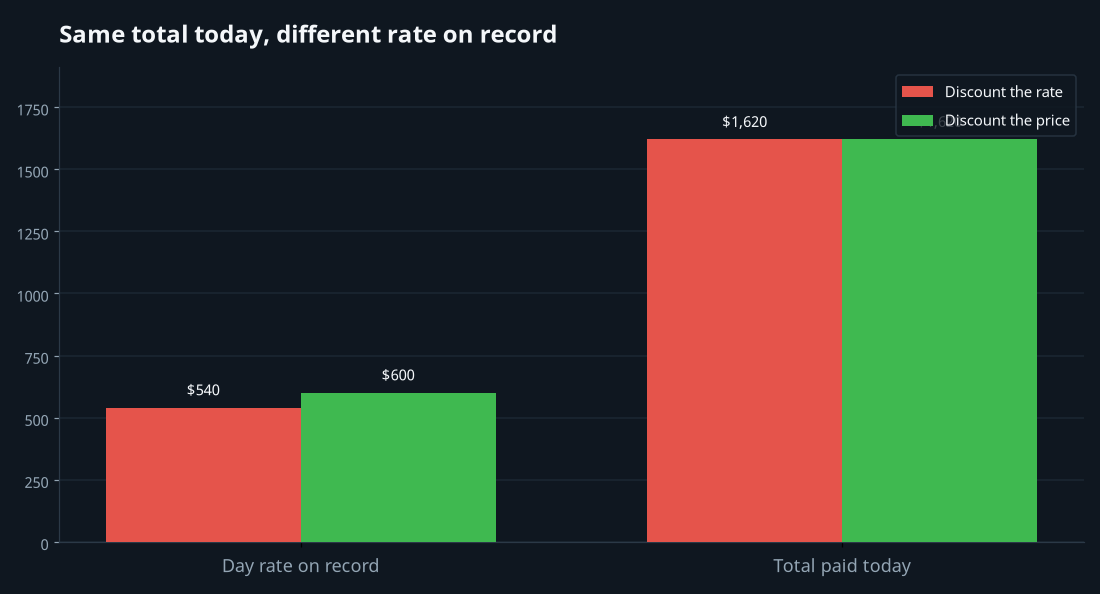
The wrong way is to quietly rewrite your day rate as $540 and bill three days at $540 = $1,620. Now the client has a document that says, in black and white, that your rate is $540. The next project, that's the number they'll expect. You haven't given a discount; you've redefined your price downward, permanently, and erased any evidence that you ever did them a favor.
The right way is to bill three days at your real $600 rate = $1,800, then add a separate line: "Loyalty discount −10% (−$180)." Total: $1,620. Same money today. But the document now tells a completely different story. It says your rate is $600, that you chose to extend a $180 courtesy, and that the favor is named and visible. Next time, the anchor is $600, and the discount is a thing you can grant again or not.
This is where the mechanics matter. In InvoiceFlow you add the discount as its own line item on the invoice, so the full value and the markdown both appear on the PDF. The client sees the real price, sees the reduction, and sees the total they actually pay. The professional version costs you nothing extra to produce and protects your rate for every future quote.
Anchoring: show the full value before you reduce it
Anchoring is the psychological principle that the first number a person sees shapes how they judge every number after it. If the first thing a client sees is $1,620, that's the value of the work in their mind. If the first thing they see is $1,800 with a visible $180 discount bringing it to $1,620, the work is worth $1,800 and they got $180 off. Identical cash, completely different perceived value.
This is why the line-item approach isn't just bookkeeping hygiene — it's persuasion. The discount line creates the anchor. It puts the full price on the page first, then the reduction, so the client's sense of what they received is calibrated to the higher number.
The same logic applies to estimates. When you send a client an estimate before the work, list everything at full price, then show any introductory or package discount as its own line. The estimate becomes a record of the real value of the engagement, with the discount clearly marked as a one-time or conditional concession. When that estimate converts to an invoice, the anchor and the favor travel with it.
Itemize generously, then discount
A related move: break the work into enough line items that the client sees the full scope of what they're getting before any reduction. A single line reading "Website — $4,000" is easy to haggle. Eight lines — discovery, wireframes, design, build, content migration, testing, launch, two weeks of support — totaling $4,000, then a $300 "package discount," is far harder to argue with, because the client can see exactly what each piece is worth. Itemizing is anchoring's quiet partner.
Conditional discounts: make them earn it
The healthiest discounts are conditional — the client gets the lower price only by doing something that's genuinely valuable to you. This reframes the discount from "my price was negotiable" to "you earned a reward by behaving in a way that helps my business." Three kinds are worth building into your standard offers.
1. Early-payment discount
Offer a small reduction — typically 1.5% to 3% — for payment within a short window, say seven days, against your normal 30-day terms. A common shorthand is "2/10 net 30": 2% off if paid within 10 days, otherwise the full amount due in 30. For a $2,000 invoice, that's $40 to get paid three weeks sooner — often a bargain when you weigh it against the cost and stress of chasing a late payer.
The early-payment discount is the cleanest conditional discount because it directly improves your cash flow, and it pairs naturally with the other side of the same coin: a late-fee policy. Together they form a carrot and a stick. Pay early, save a little; pay late, owe a little more. In InvoiceFlow you can present the early-payment incentive as a discount line or note on the invoice, and run a full late-fee policy for overdue balances — the reward and the consequence sit on the same document, both pointing the client toward paying on time.
2. Volume discount
Reward clients who buy more. A volume discount says: the more you commit to, the better the unit price — but only above a threshold you set. A copywriter might charge $150 per article for one to four articles, and $130 each from five up. A trades business might knock 5% off jobs over a certain size. The key is that the standard price stays standard; the discount kicks in only when the volume justifies it, and the client has to commit to the larger order to unlock it.
Show this on the invoice the same way: full quantity at full rate, then a "volume discount −X%" line. The client sees the per-unit value they'd pay at small scale, and the saving they unlocked by going big.
3. Bundle discount
Bundling reduces the price of a package below the sum of its parts, to nudge clients toward the bigger engagement. A photographer might price a shoot at $800 and an album at $400, then offer "shoot + album: $1,050" — $150 off the à la carte total. The bundle discount works because it's tied to a bigger sale, and because the client can see the standalone prices, so the saving is real and legible. Itemize the components, then show the bundle saving as a line. The anchor (full à la carte price) and the reward (bundle saving) are both visible.
When NOT to discount
The discounts above are healthy because they're either rewards for desirable behavior or one-time concessions clearly marked as such. Plenty of discounting is none of those things, and a discipline about when to refuse is as important as knowing how to frame a yes.
- Don't discount to win a client who only cares about price. A client who chose you because you were cheapest will leave the moment someone cheaper appears. You'll have spent your margin acquiring a relationship that has no loyalty in it.
- Don't discount reflexively at the first push-back. If you drop your price the instant a client hesitates, you teach them that hesitation is worth money. The next negotiation starts from your discounted number, and so does the one after that.
- Don't discount without getting something back. An unconditional discount is just a lower price wearing a costume. If you're going to reduce the number, attach a condition — faster payment, a bigger order, a testimonial, a case study, a referral, flexibility on timing.
- Don't discount your time to fill a slow week. It feels productive, but you've now set a precedent and a paper trail at the lower rate, and a slow week is temporary while a discounted rate lingers in the client's memory.
- Don't apply a "standing" discount that never ends. A discount that quietly renews every invoice isn't a discount anymore — it's your price, and you've lost the ability to grant it as a favor.
A useful test before every discount: can I name what I'm getting in return, and is the reduction visible as a favor rather than baked into the rate? If the answer to either part is no, you're not discounting — you're devaluing.
A worked example: the agency pitch
Dmitri runs a two-person branding studio in Prague. A promising client wants a full rebrand — logo, guidelines, stationery, a simple website — and Dmitri's honest price is €8,500. The client loves the work but says the budget tops out around €7,800.
The lazy move would be to email back "okay, €7,800" and quietly redo the math. Instead, Dmitri builds an estimate that itemizes everything at full value: strategy €1,500, logo €2,500, guidelines €1,500, stationery €1,000, website €2,000 — total €8,500. Then he adds two conditional lines. A "New-client launch discount −€400", granted on the condition that the studio can feature the project in its portfolio. And an early-payment note: 2% off the balance if the final invoice is settled within 10 days. The visible discount brings the headline to €8,100; the early-payment incentive can shave it closer to the client's number if they pay promptly.
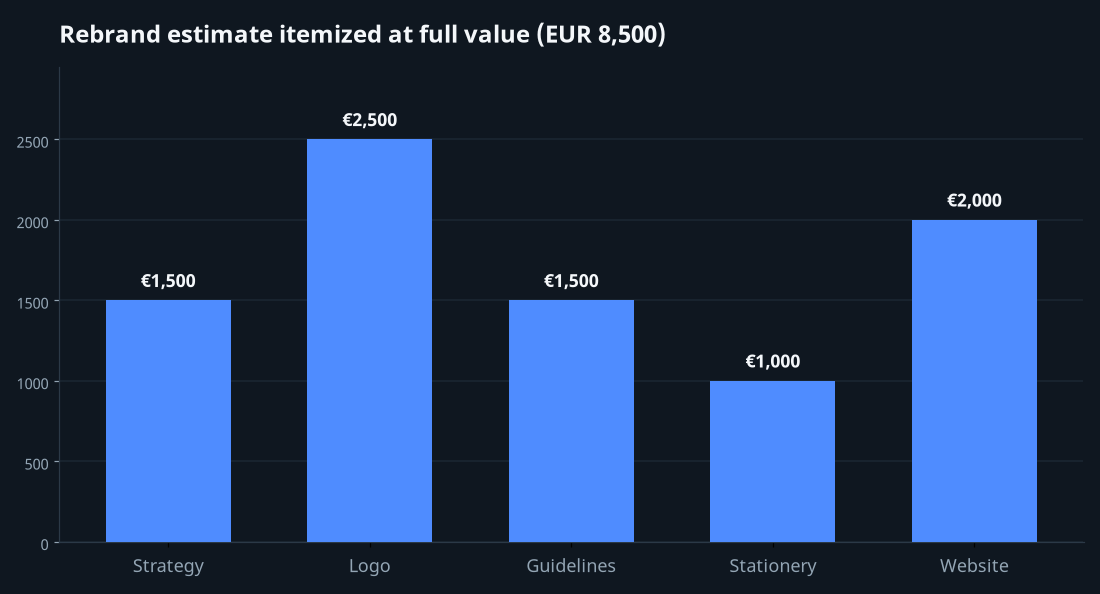
The client gets to their budget. But the document Dmitri sends — and the invoice it converts into — records a €8,500 engagement, a named €400 favor tied to a portfolio right he wanted anyway, and an early-payment reward that improves his cash flow. Next year, when the client comes back for a campaign, the anchor in both their minds is €8,500, not €7,800. Dmitri discounted without devaluing, and he got something for every euro he gave up.
The wider point
Discounting isn't the enemy. A blanket "never discount" rule costs you deals you could have closed cleanly. The enemy is the invisible discount — the one that lives in a rewritten rate, given for nothing, with no anchor and no condition, quietly resetting the client's expectation of what you cost.
Keep the full value on the page. Make the reduction a named line. Tie it to a behavior worth rewarding. Refuse the discounts that buy you nothing. Do that, and a markdown stops being a confession that your price was soft and becomes what it should be: a deliberate, professional gesture from someone whose work is clearly worth the full rate — and who chose, this once, to extend a favor.