Getting Paid Across Borders: Payment Methods, Fees, and the Invoice That Gets Paid
By the InvoiceFlow team — published 16 June 2026 — 12 minute read
Your best client this year might be in a country you've never visited, paying in a currency you don't hold, through a banking system that works nothing like yours. That's the upside of remote work: the market for what you do is now the whole planet. The downside is that getting the money from there to here is genuinely harder than getting paid down the street — not because the work is different, but because two banking systems, two currencies, and at least one exchange rate now sit between you and your fee.
The good news is that none of it is mysterious once you separate the three questions that actually matter: which rail does the money travel on, what does that rail cost (including the part nobody quotes you), and what has to be on the invoice so a foreign client can pay it without three rounds of "could you also send your…?". Get those right and a cross-border payment becomes routine. Get them wrong and you lose a slice of every fee to bad rates and a week of every project to back-and-forth.
First, the honest disclaimer about your tools
Let's be precise about what an invoicing app does and doesn't do here, because it's easy to expect magic. InvoiceFlow is not a payment processor, and it does not do live currency conversion. It will not move your euros to dollars, and it won't quote you today's rate. What it does is the documentation half: it lets you issue a clean, professional invoice in the right currency and the right language, with your payment instructions on it, so the client knows exactly what to pay and how. The actual money still travels through a bank or a transfer service that you and your client choose. Keep that division clear and you'll pick the right tool for each job — a transfer service for moving money, an invoicing app for the document that requests it.
The payment rails — and what each really costs
There are three broad ways money crosses a border to reach a freelancer or small business. Each has a personality.
Bank transfer / SWIFT
The traditional international wire. Your client's bank sends money to your bank, often hopping through one or two intermediary ("correspondent") banks on the way. It's universal and it works for large sums, but it has two sharp edges. First, intermediary fees: each bank in the chain can skim a flat charge, so a $2,000 invoice can arrive as $1,955 with no clear explanation. Second, the exchange rate your bank uses is usually mediocre, and you don't get to choose it. SWIFT is fine for big, infrequent payments where a $30–50 fee is noise against the total. It's a poor choice for a steady stream of small invoices, where the fixed fees eat you alive.
Transfer services (Wise / Payoneer-type)
A second category of service specializes in cross-border payments and tends to be cheaper and faster than a bank wire for the freelancer-sized amounts most of us deal in. The model varies, but the appeal is the same: clearer fees, exchange rates closer to the real "mid-market" rate, and often local receiving details so a client can pay you almost like a domestic transfer. For a designer in Manila billing a client in Berlin, this category is frequently the difference between keeping 97% of the fee and keeping 92%. (We're describing the category, not endorsing a specific provider — compare current fees and availability for your countries before you commit.)
Local rails and cards
Sometimes the cheapest path is the most local one. If your client is in a country with a strong domestic instant-payment system and you can receive into it, a "local" transfer can be near-free and instant. Card payments are convenient for the client but carry processing fees you'll either absorb or pass on. The lesson isn't that one rail is always best — it's that the right rail depends on the country pair, the amount, and how often you'll be paid. A recurring monthly retainer deserves a different setup than a one-off project.
The fee everyone forgets: the FX spread
Here's the cost that quietly does the most damage, because it's invisible. When money is converted from one currency to another, the rate you're given is almost never the true "mid-market" rate you'd see on a search engine. The gap between the real rate and the rate you actually get is the FX spread, and it's a hidden margin baked into the conversion. A provider can advertise "no fees" and still make 2–4% on the spread alone.
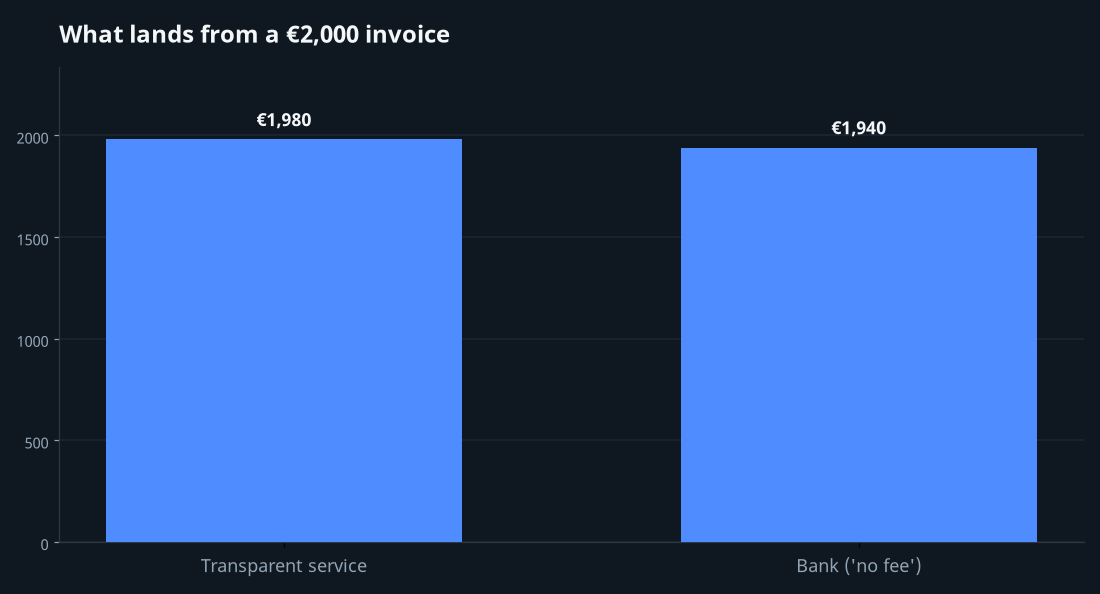
Consider a €2,000 invoice. A transparent service might take a small, stated fee and convert near the mid-market rate, costing you maybe €15–25 all-in. A bank advertising "free incoming transfers" might give you a rate 3% worse than mid-market — €60 gone — plus an intermediary fee, and call it free. Same invoice, very different take-home. The rule that protects you: compare the total amount that lands in your account, not the advertised "fee." The spread is where the real money is lost, and the only way to see it is to look at what actually arrives.
Who pays the fees — decide it up front
Cross-border transfers raise a question domestic ones rarely do: who absorbs the fees? If you invoice $2,000 and your client sends $2,000, but $45 evaporates in transit, you've been paid $1,955. Decide and state this before the work, not after the shortfall appears. Common approaches: build an estimate of fees into your rate; ask the client to send an amount that nets you the invoice total; or simply accept small fees as a cost of doing international business. Any of these is fine — what's not fine is being surprised, because a "surprise" $45 shortfall on every invoice is a real and recurring loss.
What goes on a cross-border invoice
A domestic invoice can get away with being a little casual; the client knows your system and can fill gaps with a quick call. An international invoice can't. The client is in another time zone, may not speak your language fluently, and their accounts department will pay exactly what the document tells them to and nothing more. A complete invoice is the difference between getting paid in three days and getting paid after a fortnight of clarifying emails. Here's the checklist.
- The currency — stated explicitly. "$2,000" is dangerous: which dollar? US, Canadian, Australian, Singapore? Always pair the amount with the currency code (USD, EUR, GBP) so there's zero ambiguity. In InvoiceFlow, each invoice is issued in its own currency with correct formatting, so the document itself is unambiguous about what you're asking for.
- Full bank / payment details. For an international wire that means more than an account number: the IBAN where applicable, the SWIFT/BIC code, the full bank name and address, and the exact account-holder name. Missing any one of these is the single most common reason a foreign payment stalls. Whatever your method — bank details, a payment link, or a QR code — put the instructions on the invoice so the client never has to ask. InvoiceFlow can display those payment instructions directly on the document.
- Your tax / VAT identifiers — and theirs. Cross-border B2B work often hinges on tax IDs: your VAT/tax number, and frequently the client's, drive whether tax is charged, reverse-charged, or zero-rated. Even when no tax applies, a B2B client's accounting may require the IDs on file before they can release payment. Put the relevant identifiers on the invoice.
- Clear due terms and a date format that can't be misread. "Due 30 days" is clearer than a bare date, and if you do write a date, prefer an unambiguous form (e.g. spell the month) — because 03/04 is March 4th to an American and April 3rd to most of the rest of the world. Spell out the payment terms so there's no cultural guesswork.
- The client's language and address, done properly. An invoice a client can actually read gets paid faster. This is where issuing the document in their language and formatting their address correctly pays off — see the next section.
Speak the client's language — literally
Two features turn a generic invoice into one that feels native to the client's country, and both matter more for getting paid than they look.
First, per-invoice locale. In InvoiceFlow the language of the PDF is set per invoice, independent of the language you run the app in. So you can work in English and still issue a single invoice in French, German, or Japanese for a specific client — the document's labels and formatting come out in their language. An accounts clerk in Munich who receives an invoice in German doesn't have to translate it before processing it, and "we couldn't read it" stops being a reason for delay. (PDFs render correctly in non-Latin scripts too — Cyrillic, Arabic, CJK — using bundled fonts, so a Japanese or Arabic invoice looks right, not like mojibake.)
Second, country-aware address fields. Addresses are not universal: the labels, the order, and even which fields exist differ by country. Some countries don't use a "region/state" field at all; postal-code formats vary wildly. InvoiceFlow's address fields adapt to the country — covering 199 of them — with region and postal labels that change per country, and hiding fields that a given country doesn't use. A correctly formatted address isn't cosmetic; for cross-border shipping and for some tax determinations it's load-bearing, and it signals to the client that you actually do business internationally.
A worked example
Sofia is a UX researcher in Lisbon. A SaaS company in Toronto hires her for a two-month engagement at CAD 9,000. Here's the cross-border thinking, start to finish.
Currency. She invoices in CAD, not euros, because that's what the client budgeted and it spares them a conversion decision. The invoice states "CAD 9,000" with the code, so there's no "which dollar?" ambiguity. The app issues it in Canadian-dollar formatting.
Language and address. The client's office is in Toronto, so she issues the PDF in English with a correctly formatted Canadian address (province and the right postal-code style). It reads as a domestic invoice to the Toronto accounts team, not a foreign curiosity.
Rail and fees. Rather than a SWIFT wire that might shave CAD 40–60 off each payment and deliver a poor rate, she sets up a transfer-service account that gives her local-style receiving details and a near-mid-market rate. She splits the CAD 9,000 into a 40% deposit and 60% on delivery, and decides up front to absorb the modest transfer fee rather than nickel-and-dime a good client. She notes the payment terms — "Net 14, CAD" — plainly on each invoice.
Instructions on the document. Her receiving details sit right on the invoice, so the Toronto team pays without a single follow-up email. Deposit lands in two days; the balance the same way on delivery. Total lost to fees and spread: under 1%, because she chose the rail deliberately and let the invoice do the explaining.
Notice the app's role and its limits. It made the document correct, clear, in the right currency, in the right language, with the instructions on it. It did not move the money or convert anything — the transfer service did that. That's exactly the right division of labor.
The recurring international client
If a foreign client becomes a regular — a monthly retainer, an ongoing subscription — the cross-border setup is worth optimizing once and then forgetting. Pick the cheapest reliable rail for that specific country pair, agree who covers fees, and lock the currency. InvoiceFlow's recurring schedules can then auto-generate each month's invoice on cadence with correct sequential numbering, each one issued in the agreed currency and the client's language, with the same payment instructions every time. The hard thinking happens once; after that, getting paid from abroad is no more effort than getting paid at home.
The short version
Cross-border payment isn't hard once you stop treating it as one problem and see it as three. The rail determines speed and base cost — match it to the country pair and the frequency, and don't default to a SWIFT wire for small, regular sums. The fees include a hidden FX spread that "no-fee" marketing conveniently ignores — judge a service by what actually lands in your account, and decide up front who absorbs the cost. The invoice has to be complete and legible to a foreigner — explicit currency code, full payment details, tax IDs, unambiguous terms, and ideally the client's own language and a correctly formatted address.
An invoicing app can't do the first two for you — it doesn't move money or set exchange rates, and you shouldn't trust any document tool that claims it does. But it can make the third effortless: a clean invoice in the right currency and language, with your payment instructions on it, ready for a client on the other side of the world to pay without a single email. Handle the rail and the fees with eyes open, let the invoice carry the rest, and the whole planet becomes your customer base.