 EN
EN  العربية
  Български
  Čeština
  Dansk
Dansk  Deutsch
  Ελληνικά
  Español
  Suomi
Suomi  Français
  עברית
עברית  हिन्दी
  Bahasa Indonesia
  Italiano
  日本語
日本語  한국어
한국어  Bahasa Melayu
  Nederlands
  Norsk
Norsk  Polski
  Português
  Română
  Русский
  Svenska
  Kiswahili
  ไทย
ไทย  Türkçe
  Українська
  Tiếng Việt
  中文
中文 How I Grew My Lawn Care Business From 12 Clients to 55 — With a Billing System That Actually Scaled
By David Kim, Owner — Emerald Lawn & Landscape, Dallas, TX
I started mowing lawns when I was nineteen. I did it summers between semesters, then full-time after I decided college wasn’t for me. By the time I was twenty-three I had twelve residential clients, a truck, and a trailer. By the time I was twenty-eight I had forty clients, three employees, and a problem I had not anticipated: the way I was billing simply did not work at scale.
At twelve clients, billing informally was manageable. I sent texts at the end of the month. Cash appeared. Checks arrived. A few Venmo payments came through. It was chaotic but contained. At forty clients, the same approach consumed entire Monday evenings. I was sending texts to forty different people, tracking who had paid in a notebook, and following up with late payers in person because I had no systematic way to do it.
Then the commercial accounts started calling. And that’s when I understood that my billing problem was also a growth ceiling.
The Commercial Opportunity I Almost Couldn’t Capture
The first commercial call came from a property manager who had seen my trucks working in a residential neighborhood where I had several clients. She managed six commercial properties in the area and was unhappy with her current landscaping service. She wanted a quote for monthly maintenance on all six.
I gave her the quote. She liked the number. Then she asked how I handled invoicing for commercial properties.
I told her I would send invoices monthly. She asked what format. I said I would email them. She asked if I could include her property management system’s reference codes on each invoice, and if my invoices had a formal invoice number and payment terms. I said yes — and then went home and spent two days figuring out how to actually deliver what I had just promised.
My Google Docs invoices did not have invoice numbers. They did not have payment terms. They had no field for reference codes. I built a template from scratch, realized I was spending time I did not have, and started looking for an invoice app that would let me manage this properly.
Finding InvoiceFlow
I found InvoiceFlow through a recommendation in a landscaping business group. I downloaded it and set up my business in about ninety minutes. I created my service catalog: weekly lawn maintenance, bi-weekly maintenance, monthly maintenance, spring cleanup, fall cleanup, aeration, overseeding, irrigation inspection, installation project management. I assigned prices to each. I created a standard commercial invoice layout with a field for property reference codes.
I was ready to invoice the property manager before the first maintenance visit.
Recurring Billing: The Change That Saved Me Monday Evenings
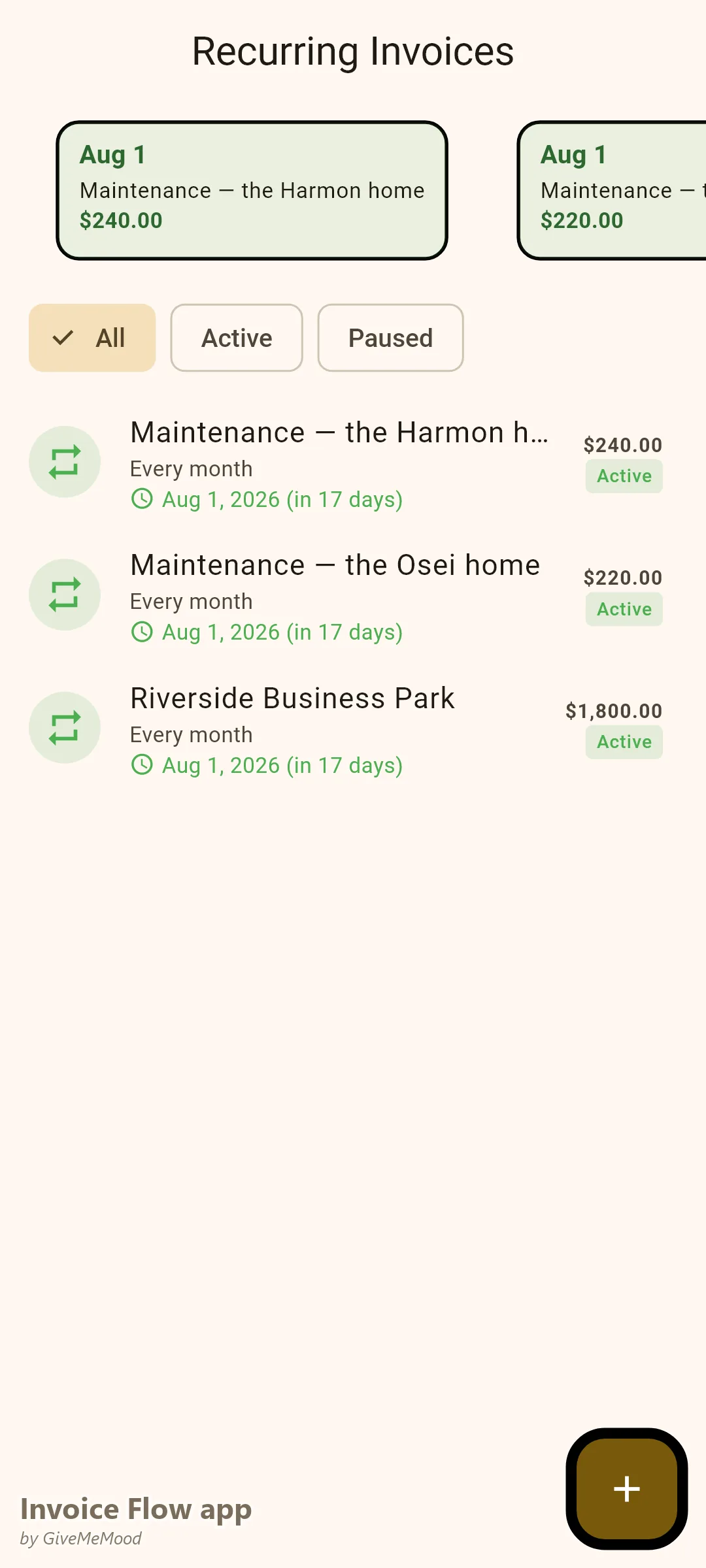
The most immediately impactful change was setting up recurring invoices for my residential clients. Instead of texting forty people at the end of each month and tracking responses in a notebook, each client has a recurring invoice in InvoiceFlow that generates automatically and delivers to their email on the first of the month.
The time savings was significant. What had been a three-to-four-hour Monday evening became nothing. The invoices go out. Clients pay them. The occasional late payment shows up clearly in the app as an unpaid invoice, and I send a follow-up from within InvoiceFlow in about thirty seconds.
The other improvement was client clarity. Several of my long-term residential clients mentioned that they appreciated receiving a consistent, professional invoice each month instead of a text. Two of them referred new clients specifically because they had shown the invoice to a neighbor who was looking for a landscaping service and the professionalism had made an impression. One referred client told me at the initial meeting that she had hired me partly because of how organized her neighbor said I was.
Professional billing generates referrals. That was not something I had expected.
The Commercial Property Portfolio
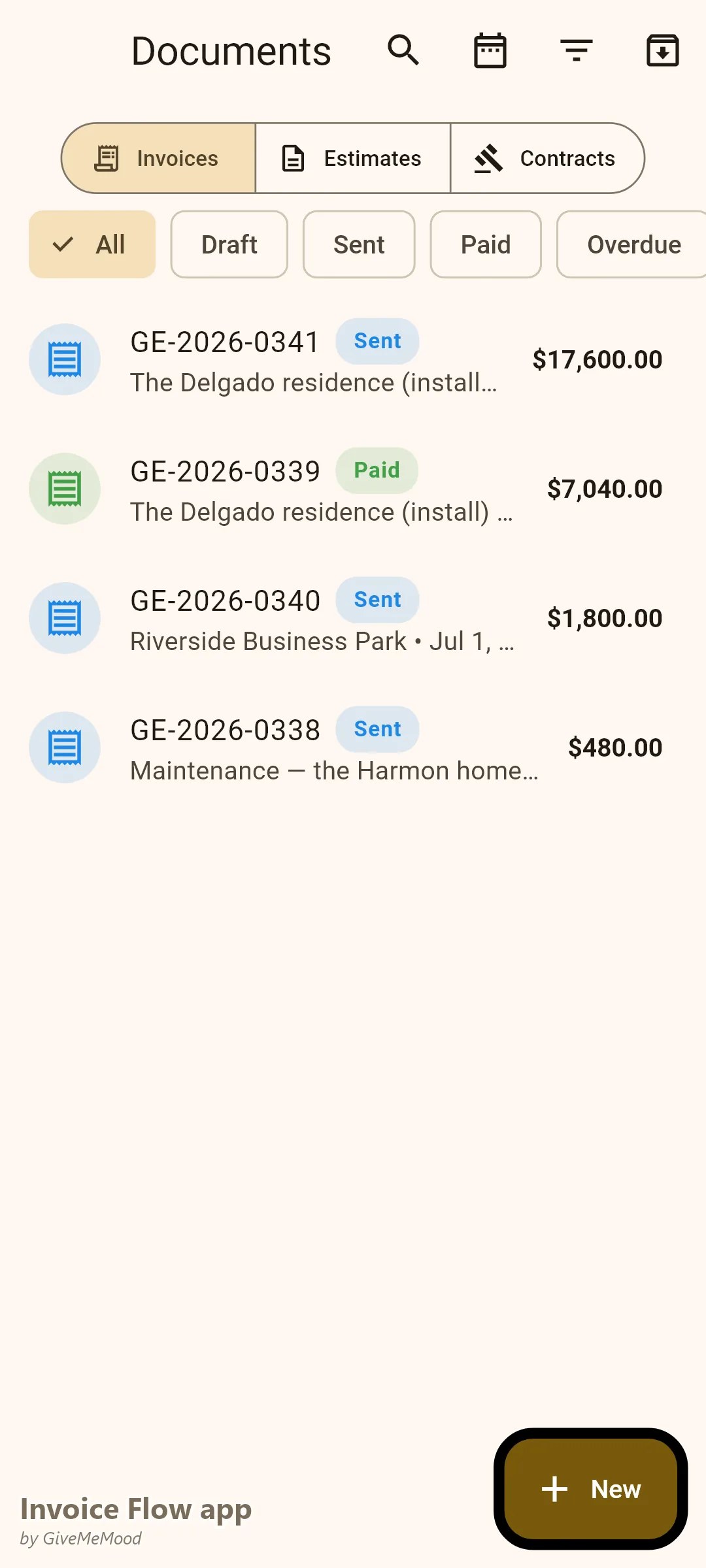
The property manager account became real. I now maintain all six of her properties under monthly maintenance contracts. Each property has its own recurring invoice with the property code she provided: “Grounds Maintenance — Lakewood Office Center, May 2026 — Contract Ref: MAINT-LWD-2026: $1,400.” She has three sets of eyes across her office who review the invoices — her, her assistant, and her company’s central accounts payable. Every invoice passes without a single request for revision.
Contrast this with what I found out was happening with the landscaping company she had fired before me: they sent invoices via email with no invoice numbers, no reference codes, and totals that varied from month to month without explanation. Their average payment time was 60 days because her AP kept requesting documentation that never arrived. My average payment time on this account is 18 days.
Getting paid faster is not a coincidence. It is a direct result of giving clients the documentation they need to process your invoice on their first review.
HOA Contracts: The Paperwork-Intensive Account Type
I added my first HOA contract two seasons ago. A homeowner’s association managing 280 homes in a suburban development put out a request for proposals for common area maintenance. I won the contract. It is the largest single account I have ever had.
HOA contracts require formal invoicing on a different level than residential or even standard commercial. The HOA board reviews invoices in their monthly meeting. Everything needs to be documented: what work was performed, on what dates, at what cost. Any deviation from the contracted scope — additional work requested by the board, supply-related adjustments, weather-related service changes — needs to be reflected in the invoice with explanation.
I manage all of this through InvoiceFlow. The base monthly invoice goes out on the first: “Common Area Grounds Maintenance — April 2026 — Per Contract HOA-2026: $3,800.” If there was additional work, a supplemental line item is added: “Irrigation System Spring Startup — Requested by Board April 4: $280.” The board sees exactly what happened. There are no questions at the monthly meeting about what they are paying for. The invoice is its own meeting note.
Installation Projects: The High-Value Work I Was Underinvoicing
My business has two revenue streams: recurring maintenance and installation projects. Maintenance is predictable monthly revenue. Installation is where the larger single invoices come from — landscape design and construction, hardscape, drainage, planting projects for both residential and commercial clients.
Before InvoiceFlow, I was underinvoicing my installation work in two specific ways. First, I was not documenting materials properly. A $12,000 residential installation project would get a single-line invoice: “Landscape Installation — 123 Oak Street: $12,000.” No breakdown. No material itemization. No labor line. When clients asked what they were paying for, I had to go back to my notes and explain verbally.
Second, I was not consistently taking deposits. I would start ordering materials — sometimes spending $3,000-$4,000 with nurseries — before the client had paid anything. If a project fell through for any reason, I had exposure.
Now every installation project starts with a deposit invoice at contract signing. A $14,000 project gets a deposit invoice for 40%: $5,600. Materials are ordered after the deposit is paid. I have never had to absorb material costs from a failed project since implementing this.
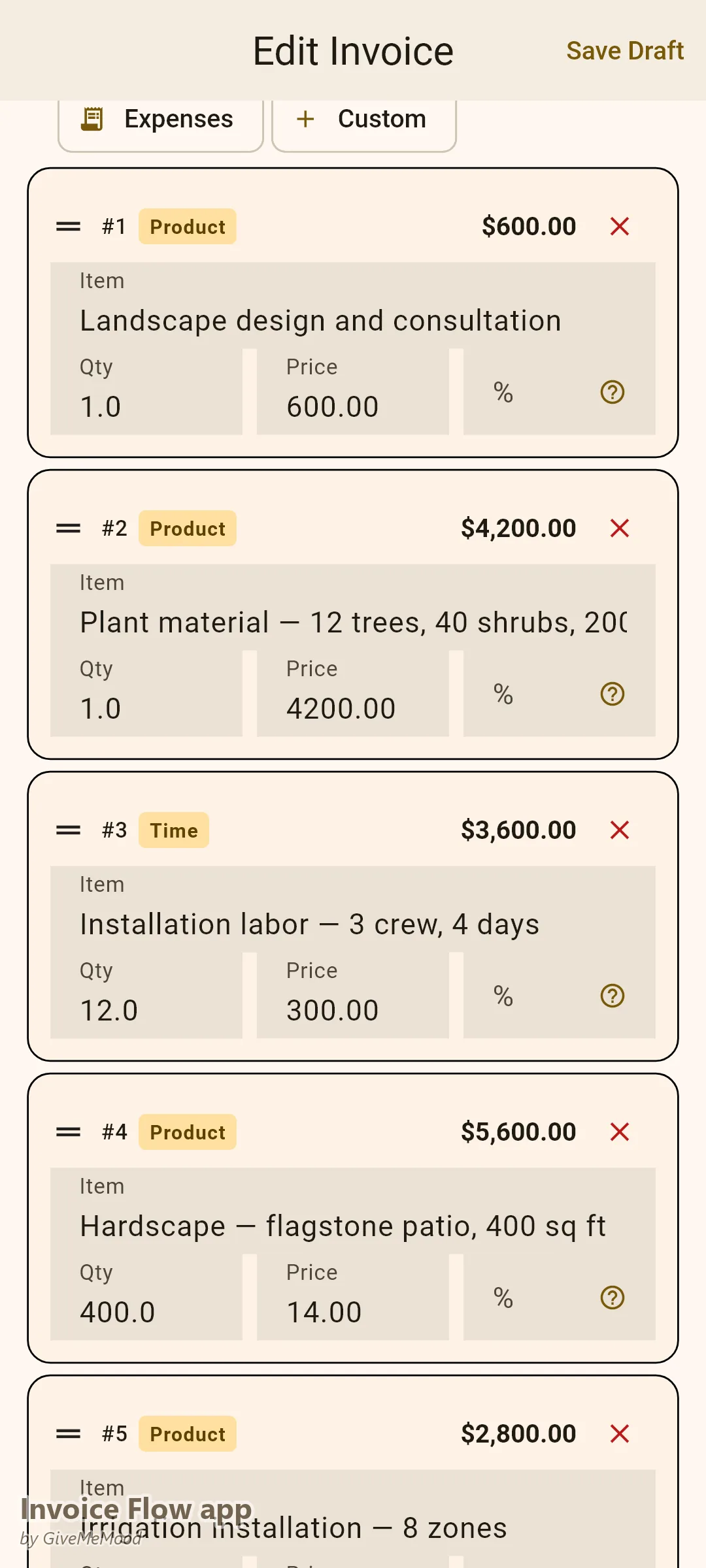
The full installation invoice at completion looks like this: Plant Material — 8 ornamental trees, 32 shrubs, 180 perennials: $4,200; Installation Labor — 3 crew, 3 days: $3,600; Hardscape — Natural stone edging, 180 linear feet: $2,400; Soil amendments and mulch: $800; Irrigation — 4-zone drip system: $2,800. Total: $13,800. Deposit Paid: $5,520. Balance: $8,280.
Every line is visible. The client has been watching this invoice build since the project started. There are no surprise totals.
Seasonal Services: Capturing Revenue I Used to Leave on the Table
Spring cleanup. Fall leaf removal. Aeration and overseeding. Pre-emergent weed treatment. These seasonal services are additional revenue opportunities that I used to handle informally — calling clients to ask if they wanted them, getting verbal agreements, billing whenever I got around to it.
Now I have templates for each seasonal service in InvoiceFlow. When spring arrives, I generate a spring cleanup invoice for every maintenance client who opted in: “Spring Property Cleanup — Dethatching, bed cleaning, mulch refresh, blowing: $320.” Sent to 38 clients in about twenty minutes. Opt-in rate is around 60%. The services are scheduled. The billing goes out before the work is done, so I know exactly which days are committed.
Seasonal service revenue is now a meaningful and predictable add-on to my maintenance base.
What the Business Looks Like in Year Six
My business now has 55 residential maintenance clients, six commercial property accounts, one HOA contract, and a consistent installation project volume. My annual revenue is more than double what it was before I implemented professional invoicing.
I cannot attribute all of that growth to billing. My crews do excellent work. My materials suppliers are reliable. I have built relationships that took years to develop. But the billing infrastructure enabled the commercial accounts and the HOA contract, which represent a significant portion of the revenue growth. Without professional invoicing, I would not have gotten past the initial conversation with the property manager who became my first commercial client.
I also spend zero time on billing anxiety. Zero Sunday evenings wondering who has paid and who has not. Zero awkward conversations about collecting. The invoices go out. The payments come in. The late payers get automated reminders. I spend my time on the business, not on chasing paperwork.
For any landscaping company owner who is still texting clients and billing from a notebook: the system change is one afternoon of setup. The payoff is every Monday evening you get back, every commercial account you can now credibly pitch, and every installation project where your deposit arrives before your material order goes in.
David Kim is the owner of Emerald Lawn & Landscape in Dallas, Texas, operating since 2019 with residential, commercial, and HOA maintenance contracts and installation services throughout the Dallas–Fort Worth metro area.