
 EN
EN  العربية
  Български
  Čeština
  Dansk
Dansk  Deutsch
  Ελληνικά
  Español
  Suomi
Suomi  Français
  עברית
עברית  हिन्दी
  Bahasa Indonesia
  Italiano
  日本語
日本語  한국어
한국어  Bahasa Melayu
  Nederlands
  Norsk
Norsk  Polski
  Português
  Română
  Русский
  Svenska
  Kiswahili
  ไทย
ไทย  Türkçe
  Українська
  Tiếng Việt
  中文
中文 How I Turned My Tree Service Into a Business Insurers Actually Want to Work With
By Tom Rodriguez, Owner — Canopy Tree Service, Nashville, TN
I have been doing tree work since I was twenty-two. I started as a ground crew member for a larger company, got my climbing certification, worked my way up to crew lead, and eventually went out on my own with a truck, a chipper, and enough reputation in the neighborhood to keep the phone ringing. That was eight years ago. The tree work itself has never been the problem. The money side of it — specifically the documentation side — took me years longer to get right than it should have.
The moment that crystallized the problem happened on a Thursday night in October, five years ago, when a severe storm came through Nashville and knocked trees down all over the city. I spent the next four days doing emergency removals from dawn to dark. Eighteen jobs. Six crews of two. Trees on roofs, trees across driveways, trees that had fallen through fences and garages. It was the busiest week of my business life.
At the end of that week, I was physically exhausted and financially confused. I had a rough sense of what I had invoiced — mostly amounts I had typed into my phone as text messages, or verbal agreements I had made on-site while the homeowner was panicked about their roof. When I tried to reconcile the week’s work, I could not. I had the amounts for about twelve of the eighteen jobs. The other six were guesses.
Then the insurance calls started.
What Storm Response Insurance Billing Actually Requires
When homeowners file insurance claims for storm damage, their insurer sends an adjuster who reviews the claim. Part of that review involves the documentation from service providers — in my case, me. The insurer needs an itemized invoice that shows exactly what work was performed, what equipment was used, what the emergency callout charge was, and how the hours break down.
My text message confirmations were not documentation. My handwritten notes on a legal pad were not documentation. Three of my eighteen emergency jobs were delayed for weeks because the homeowner’s insurer could not process my “invoices” through their claims system. One adjuster called me directly and told me, politely but clearly, that if I wanted to continue getting insurance referrals I would need to start sending proper documentation.
That call was the push I needed.
I calculated the cost of my documentation failures during that one storm week: three delayed jobs added an average of 34 days to payment, and I had absorbed one job entirely because I genuinely could not reconstruct what I had charged. The following month I downloaded InvoiceFlow and rebuilt my billing from the ground up.
What Tree Service Billing Actually Needs
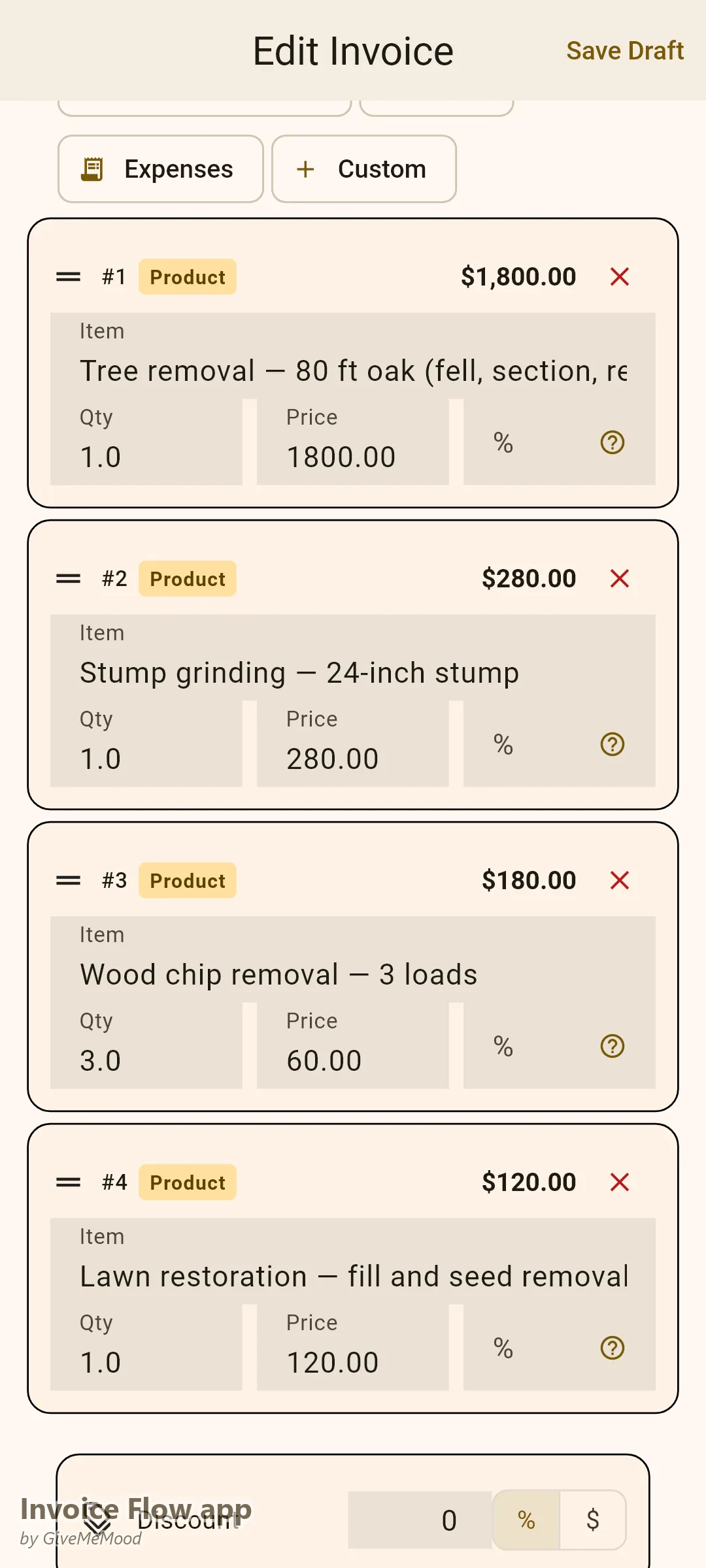
Before I could fix the billing, I needed to think clearly about what different types of tree work actually required in terms of documentation. I broke it down:
Emergency storm response is different from scheduled removal. Emergency work commands a premium — early morning callouts, weekend work, the surcharge for responding within four hours — and those premiums need to be visible on the invoice. An insurer processing a claim needs to see the base rate and the emergency supplement as separate line items.
Scheduled tree removal is different from trimming. A removal has multiple components: felling and sectioning the tree, hauling the debris, grinding the stump, restoring the area. Each of these is a separable service that clients sometimes add or remove from the scope. They need to appear as line items.
Arborist consulting is a professional service that I had been giving away. For eight years I did “free estimates” that sometimes took two hours, required climbing or at minimum careful assessment of multiple trees, and represented genuine professional expertise. I had been treating all of this as marketing overhead. It is not.
Commercial and municipal work is fundamentally different from residential. A commercial property manager or a city parks department wants formal invoices with their purchase order references, their account codes, and net payment terms. They do not pay cash. They do not pay Venmo. They have processes, and your invoice needs to fit those processes.
Rebuilding in InvoiceFlow
Setting up InvoiceFlow for a tree service is straightforward but requires thinking through your pricing structure first. I set up:
Standard tree removal categories by size: small (under 30 feet), medium (30–60 feet), large (60+ feet), and emergency surcharge rates for each. I set up stump grinding as a separate line item by stump diameter. I set up debris hauling by load. I set up arborist consultation as a fixed fee with a credit provision if the client proceeds with work.
I set up emergency callout as a flat supplemental fee. I set up equipment rental pass-through lines for jobs that require crane or elevated platform access.
The whole setup took about an hour and a half. Every job type I do has a corresponding set of items I can put on an invoice in about three minutes on my phone.
Storm Response Billing: The Transformation
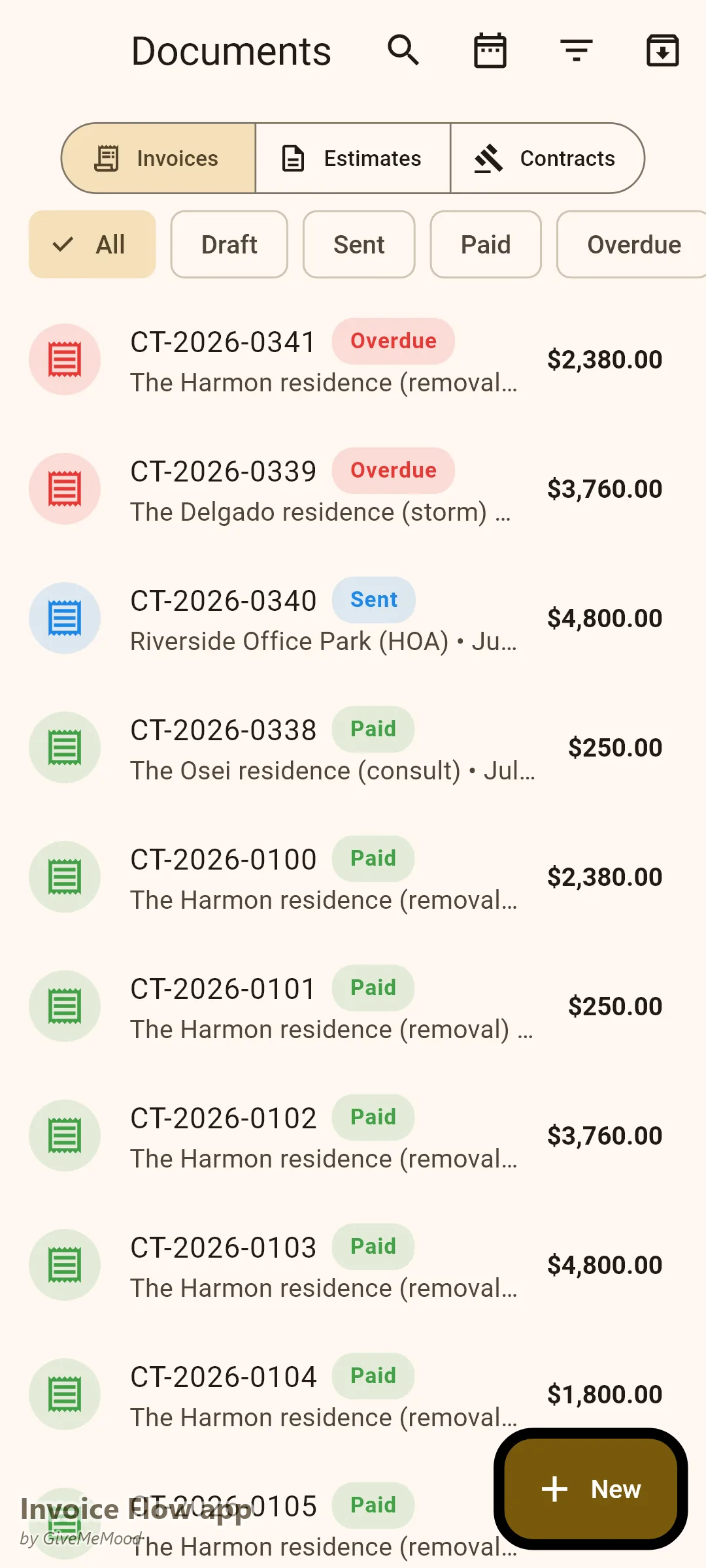
The next major storm season, I was ready. A significant weather event came through the area in the spring and I had twelve emergency jobs over a weekend. Every single one was invoiced from my phone before I left the site.
A typical emergency roof clearance invoice: Emergency Tree Removal — 60ft Oak, storm damage, roof impact — Emergency Response Callout: $280; Tree Felling and Sectioning: $1,200; Debris Removal — 4 loads: $320; Temporary Tarp Application — 200 sq ft: $80; Emergency Overtime — Saturday: $160. Total: $2,040.
The homeowner received the invoice via email within minutes of job completion. When they filed their insurance claim, the adjuster had a professional document to work with. The payment on that job came in 16 days. The equivalent informal documentation during the previous storm had taken 60+ days.
Three of the homeowners from that spring storm event referred me to a roofer they were working with for the damage repairs. That roofer now sends me storm referrals on a regular basis — specifically because he told me that I am “the tree service that makes the insurance paperwork easy.” I have never had a roofer referral relationship before. It came directly from the quality of my billing documentation.
Arborist Consultation: Charging for What I Know
The other major change was charging for arborist consultations. I offer two types: a standard assessment where I walk the property and assess tree risk, health, and recommended work, and a formal written risk assessment that includes a report clients can use for HOA approvals or insurance purposes.
My standard assessment fee is $150, credited against any work that proceeds within 60 days. My formal written risk assessment is $350, also credited if work follows.
The first few times I sent a consultation invoice, I expected pushback. Not one client has refused to pay the consultation fee. Several have specifically mentioned that the professional fee made them take the assessment more seriously. And the credit provision — the fact that the consultation cost comes off the work invoice if they proceed — means that for clients who become full-service customers, there is no net cost. I am only collecting the fee from clients who use my professional time and expertise but do not proceed with work.
This is exactly what consultation billing is supposed to do.
Large Job Deposits: Protecting My Equipment Reservations
For jobs that require renting specialty equipment — cranes for large removals, elevated platforms for canopy work — I now require a deposit at the time of scheduling. A deposit invoice: “Tree Removal — 85ft Silver Maple, front property — 35% deposit: $1,050.” Equipment reserved. Crew day blocked. Subcontractors coordinated.
Before deposits, I had twice rented equipment for a scheduled large removal only to have the client call the morning of the job to reschedule. Equipment rental does not refund for late cancellation. I absorbed those costs. With deposits, the client has financial skin in the game. Large job cancellations have not happened since I implemented the deposit system.
Municipal and Commercial Work: A Different Game
About three years ago I bid on and won a contract to maintain trees on a commercial property campus — about 140 trees across twelve acres, with annual maintenance, quarterly assessments, and storm response on retainer. This was the largest contract I had ever had.
The procurement process required formal business documentation, insurance certificates, and — critically — an invoice format that would work with their accounts payable system. They needed invoice numbers, net-30 payment terms, their purchase order reference on each invoice, and itemized work descriptions that matched their contract scope.
InvoiceFlow handled all of this. The annual maintenance contract invoice goes out quarterly: “Campus Tree Maintenance — Q2 2026, April–June — Per Contract REF: FM-TREES-2026: $4,800.” Any work outside the contract scope gets a supplemental invoice referencing the same contract. When storm damage hits the campus, the emergency response invoice follows immediately with the storm rate and equipment costs.
This account has now been renewed twice. Both times the facilities director mentioned that the invoicing is “exactly what they need.” This is one of the primary reasons they renewed.
What Year Eight Looks Like
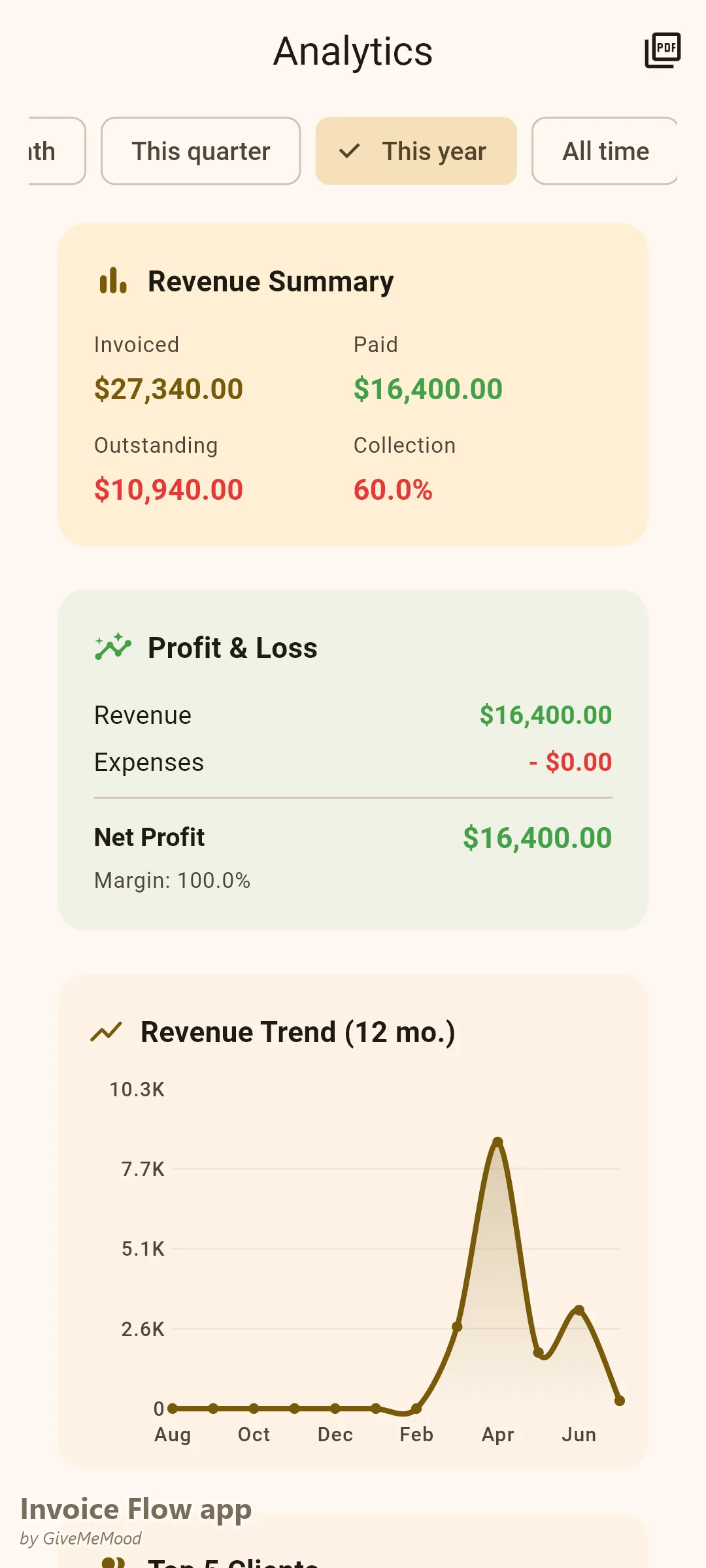
My business is in its eighth year. I have residential work, commercial maintenance contracts, a municipal parks department service agreement, and an insurance referral network that generates consistent storm response business. My annual revenue is more than three times what it was when I sent that informal text message billing for the storm jobs five years ago.
I cannot attribute all of that growth to billing. The work has to be excellent. The crew has to be reliable. The phone has to be answered. But the billing infrastructure was the gate that kept me from the commercial and municipal opportunities I now have. Without documentation that meets their standards, those clients would not have considered me.
For tree service owners who are still billing informally: the insurance adjusters are a good barometer. If your invoices are not getting accepted cleanly by insurance claims departments, they are also not going to get accepted cleanly by commercial and municipal procurement offices. The fix is the same for both.
Download InvoiceFlow. Set up your service categories with emergency rates. Create your arborist consultation fee. Issue your first storm response invoice on-site before you start your truck.
Tom Rodriguez is the owner of Canopy Tree Service in Nashville, Tennessee, serving residential, commercial, and municipal clients with tree removal, trimming, and certified arborist consulting services.