 EN
EN  العربية
  Български
  Čeština
  Dansk
Dansk  Deutsch
  Ελληνικά
  Español
  Suomi
Suomi  Français
  עברית
עברית  हिन्दी
  Bahasa Indonesia
  Italiano
  日本語
日本語  한국어
한국어  Bahasa Melayu
  Nederlands
  Norsk
Norsk  Polski
  Português
  Română
  Русский
  Svenska
  Kiswahili
  ไทย
ไทย  Türkçe
  Українська
  Tiếng Việt
  中文
中文 The Skincare Business That Finally Makes Sense: My Journey from Cash Chaos to Predictable Income
By Lauren Hayes, Licensed Esthetician & Skincare Studio Owner — Denver, CO
I became an esthetician because I love skin. I love the science of it, the transformation possible with consistent treatment, the relationship that develops when someone trusts you with their face for years. What I did not love — what I was not trained for, what nobody at esthetics school mentioned — was billing.
For the first four years of my practice, I handled my finances the way most estheticians do: clients paid at the end of each appointment. Cash, Venmo, sometimes a check. I kept a spreadsheet. I had a vague sense of my monthly income. My tax preparer every April would ask me questions I could not fully answer, and I would hand over a folder of half-organized receipts and hope for the best.
The problem was not the individual appointments. Those were manageable. The problem was everything else: the skincare package series I sold, the monthly membership I wanted to launch, the corporate wellness events I was being asked to do, the product retail that was generating meaningful income I was not tracking. The informal system that worked for a single treatment room was actively failing me as my practice grew.
The Treatment Package That Disappeared
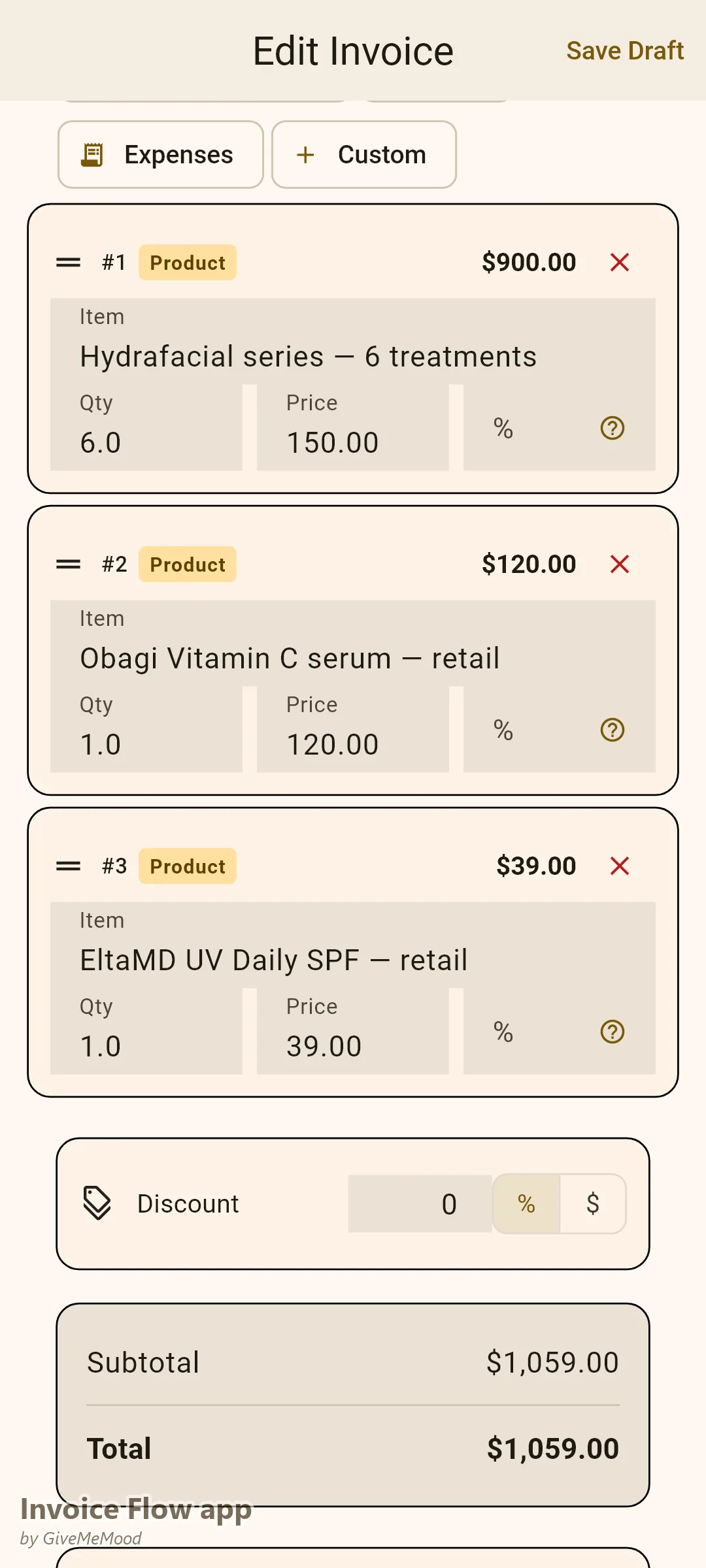
The breaking point came in a way I should have seen coming. A client — a longtime member of my practice, someone who had been coming to me for three years — purchased a six-treatment Hydrafacial series. We agreed on the price verbally. I wrote it on a sticky note, she paid the first two treatments upfront, and we moved forward.
Four treatments in, she disputed what she owed for the remaining two. She remembered a different price. I had the sticky note; she had a text conversation with a slightly different number I had apparently quoted early in our negotiation. We went back and forth. It was uncomfortable. I ultimately reduced the amount to end the conflict.
The money I lost was not the real cost. The real cost was the relationship. She has not been back since. A three-year client, gone because I did not have a professional document both of us had signed off on.
I had sold probably forty treatment packages over three years with no formal invoicing. I had been lucky until that day. After it, I was done with luck.
Understanding What My Business Actually Needed
I spent an evening mapping out everything I billed for. It was more complicated than I had realized:
Individual treatments: Regular facials, specialty facials, chemical peels, waxing. These were the easy ones — pay at appointment end.
Treatment package series: Six or twelve treatments sold as a package for a discount. These required upfront payment or payment plans, which required documentation.
Monthly membership: I had been wanting to launch a membership program for two years but kept putting it off because I could not figure out how to handle the recurring billing. Twenty clients on a monthly auto-bill felt administratively impossible.
Corporate wellness events: I had done four of these over the past year — companies that wanted mini facials or skincare consultations for employee appreciation events. Two of them were small businesses that paid cash. Two were larger companies that needed to process my payment through accounts payable. I had sent them spreadsheets. One paid in 55 days. One asked me to resubmit because my “invoice” did not have the right fields.
Product retail: I sell professional-grade skincare products — serums, SPFs, moisturizers, treatment masks — from my treatment room. My product sales were somewhere between $400 and $700 most months. I was tracking them as “misc cash” in my spreadsheet.
Everything except the individual appointments needed a better system.
Setting Up InvoiceFlow
I downloaded InvoiceFlow and spent about two hours the first evening building my service catalog. I entered every treatment I offer with standard pricing. I added my package options. I added the products I sell most frequently. I set up my business information.
The next morning I had my first real use case: a client who wanted to purchase a six-treatment vitamin C brightening series. Instead of a verbal agreement and a sticky note, I opened InvoiceFlow and built the invoice in three minutes.
“Vitamin C Brightening Series — 6 treatments × $155 = $930. 50% due at enrollment: $465. Balance due at Treatment 4: $465.”
I sent it to her from my phone before she left the treatment room. She paid the deposit via the payment link that evening. We both had a document. The terms were clear. There was nothing to dispute later.
She has since completed the series and purchased a follow-up package. The invoice is still in her client file.
Launching the Membership I Had Been Postponing
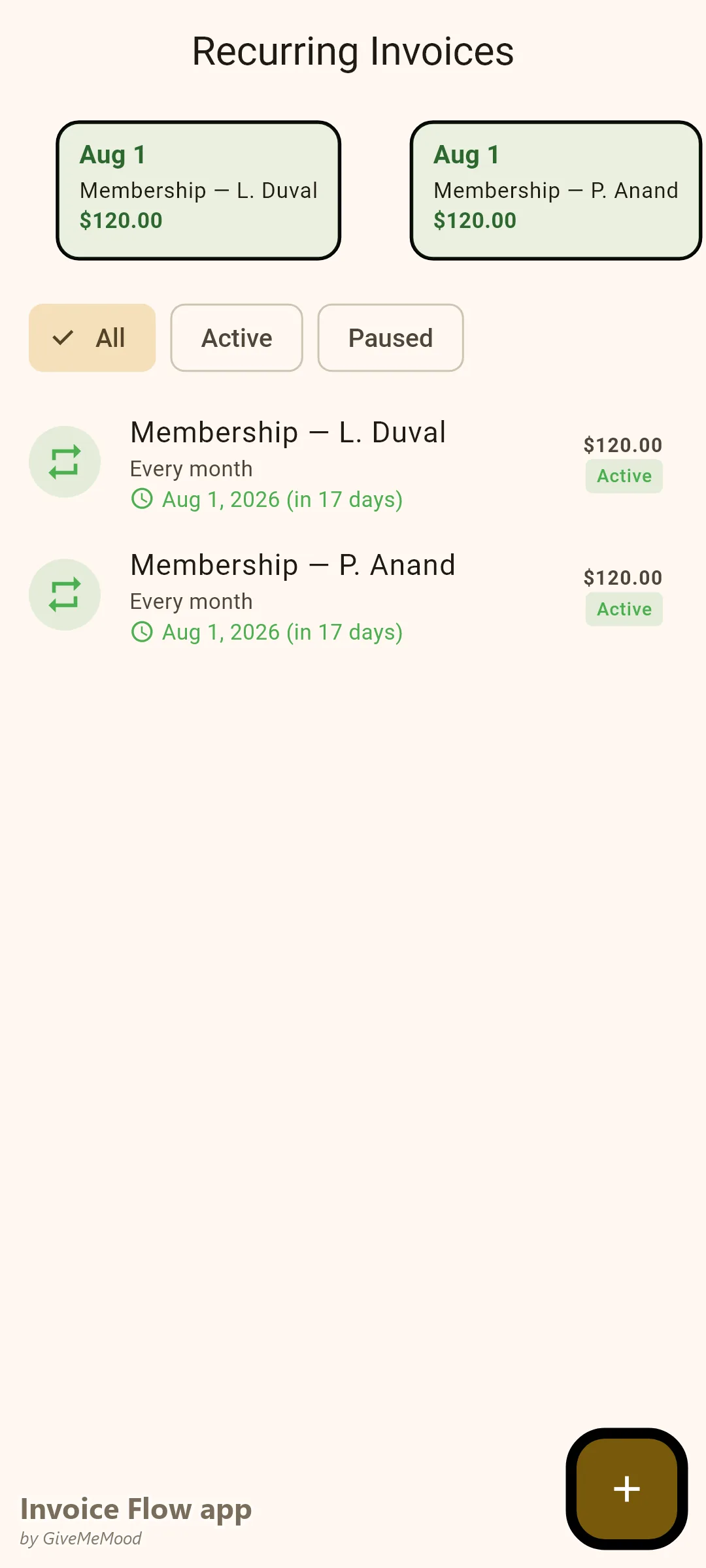
With InvoiceFlow’s recurring invoice feature, the membership program I had been planning for two years became straightforward.
I designed three membership tiers:
Essential Membership: One signature facial per month — $109/month.
Advanced Membership: One advanced facial (microdermabrasion, chemical peel rotation) per month — $139/month.
Comprehensive Membership: One advanced facial plus one complementary service (brow shaping, lip treatment, or targeted spot treatment) per month — $169/month.
I announced the program to my client list. Sixteen clients enrolled in the first two weeks. Each one received a recurring monthly invoice, set to generate on the first of the month.
The first of the following month, sixteen invoices went out automatically. Fourteen were paid within three days. Two needed a follow-up. By day seven, all sixteen were paid.
I have never had more predictable income. Before the membership, I would look at my schedule for the month and calculate projected income based on bookings, knowing that cancellations, rescheduling, and slow weeks would reduce that number unpredictably. Now I know the first of every month, sixteen payments are coming in before I see a single client. The membership income alone covers my treatment room rent and most of my product inventory costs.
I am at twenty-three members now and have a waitlist of six.
Corporate Wellness: Billing That Gets Paid
The corporate wellness events had been a frustrating income source. The events themselves were enjoyable — I set up in a conference room or break room, gave mini consultations and express treatments, talked about skincare with employees who genuinely appreciated the break. But the billing aftermath was exhausting.
Larger companies do not pay from a petty cash drawer. They have accounts payable departments with requirements: formal invoices with invoice numbers, line-item descriptions, total amounts, payment terms, and often a purchase order or event reference number. My spreadsheet invoices did not meet those requirements. I was resubmitting, following up, waiting.
After InvoiceFlow, I built a corporate event invoice template. For the next event — an employee wellness day for a financial services company with twenty employees — I sent:
“Corporate Skincare Wellness Event — [Company Name], May 8, 2026: 20 employees, 30-minute skin consultations and express treatments: $1,400. Product samples included: $80. Travel and Setup: $35. Total: $1,515. Event Reference: [THEIR CODE]. Net-30.”
It went to the event coordinator the day after the event. She forwarded it to accounts payable. Payment arrived on day 24. She emailed me the following month asking about availability for their Q3 event.
I have since done two more events for that company and been referred to a sister company. My corporate events calendar is now four to six bookings per year at an average of $1,200-$1,800 per event. Every single one is invoiced net-30 through InvoiceFlow. Every single one pays within terms.
The HSA Documentation Clients Started Asking For
About six months into using InvoiceFlow, a client asked me if I could give her documentation she could submit to her flexible spending account administrator. She had been getting medical-grade acne treatments from me — a series of salicylic acid peels — and her dermatologist had written a recommendation for ongoing esthetician care.
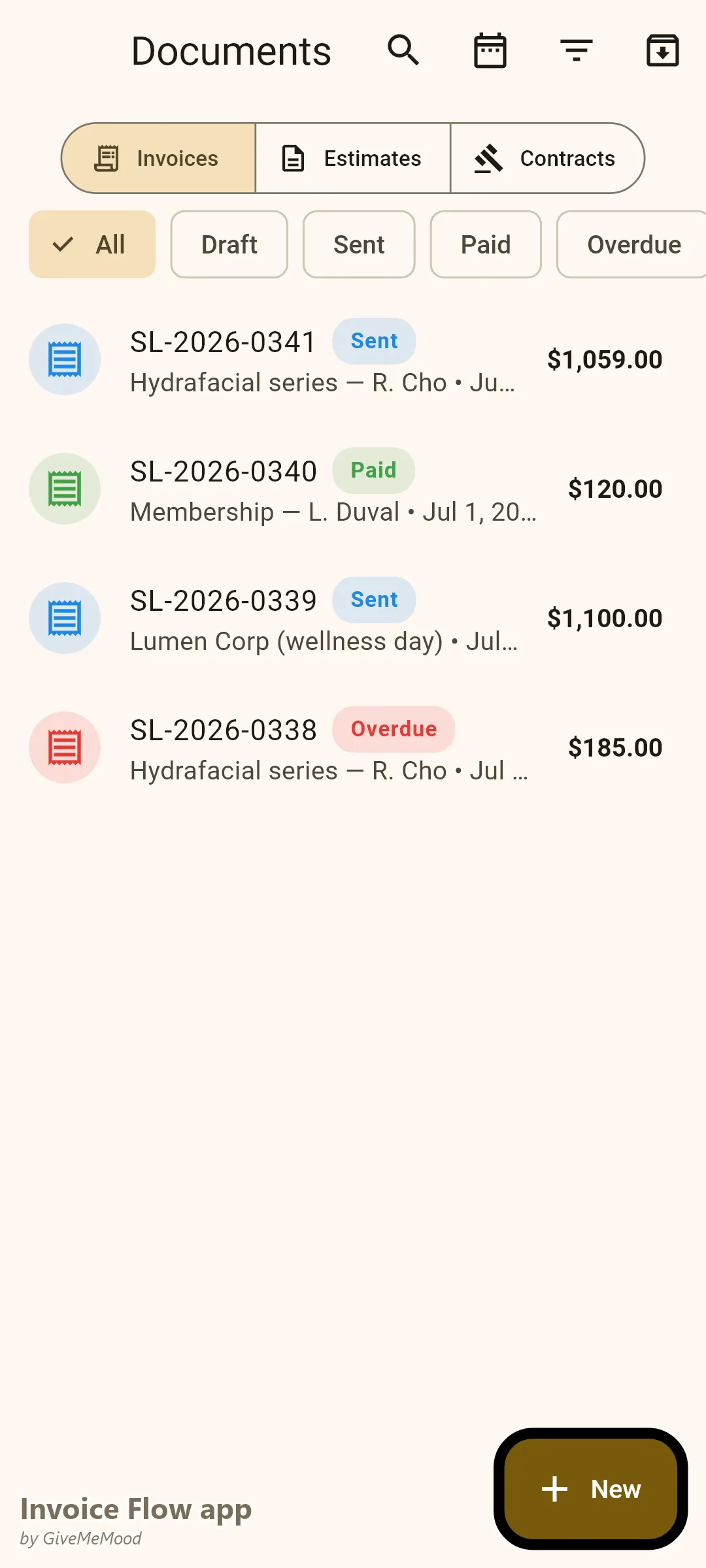
With my old system, I could not have helped her. With InvoiceFlow, I sent her a professional PDF with the treatment type, the date, the service code I used, and the total. She submitted it. It was accepted.
After that, I started mentioning to clients with HSA or FSA accounts that I could provide professional documentation. Several have asked for it. For medically-adjacent treatments — acne, rosacea, scar management — this is a genuine client service. It also reinforces my position as a professional healthcare-adjacent provider, not just a day spa.
Product Retail: The Revenue I Was Not Counting
I had always sold products. Clients who trusted my recommendations would purchase the Obagi Vitamin C serum I used in their treatment, the EltaMD SPF I insisted they wear, the SkinCeuticals CE Ferulic they asked about. These sales were meaningful. But I was not tracking them meaningfully.
When I started line-iteming product sales on invoices and receipts, I could finally see the numbers. My product revenue in the first full month I tracked it: $612. The month after that: $688. The month after that: $729.
The analytics in InvoiceFlow showed me my top-selling products, which months had higher product revenue (typically the months I focused on education about home care), and which clients were regular product purchasers. I expanded my retail selection based on this data. I added a monthly skincare “edit” — a curated product recommendation I share with members — and product sales increased further.
Product revenue is now consistently $700-$900 per month. Before InvoiceFlow, I was not counting it at all.
What the Practice Looks Like Three Years After Changing the System
I have a full treatment schedule, twenty-three monthly members, four to six corporate events per year, ongoing treatment package sales, and product retail that contributes meaningfully to monthly income.
My monthly income is approximately 65% predictable recurring revenue (memberships, package series) and 35% variable (walk-in appointments, event bookings, product sales). Three years ago, it was 100% variable and nearly untrackable.
At the end of every year, I can show my tax preparer an income breakdown by category: facial treatments, package series, membership, corporate events, retail. Not an approximation. Actual numbers, from actual invoices.
The three-year client who left because of a billing dispute — I still think about her sometimes. Not with guilt, exactly, but as a reminder that professional billing is not just administration. It is client care. When the financial relationship is clear, documented, and professional, clients trust you more. They stay longer. They refer others.
Professional documentation is part of what I offer. It took me too long to figure that out.
Download InvoiceFlow. Set up your packages, your membership tiers, your product catalog. Send the first recurring membership invoice. Start knowing what your business actually earns.
Lauren Hayes is a licensed esthetician and skincare studio owner in Denver, Colorado, specializing in treatment series for acne, brightening, and anti-aging protocols. She works from a private treatment room with a growing membership client base.