 EN
EN  العربية
  Български
  Čeština
  Dansk
Dansk  Deutsch
  Ελληνικά
  Español
  Suomi
Suomi  Français
  עברית
עברית  हिन्दी
  Bahasa Indonesia
  Italiano
  日本語
日本語  한국어
한국어  Bahasa Melayu
  Nederlands
  Norsk
Norsk  Polski
  Português
  Română
  Русский
  Svenska
  Kiswahili
  ไทย
ไทย  Türkçe
  Українська
  Tiếng Việt
  中文
中文 From Solo Nail Tech to Bridal Nail Specialist: How I Built a Business That Pays Me on Time
By Jessica Park, Licensed Nail Technician & Bridal Specialist — Seattle, WA
I got my nail license at twenty-four, started in a small salon doing acrylics and gel manicures, and within two years had enough of a following to rent my own suite. The suite was the goal. My own space. My own hours. My own clients. The independence I had been working toward since I started.
What nobody told me when I moved into the suite was that independence also meant managing my own finances entirely — and that my approach to billing, which had been “collect payment at the end of the appointment,” was going to create serious problems as my business grew.
The nail industry has a particular billing complexity: it sits at the intersection of regular appointment clients (who come every 2-3 weeks, who expect a familiar routine, who are relationship-based) and event clients (brides, wedding parties, corporate events) who are one-time or infrequent, high-value, and require more formal commitment on both sides.
Managing both of these client types informally — as I was doing — costs money in ways that are easy to miss until the total adds up to something significant.
The Bridal Party That Taught Me About Deposits
In my second year in the suite, I took a bridal nail booking from a bride I had met at a bridal expo. She wanted gel manicures and pedicures for herself, her maid of honor, and four bridesmaids — six people total, three hours of work with my assistant. I blocked the entire Saturday morning for her. I declined two other bookings that week for that time slot.
Thursday evening, two days before the appointment, she sent me a text saying the wedding had been “moved to a destination location” and she would be having her nails done there. She was sorry for the inconvenience.
I sat with the financial math: six gel manis and pedis, my rate, my assistant’s portion, three hours of prime Saturday time, two declined bookings. The loss was significant. And I had nothing to show for it — no deposit, no contract, no commitment of any kind.
I had been doing bridal nails for two years with no deposit system. This was not my first bridal cancellation. It was just the one that finally made me stop accepting that “it’s just part of the business.”
Understanding Why the Deposit System Is Not Optional
Bridal nail bookings are fundamentally different from regular appointments in a way that makes deposits non-negotiable:
First, the time commitment is much larger. A single bridal party can occupy your entire morning or afternoon. This is not one appointment slot — it is multiple hours that cannot be partially filled if the booking cancels.
Second, the lead time is much longer. Brides book 3-12 months in advance. That is a long time to hold time with no financial commitment.
Third, the value is much higher. A single bridal party might represent $400-$800+ of income in a single session. The financial exposure from a no-show is not comparable to a single manicure.
Fourth, the client is in a planning mindset. Brides who are planning a wedding are making many large financial commitments simultaneously. A deposit invoice from you is consistent with every other vendor deposit they are paying. It is not unusual. It is expected.
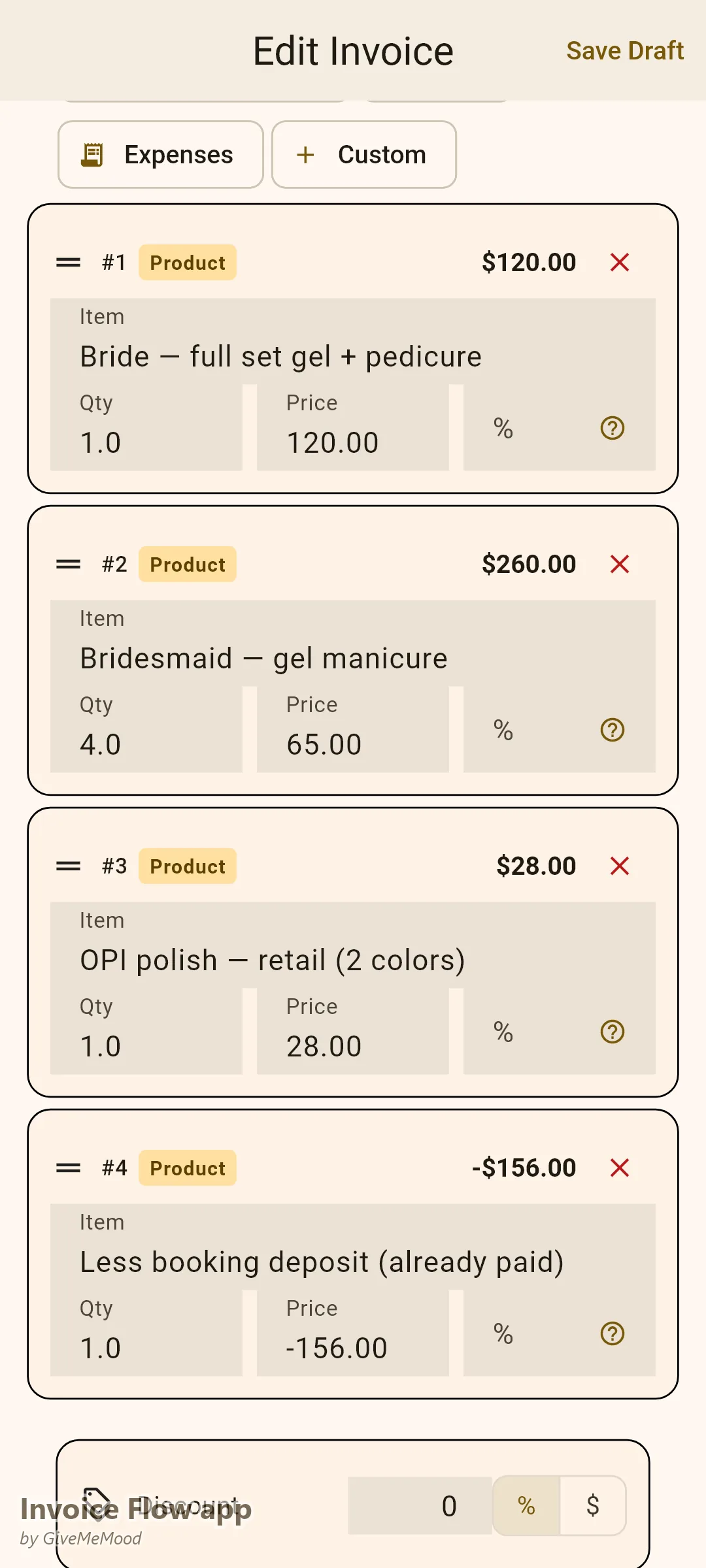
I set up InvoiceFlow and created my first bridal deposit invoice. The next bridal inquiry I received — a bride and four bridesmaids — got a deposit invoice at the end of the consultation. 35% of the total booking, sent from my phone before she left the nail suite. She paid it the same evening.
I have not had an unpaid bridal cancellation since implementing the deposit system.
The Group Invoice That Eliminates Morning Chaos
Before InvoiceFlow, bridal mornings had a financial awkwardness that I had come to dread. After three to four hours of nail work, with a wedding party ready to leave for the venue, I had to collect payment. Sometimes the bride had a check for everything. Sometimes different bridesmaids were paying their own portion. Sometimes there was confusion about what the total was. Sometimes people remembered the number differently than I did.
This is not how a professional service should end.
Now the group invoice goes to the bride the week before the wedding: Bride — Gel Manicure and Pedicure, Nail Art: $165; Maid of Honor — Gel Manicure: $55; Bridesmaid 1 — Gel Manicure: $55; Bridesmaid 2 — Gel Manicure and Pedicure: $95; Bridesmaid 3 — Gel Manicure: $55; Bridesmaid 4 — Gel Manicure: $55; Travel to Venue (Saturday morning only): $25. Total: $505. Deposit Paid: $177. Balance Due: $328.
The bride sees the full breakdown. She shares it with the wedding party. Each bridesmaid knows what they owe if they are paying separately. By the time I arrive on the wedding morning, the payment situation is already resolved.
I finish the nails. Everyone leaves looking beautiful. I leave with my balance in hand and no awkward conversations.
Corporate Nail Events: A Market I Stumbled Into
About three years into my suite, I got a call from an event planner who was organizing a “beauty day” for the HR department of a technology company — a small employee appreciation event where they wanted nail services for about fifteen employees over two hours. She had found me through Instagram.
This was my first corporate event inquiry. I said yes immediately. Then I asked how they handle payment. She told me they process vendor payments through accounts payable, net-30 from invoice receipt. They would need a formal invoice with the company’s event reference code.
I thought about my billing system at the time — an iPad POS that collected individual client payments — and realized none of it would work for this situation. I needed to send one invoice to the company for the total event cost.
InvoiceFlow was already set up for my bridal billing. I used it to create the corporate invoice: On-Site Nail Services — Employee Appreciation Event, March 12 — 15 clients, 2 hours: $675; Kit Fee and Products: $45; On-Location Travel: $20. Total: $740. Event Reference: HR-EVENT-Q1-2026. Net-30.
I emailed it to the event planner. They processed it through their accounts payable. Payment arrived on day 26. The company booked me again for their summer event and their holiday party.
I now do four to six corporate nail events per year. Each one requires a formal invoice. Each one pays net-30 cleanly. The income is predictable, the clients require minimal marketing, and the invoicing works the same way every time.
Mobile Services: The Travel Fee That Used to Be a Conversation
When I added mobile nail services to my offering — going to brides at their homes or hotels, to corporate events at office locations, to clients who could not make it to the suite — I had the familiar problem of travel fees.
I knew I needed to charge for travel. I owned a car, paid for insurance, used fuel, and gave up my time getting to and from locations. But saying “there’s a travel fee” in conversation felt like negotiation. Clients sometimes pushed back. Sometimes I dropped it to avoid conflict.
When I put the travel fee on the invoice as a standard line item — “On-Location Travel — Westin Hotel, 14 miles: $21” — it stopped being a conversation. It was a documented professional expense. Not one client has questioned it since I started invoicing it formally.
Nail Product Retail: Income I Was Not Tracking
I sell nail care products to my clients: cuticle oils, nail strengtheners, base coats, topcoats, and gel kits for at-home maintenance. These sales have always been part of my business — probably $300-$600 per month — but I was tracking them as vague “cash income” in my notes.
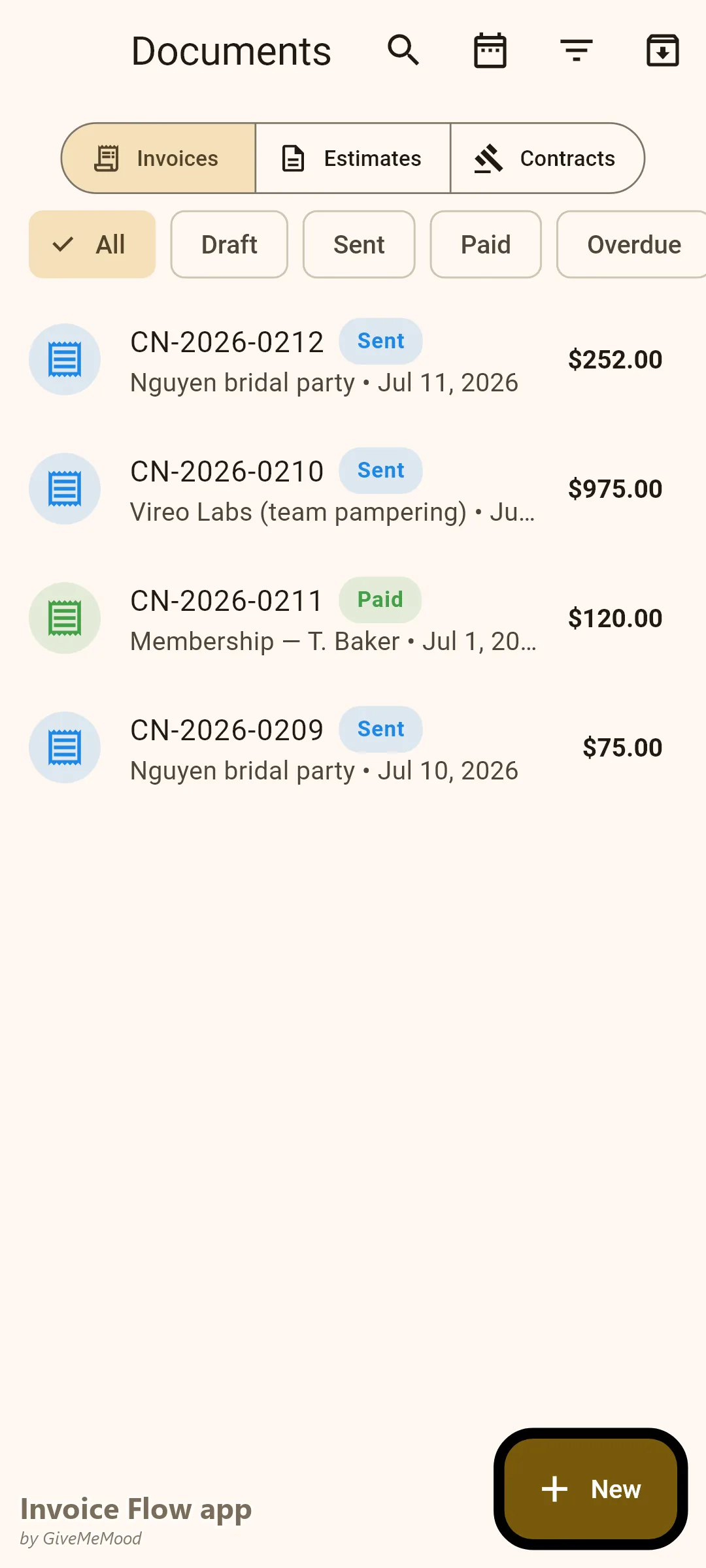
When I started adding product sales as line items on invoices: “OPI ProSpa Nail & Cuticle Oil: $18,” “Essie Treat Love & Color: $12” — they became part of my professional billing record. My product income is now visible in analytics. At year-end, I know exactly what I sold.
This visibility revealed that my product sales were higher than I thought, and that certain products sold consistently. I have since expanded my retail selection based on what the data showed was moving. Sales have increased.
The Membership Billing Experiment
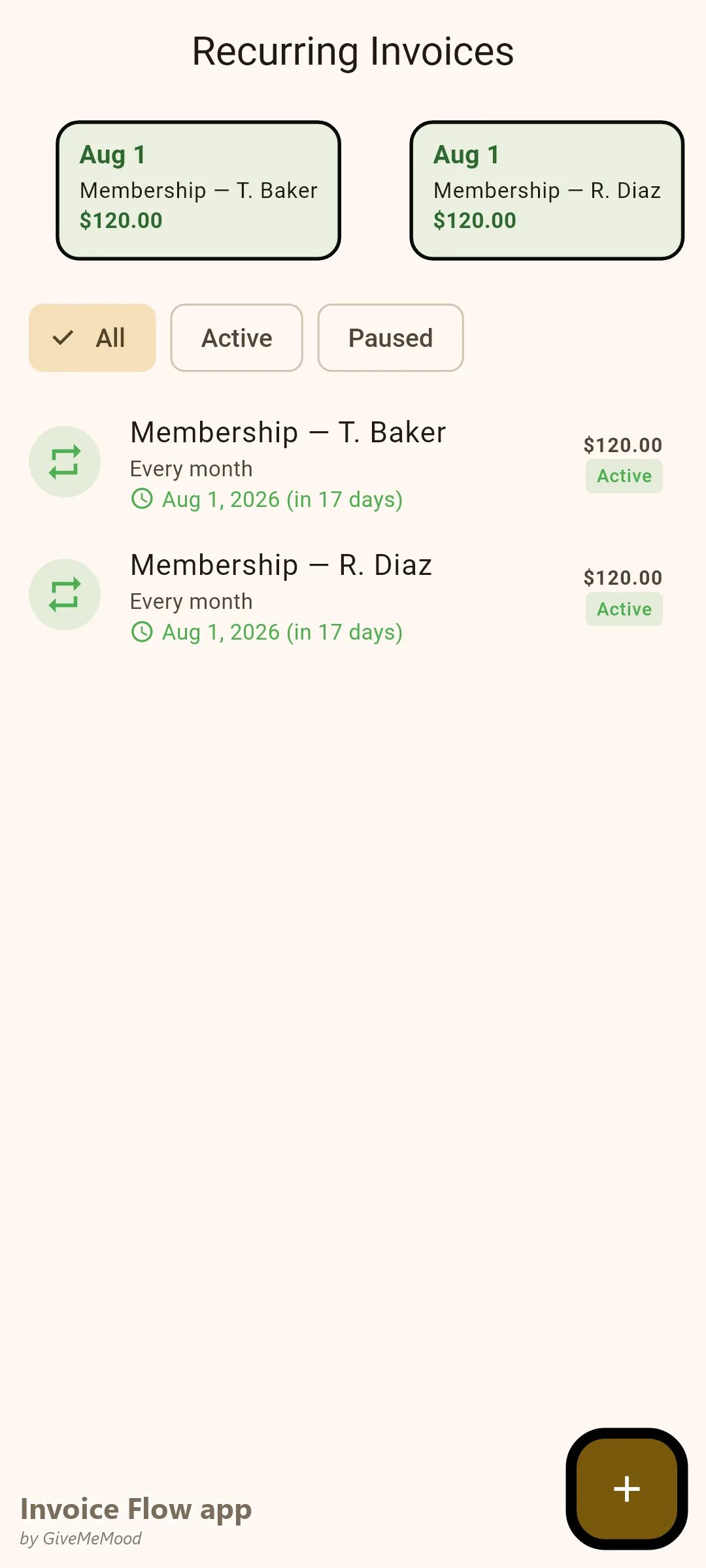
In the past year I started a nail care membership: a monthly flat fee for two gel manicures per month, with a 10% discount on any additional services. Twenty clients signed up in the first month. Each of them gets a recurring monthly invoice through InvoiceFlow.
Before InvoiceFlow, a membership like this would have been administratively painful — 20 clients on a recurring billing cycle, manually managed. With InvoiceFlow, it is nearly automatic. Invoices go out on the first of the month. Most clients pay within a day or two through the payment link.
The membership has been the most reliable income I have ever had. Twenty clients, predictable revenue, minimal marketing effort. I am growing it to 35 members by the end of the year.
What the Business Looks Like Five Years In
Five years after moving into my suite, I have a full appointment calendar, a bridal portfolio that books out 6-8 months in advance, four to six corporate events per year, a growing nail care membership, and a mobile service offering for clients who prefer it.
My billing is entirely through InvoiceFlow. Bridal deposits go out at consultation. Group invoices go to brides the week before the wedding. Corporate events get formal net-30 invoices. Membership clients are billed automatically. Mobile clients get travel fees documented on every invoice. Product sales are line-itemed.
My income is visible. My outstanding balances are visible. My categories are visible. At year-end, I have a full picture of what drives my revenue — and I can make decisions about what to grow.
The nail tech I was five years ago — collecting cash at the end of appointments, eating bridal cancellations without recourse, guessing at my monthly income — would not recognize the business I run today.
Download InvoiceFlow. Build your service catalog. Send the first deposit invoice at your next bridal consultation. Your business will look different in a year.
Jessica Park is a licensed nail technician and bridal nail specialist based in Seattle, Washington, with a suite-based practice, mobile services, and bridal morning bookings throughout the Pacific Northwest.