
 EN
EN  العربية
  Български
  Čeština
  Dansk
Dansk  Deutsch
  Ελληνικά
  Español
  Suomi
Suomi  Français
  עברית
עברית  हिन्दी
  Bahasa Indonesia
  Italiano
  日本語
日本語  한국어
한국어  Bahasa Melayu
  Nederlands
  Norsk
Norsk  Polski
  Português
  Română
  Русский
  Svenska
  Kiswahili
  ไทย
ไทย  Türkçe
  Українська
  Tiếng Việt
  中文
中文 How Informal Billing Was Costing My Marketing Agency More Than I Realized
By Jordan Hayes, Digital Marketing Agency Owner — Nashville, TN
I started my digital marketing agency in 2020 running social media accounts and Google Ads for local businesses. By 2023 I had a team of three and clients across Tennessee and beyond. The revenue looked healthy on the surface. The cash flow was a mess underneath.
My billing system was a collection of problems I had never stopped to examine: invoices sent inconsistently, project scopes that expanded without documentation, month-to-month clients who churned without notice, and retainer billing that I sometimes forgot to send entirely. I was running a business that was growing in clients and collapsing in margin.
The turning point was a conversation with my accountant in February of that year. She had pulled the previous twelve months of income data and showed me a number I did not expect: I had done approximately $340,000 in billable work and collected approximately $281,000. The gap — nearly $59,000 — was a combination of scope absorbed without invoicing, late billing that led to late payment, and a few clients who had gone quiet before I followed up.
The Three Places Money Was Disappearing
When I traced the $59,000 gap, it broke down across three categories.
Absorbed scope. Digital marketing projects rarely stay exactly as scoped. A client running ads asks for a landing page. The landing page client asks for a blog post to support it. The blog post client asks for an email to promote it. Each of these extras takes real hours. I was doing them without documentation because I did not want to seem difficult, and the value was small enough individually that it never felt worth a conversation. Collectively, across a year, it was enormous.
Delayed invoicing leading to delayed payment. Some clients I was invoicing monthly. Some quarterly. Some “when I remembered.” Delayed invoices are paid late by definition. I had outstanding balances that were 60, 90, and in one case 180 days old — not because clients refused to pay, but because I had not followed up with sufficient structure.
Month-to-month clients with no notice requirement. Four clients cancelled services during the year with less than a week of notice. In three of those cases, I had already done significant work for the upcoming month. Without a formal retainer agreement with notice terms, I had no protection.
Rebuilding the Retainer Structure
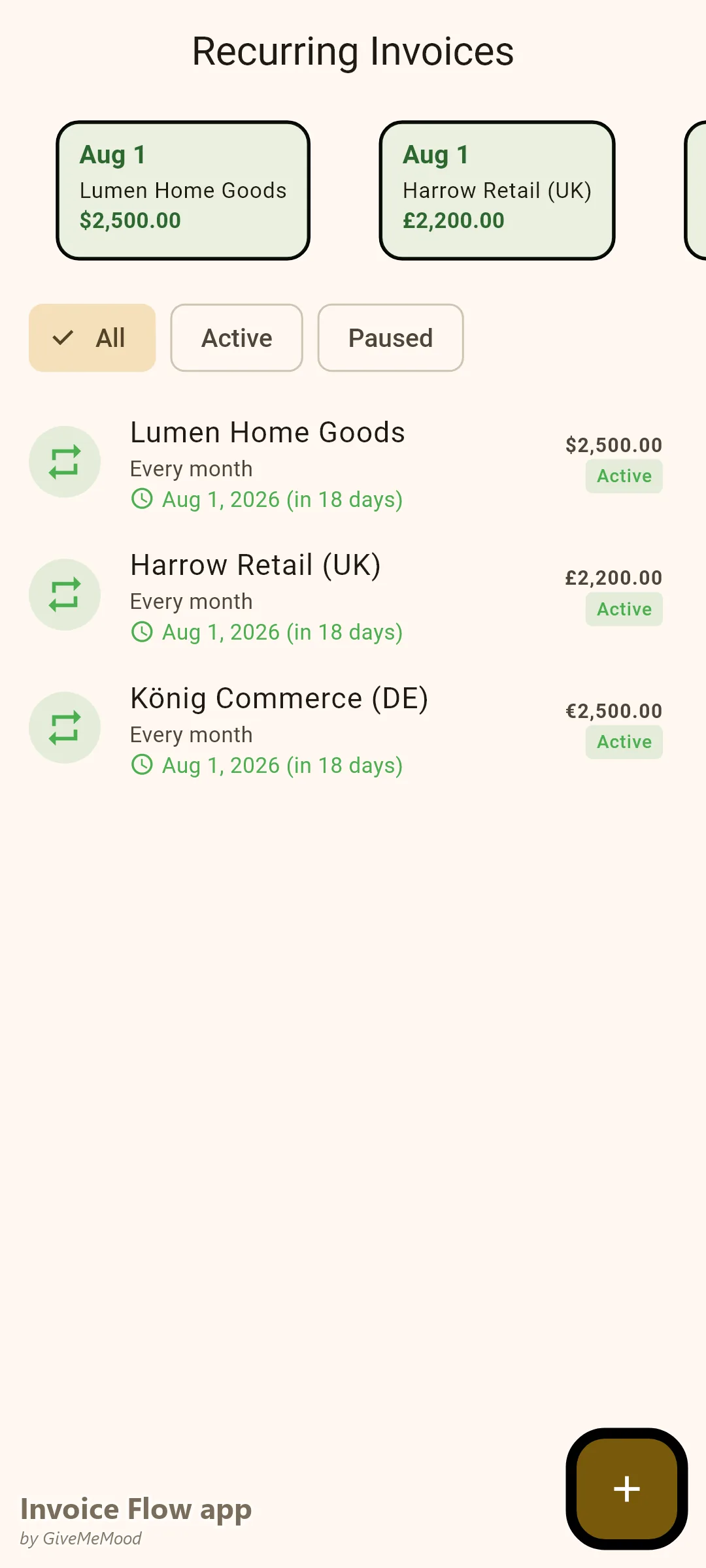
The most impactful change I made was converting every ongoing client from month-to-month informal arrangements to formal retainer agreements with standard terms.
I built three retainer packages in InvoiceFlow:
“Digital Marketing Retainer — [Client Name] — [Month Year]:
Starter Package — Social Media Management: 3 platforms (Facebook, Instagram, LinkedIn), 15 posts/month, community management, monthly analytics report. $1,200/month.
Growth Package — Full Digital Marketing: Above plus Google/Meta Ads management (up to $5K ad spend), monthly blog content (2 posts), email marketing (2 campaigns). $2,800/month.
Premium Package — Integrated Marketing: Above plus SEO management, conversion rate optimization, bi-weekly strategy calls, quarterly marketing audit. $5,200/month.”
I set up recurring invoices in InvoiceFlow for each client. The invoice generates automatically on the first of the month. Clients receive it consistently, budget for it predictably, and pay it reliably.
The retainer agreement I now use includes a 30-day written notice requirement for cancellation. When a client wants to discontinue services, they owe one final month at the contracted rate. In the eighteen months since implementing this requirement, I have had four clients cancel — all four paid their final month without dispute.
The Project Scope Documentation System
For project-based work — website audits, campaign launches, content creation packages, competitive analyses — I built a milestone billing system.
“Digital Marketing Project — [Client Name] — Google Ads Campaign Launch:
Phase 1 — Strategy and Setup (40%): Campaign strategy document, keyword research, ad creative brief, landing page audit, account structure setup. Due upon phase completion. $2,800.00
Phase 2 — Launch and Initial Optimization (35%): Ad copy creation and upload, bid strategy implementation, conversion tracking setup, first 30 days of active optimization. Due upon campaign launch. $2,450.00
Phase 3 — Reporting and Handover (25%): 60-day performance report, optimization recommendations, campaign handover documentation (if applicable). Due upon report delivery. $1,750.00
Total: $7,000.00”
I create all three milestone invoices in InvoiceFlow at project kickoff. Each one is ready to send when the trigger event occurs. The client knows exactly what they are paying for at each phase. The conversation about value is built into the structure.
Scope Change Documentation
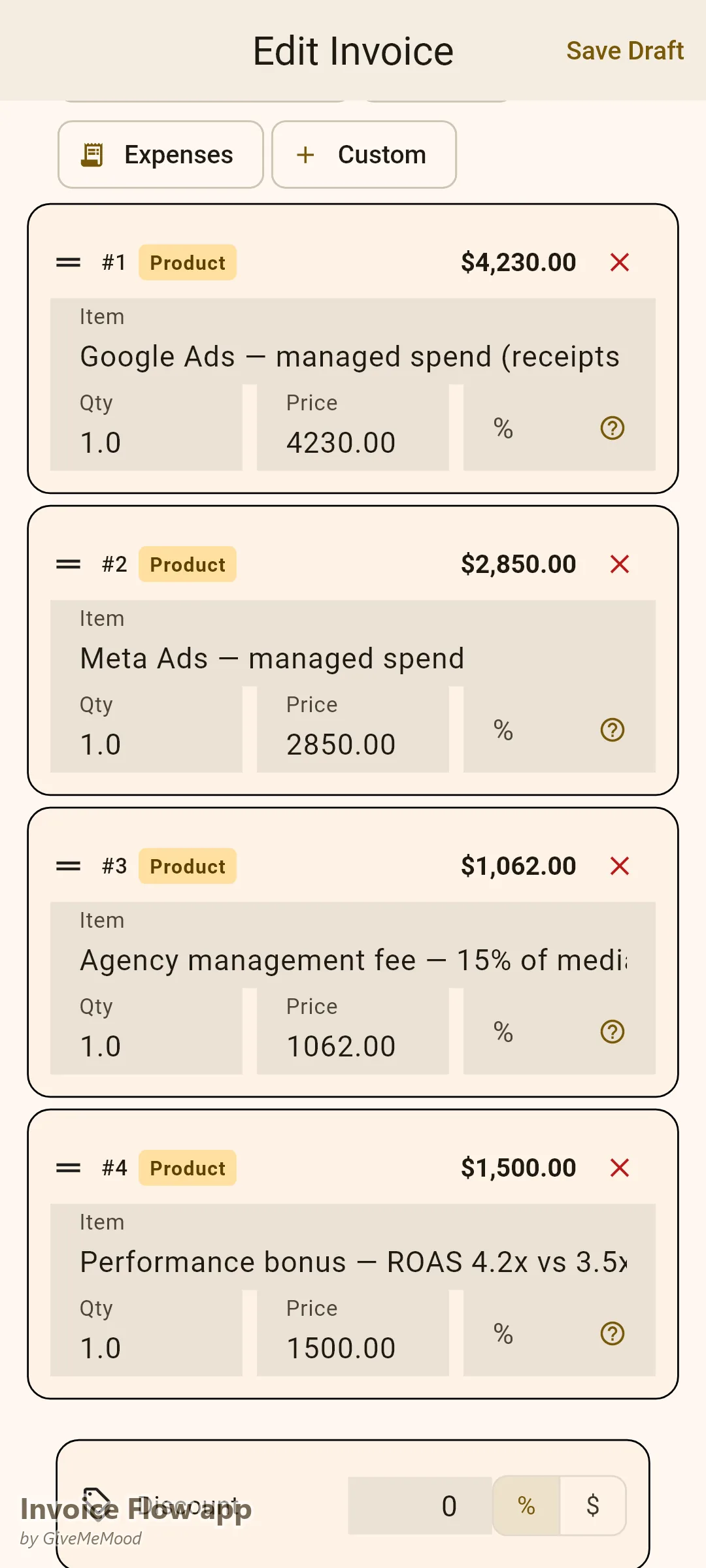
The absorbed scope problem was solved by a simple rule: no out-of-scope work without a scope change invoice, sent before the work begins.
The first time I sent one felt awkward. A client had asked me to write an email sequence to support their ad campaign — not in our original scope.
“Scope Addition — Email Sequence: 5-email welcome and nurture sequence copywriting and setup in Klaviyo. 8 hours × $125/hr: $1,000.00. Authorization required before work commences.”
The client responded: “Of course, go ahead.” That single email took fifteen minutes to write and recovered $1,000 in previously-absorbed work.
I now issue scope addition invoices for every out-of-scope request. In the first six months after implementing this: eleven scope change invoices issued, ten approved without negotiation, one reduced in scope by mutual agreement. Revenue recovered: approximately $8,400 in a six-month period.
Corporate Client Billing

Two of my agency’s clients are mid-size companies with procurement departments. Their invoices require purchase order references and formal payment terms documentation.
“Digital Marketing Services — [Corporate Client] — June 2026: PO Number: PO-2026-MKTG-0189 Vendor ID: VND-55621 Project Code: BRAND-DIGITAL-2026 Q2 Google Ads management and optimization, social media content (3 platforms), SEO monitoring, monthly analytics report. Amount: $4,800.00 Payment Terms: Net-30 Due: July 15, 2026”
These invoices are processed by AP without follow-up. The clients pay within terms. The formality signals that my agency operates at a level appropriate for corporate procurement.
The Numbers After Eighteen Months
Before the billing overhaul, my collection rate was approximately 83% of billable work. After eighteen months of structured invoicing:
- Nine retainer clients on formal agreements generating $21,600/month in recurring base revenue
- Project billing structured with milestone payments — no more 90-day waits at completion
- Scope change documentation recovered an estimated $16,000 in previously-absorbed work over eighteen months
- Collection rate now above 97% of billable work
- One finance hire deferred because the InvoiceFlow billing structure handled tracking automatically
My accountant ran the same analysis at the eighteen-month mark. The gap between billable work and collected revenue had shrunk from $59,000 to under $11,000 — and most of that remainder was within normal payment terms.
What the Agency Looks Like Now
A team of four serving eighteen clients. Nine on formal retainer agreements, six on project billing, three corporate accounts. Every piece of work invoiced, every scope addition documented, every payment tracked.
Download InvoiceFlow. Set up your retainer tiers. Issue scope change invoices before you do any out-of-scope work. Convert your next informal monthly client to a formal retainer this week.
Jordan Hayes is a digital marketing agency owner in Nashville, Tennessee, serving regional businesses across the Southeast with social media management, paid advertising, content marketing, and SEO.