
 EN
EN  العربية
  Български
  Čeština
  Dansk
Dansk  Deutsch
  Ελληνικά
  Español
  Suomi
Suomi  Français
  עברית
עברית  हिन्दी
  Bahasa Indonesia
  Italiano
  日本語
日本語  한국어
한국어  Bahasa Melayu
  Nederlands
  Norsk
Norsk  Polski
  Português
  Română
  Русский
  Svenska
  Kiswahili
  ไทย
ไทย  Türkçe
  Українська
  Tiếng Việt
  中文
中文 The Scope Creep Problem That Was Quietly Draining My Web Design Agency
By Maya Patel, Web Designer & Agency Owner — Denver, CO
I started my web design freelance practice in 2018 with a single goal: stop working for other people. By 2022, I had hired two part-time contractors and was calling it an agency. The revenue was growing. The profitability was not.
For four years, I ran my business on a combination of Google Docs proposals, emailed PayPal invoices, and an internal tracking system that consisted of a sticky note on my monitor. The billing was informal because everything about the business had started informally. I had never paused to design how money actually flowed in.
The year I finally looked at the numbers honestly was the year I realized I had a scope creep problem, a delayed billing problem, and a retainer problem — all at once, and all eating the same margin.
The Project That Made Me Do the Math
A local restaurant chain hired me for a full website redesign: four locations, online ordering integration, new photography sections, event calendar. We agreed on $8,500 for the project.
Three months later, I delivered the site. I had done what I quoted plus eight additional change requests the client described as “quick tweaks” during the project. The tweaks took me and my contractor about twenty-two hours of combined work. I never invoiced for any of it.
Final invoice: $8,500. Actual value delivered: closer to $10,700 at my standard rates.
When I added up the unbilled scope from all my projects that year, the number was somewhere between $14,000 and $18,000. I had essentially worked a month and a half for free across my client base.
Understanding the Three Billing Failures
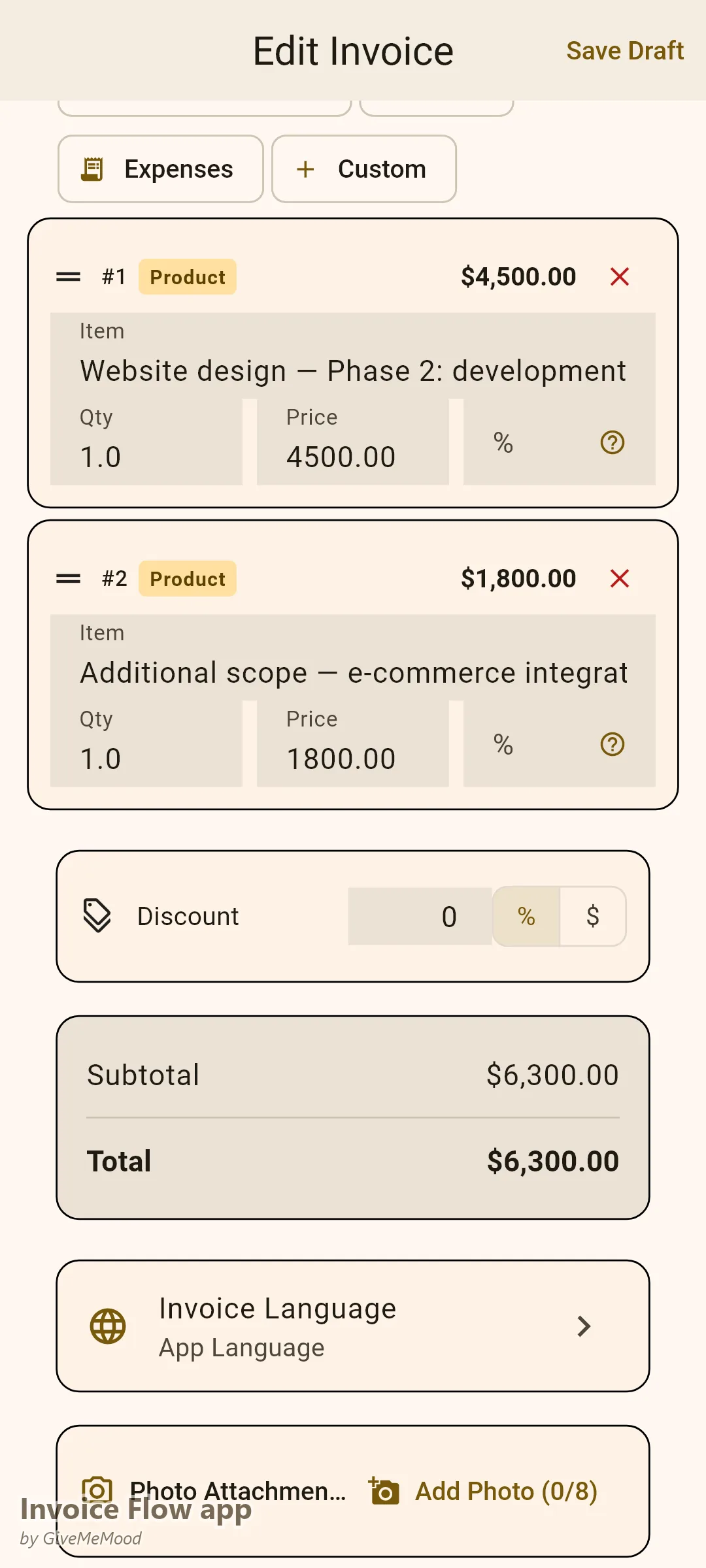
Once I started looking clearly at the problem, I could identify three distinct issues.
Scope creep with no invoicing mechanism. When a client asked for an extra page or a revised navigation structure, I would say yes and absorb the time. There was no process for issuing a scope change invoice. I did not want to seem difficult mid-project.
Delayed invoicing on project milestones. My contracts called for 50% upfront and 50% on completion. “Completion” was vague. Clients would request small finishing items — one more revision, a content update — and I would hold the final invoice until everything was done. The gap between delivering the work and issuing the invoice was often weeks.
No recurring retainer system. Clients who came back for ongoing maintenance were invoiced ad-hoc whenever they reached out. Some months I sent them invoices. Some months I forgot. There was no formal retainer structure that guaranteed any of this income.
The Deposit Structure That Fixed Project Cash Flow
The first thing I rebuilt was the deposit system. I moved from a simple 50/50 split to a three-milestone structure for any project over $3,000.
“Web Design Project — [Client Name] — Project Agreement:
Phase 1 — Project Deposit (33%): Due upon signed agreement. Covers discovery session, site architecture planning, initial wireframes. Amount: $2,805.00
Phase 2 — Design & Development (34%): Due upon client approval of design mockups. Covers development build, integrations, content migration. Amount: $2,890.00
Phase 3 — Final Launch (33%): Due upon site launch. Covers testing, revisions, live deployment, 30-day post-launch support. Amount: $2,805.00”
I create all three invoice phases in InvoiceFlow at the project start. Phase 1 goes immediately. Phase 2 triggers when mockups are approved. Phase 3 triggers at launch. There is no ambiguity about what is owed when, and the project cash flow is distributed across the timeline rather than front-loaded then dry for months.
The Scope Change Invoice That Changed Client Behavior
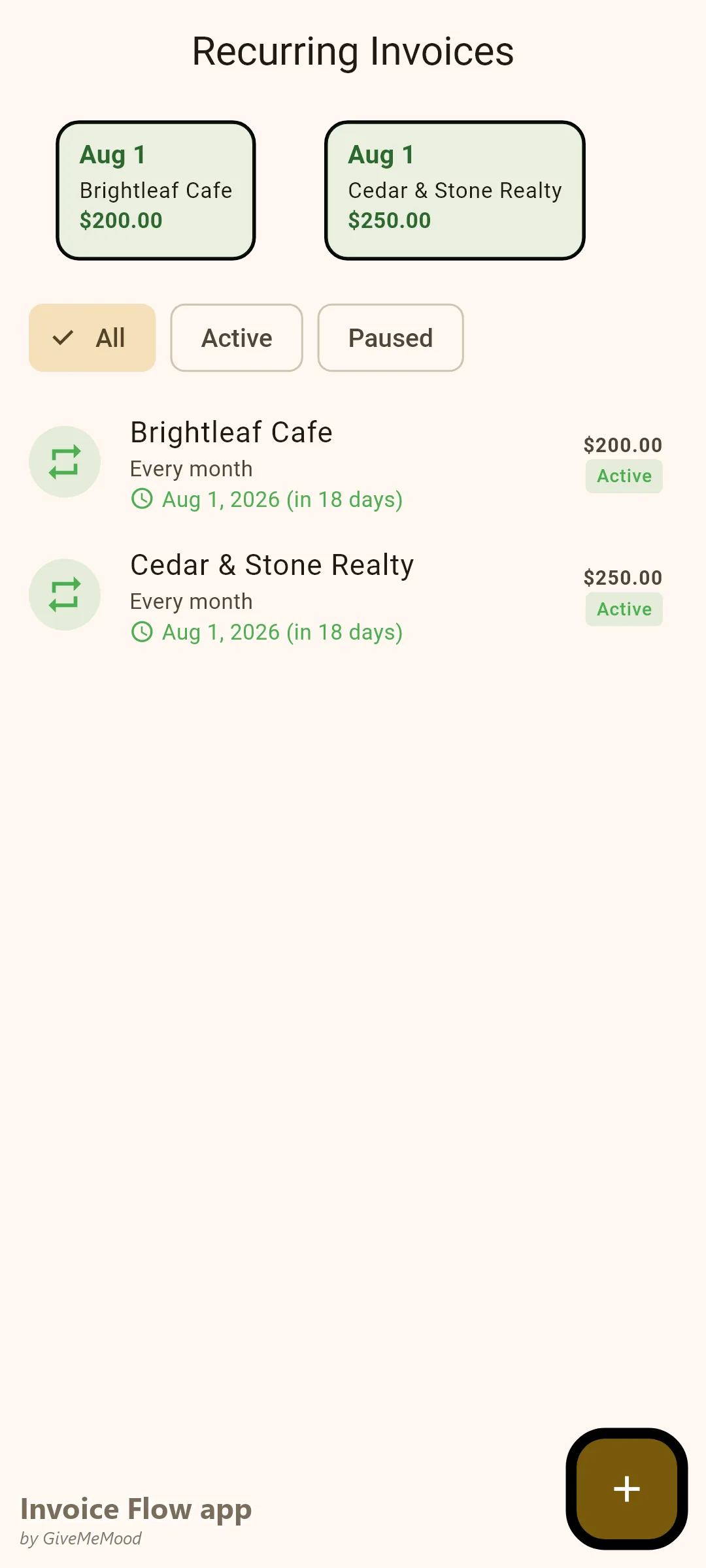
The second thing I rebuilt was my change order process. I stopped saying yes verbally to additions and started sending a formal scope change invoice before doing any out-of-scope work.
The first time I sent one, I was nervous. A client had asked for an additional e-commerce product page and a revised checkout flow — work I would have previously absorbed without comment.
Instead, I opened InvoiceFlow and created:
“Scope Change Authorization — [Client Name] — Additional Work:
- Additional e-commerce product page design and build: 4 hours × $135/hr: $540.00
- Checkout flow revision and mobile optimization: 3.5 hours × $135/hr: $472.50 Total additional scope: $1,012.50
Authorization required before work commences. This invoice must be paid or acknowledged to proceed.”
The client responded within two hours: “That’s fine, go ahead.” Paid within three days.
Since implementing scope change invoices, I have issued fourteen of them across various projects. Twelve were approved without negotiation. Two required brief discussions that resulted in the scope being reduced rather than eliminated entirely. None were refused outright.
The psychological shift for clients is significant: when scope is documented and priced before it happens, clients make intentional decisions about what they actually want. The “quick tweak” culture disappears when there is a line item attached to it.
Building the Retainer Business
The third problem — the ad-hoc maintenance billing — required a more fundamental rethink. I needed retainer agreements that converted my ongoing clients from unpredictable monthly invoicing to predictable monthly fees.
I analyzed my maintenance clients and identified what they actually used. The typical pattern was about two to four hours of work per month: content updates, plugin maintenance, small design changes, performance checks. I built retainer tiers around this.
My standard retainer invoice:
“Monthly Web Maintenance Retainer — [Client Name] — [Month Year]:
- Starter Package: 2 hours/month included — content updates, plugin updates, security monitoring: $270.00/month
- Standard Package: 4 hours/month included — above plus design changes, performance optimization: $540.00/month
- Premium Package: 8 hours/month included — above plus priority response, monthly analytics report, A/B testing: $1,080.00/month”
I set up recurring invoices in InvoiceFlow for each retainer client. They generate and send on the first of each month automatically. I have eight clients on retainer agreements now. That is $3,840 per month in base recurring revenue before any project work comes in.
The retainer conversation is also much easier than it sounds. I approached each existing maintenance client with the proposal framed as a benefit to them: “You’ll have guaranteed access to support hours each month, priority scheduling, and a predictable budget instead of variable monthly bills.” Most agreed within a week.
Corporate Client Billing: A Different Process Entirely

Two of my clients are mid-size companies with procurement departments. They do not use PayPal. They use purchase order systems and pay on net-30 terms.
My early invoices to these clients were rejected by their AP departments because they lacked the required fields: no PO number reference, no vendor ID, no clear payment terms statement. I would send an invoice and hear nothing for weeks, then get an email from AP asking for a corrected invoice.
InvoiceFlow’s custom fields solved this cleanly. I added fields for Purchase Order Number, Vendor/Supplier ID, and Project Code. Now every corporate invoice includes:
“Web Development Services — [Corporate Client] — June 2026: PO Number: PO-2026-IT-0892 Vendor ID: VND-48821 Project Code: DIGITAL-REBRAND-2026 Website redesign — Phase 3 completion: landing page build, CMS integration, QA testing: $4,200.00 Payment Terms: Net-30 Due Date: July 8, 2026”
The AP team processes these without follow-up. The payment arrives within terms. I have not had a corporate invoice bounce back for missing information since I implemented this format.
The Numbers After Two Years
Before the overhaul, my monthly revenue was entirely project-dependent — good months when projects closed, thin months when they did not. My effective hourly rate, when I counted all the unbilled scope, was well below my stated rate.
After two years of structured billing:
- Eight retainer clients at an average of $480/month: $3,840/month in recurring revenue
- Scope change invoices have recovered an average of $1,200/month in previously-absorbed work
- Project milestone billing means I am never waiting more than thirty days for a substantial payment
- Two corporate clients on net-30 terms represent reliable $4,000-$6,000 quarterly project work
- My effective hourly rate is now close to my stated rate, because I am billing for what I actually do
The business grew, but the more important change was that the existing revenue became more complete and more visible.
What the Practice Looks Like Now
Seven to ten active project clients at any time, all on three-phase milestone billing. Eight retainer clients generating predictable monthly income. Two corporate accounts with formal PO-referenced billing. Scope change invoices issued for any work outside original agreements before that work begins.
I run a real agency now — one where the billing matches the quality of the design work. Download InvoiceFlow. Build your retainer tiers. Issue your first scope change invoice before you absorb one more “quick tweak.”
Maya Patel is a web designer and agency owner in Denver, Colorado, specializing in small business websites, e-commerce builds, and ongoing digital maintenance for regional brands.