
 EN
EN  العربية
  Български
  Čeština
  Dansk
Dansk  Deutsch
  Ελληνικά
  Español
  Suomi
Suomi  Français
  עברית
עברית  हिन्दी
  Bahasa Indonesia
  Italiano
  日本語
日本語  한국어
한국어  Bahasa Melayu
  Nederlands
  Norsk
Norsk  Polski
  Português
  Română
  Русский
  Svenska
  Kiswahili
  ไทย
ไทย  Türkçe
  Українська
  Tiếng Việt
  中文
中文 The Interior Designer Who Started Winning Commercial Clients: A Billing Transformation
By Natalie Rhodes, Interior Designer & Principal — Nashville, TN
I started my interior design studio fresh out of graduate school, working from a home office and taking any residential project I could find. Those early years were a design education: every project taught me something about client communication, scope management, and the realities of turning a vision into a finished space.
What they also taught me, slowly and sometimes painfully, was that the financial structure of interior design work is one of the most complex in any service industry. You are simultaneously a creative service provider, a procurement specialist, a project manager, and a contractor coordinator. Each role has a different billing logic. Managing all of them in a coherent, professional way took me years to figure out.
The story of how I figured it out is really the story of winning my first major commercial project — and losing it temporarily because my billing documentation was not good enough.
The Hotel Project That Almost Slipped Away
Five years into my practice, I received an inquiry from a boutique hotel developer who was creating a ten-room property in East Nashville. He had seen my residential work and thought my aesthetic was right for the property. We had a meeting. He loved my concept. We started talking about fees.
When I presented my fee structure — verbally, in a meeting — he was genuinely interested. When he brought in his business partner and their accountant, the conversation changed. They needed formal documentation. They needed a project invoice structure that matched their construction budget process. They needed to see phase billing with deliverable milestones, subconsultant pass-through documentation, and something that their accountant could categorize against their CapEx budget.
I went home and tried to produce what they were asking for. What I had was a Word document template that I had used for residential projects, modified slightly for commercial use. It did not have phase milestone structure. It did not have subconsultant billing format. It did not have the corporate fields they needed.
I sent it. They came back with a list of what was missing. I revised. I sent again. They came back with more questions.
The project ultimately moved forward. But it was two additional weeks of back-and-forth on billing documentation before we could begin. I came very close to losing the project because the developer’s accountant was not comfortable with my documentation quality.
After that experience, I rebuilt my entire billing system.
What Commercial Interior Design Billing Actually Requires
Commercial clients — hotels, restaurants, offices, retail spaces — operate in a fundamentally different financial environment than residential clients. They have:
Budget codes and project references: Every invoice needs to reference a specific budget line or project code so it can be categorized against their capital expenditure tracking.
Phase-based milestones: Commercial projects go through defined phases — concept design, schematic design, design development, construction documents, construction administration — and billing is tied to phase completion, not to time spent.
Subconsultant documentation: When I coordinate an AV consultant, a lighting designer, or a custom furniture fabricator, the client needs that cost documented separately from my design fee, with my coordination markup clearly stated.
Net-30 payment terms: Commercial clients pay through accounts payable on net-30 cycles. They do not pay at the end of a meeting. They need formal invoices that can be routed through their finance team.
My residential billing approach handled none of these requirements.
Building the Commercial Billing System in InvoiceFlow
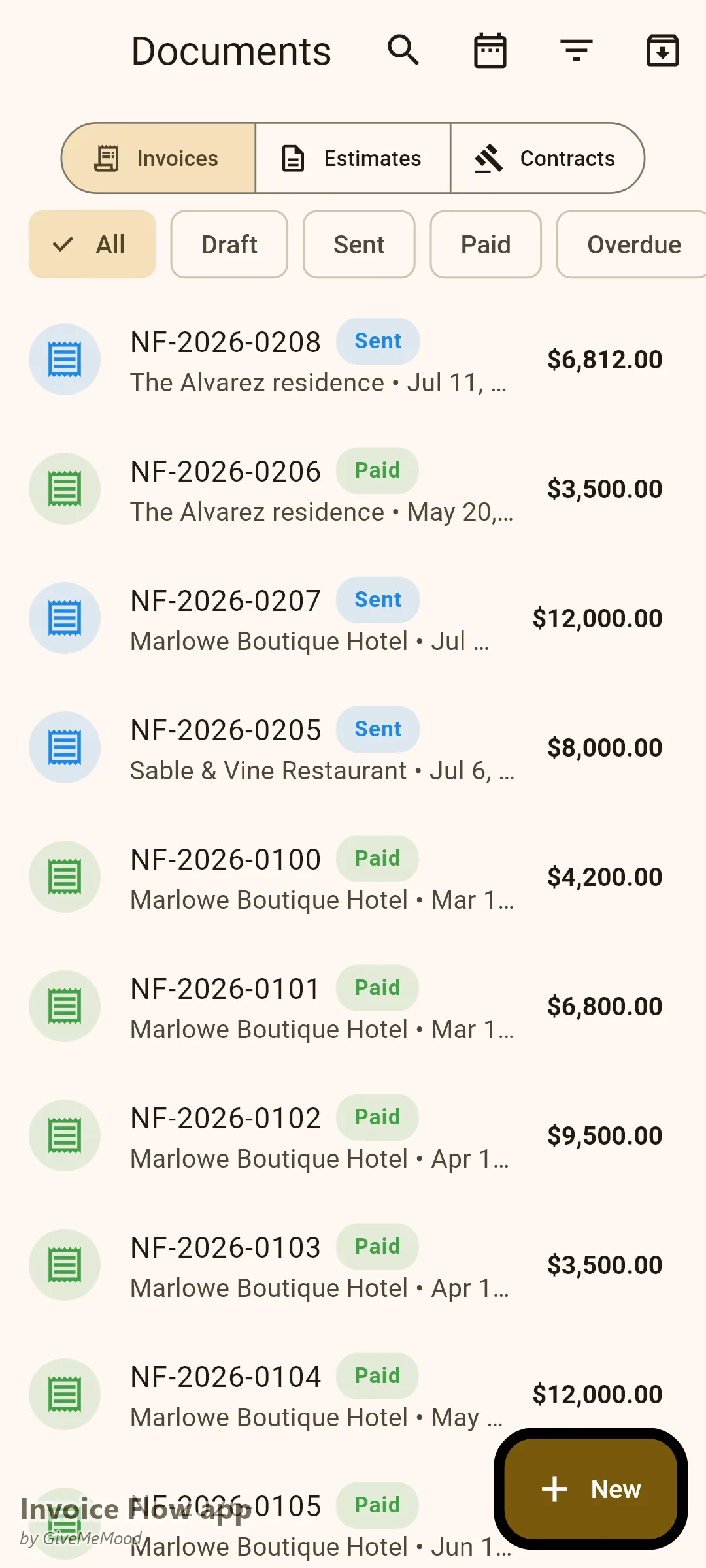
After the hotel project, I spent a weekend setting up InvoiceFlow for commercial work.
I built four invoice templates:
Project Engagement Invoice: Design retainer at project commencement. Documents the full project scope, fee structure, and initial deposit requirement. Corporate project reference field. Net-30 terms.
Phase Completion Invoice: Triggered at the end of each design phase. Documents the phase completed, deliverables provided, and the fee for that phase. Includes running total of fees billed and balance remaining.
Procurement Invoice: For furniture, fixtures, and materials purchased on the client’s behalf. Itemized by item with trade cost and design markup clearly stated on each line. Subconsultant line items for any specialty consultants.
Completion Invoice: Final balance invoice at project completion, including any outstanding coordination fees, installation supervision, and travel reimbursables.
The hotel project — which had started messily — was rebilled using these templates as we progressed through the design phases. By the time we reached phase three, the developer’s accountant was approving invoices the same day they were received. She told me at one point that my billing had become “exactly what we need.”
The Mark-Up Conversation That Became a Non-Issue
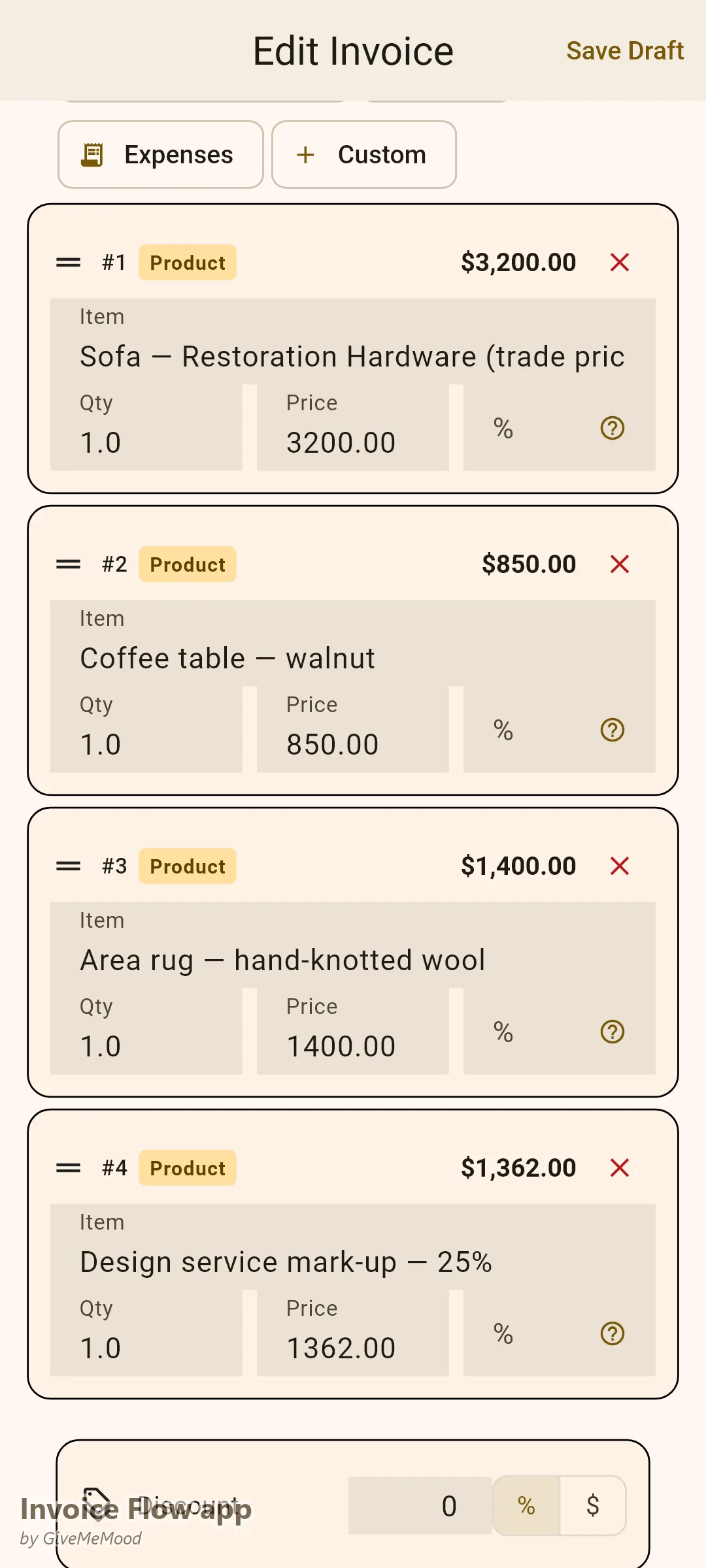
One of the most delicate aspects of interior design billing is the trade price markup. When I purchase furniture, fixtures, and materials at trade prices and sell them to clients with a markup, the markup is legitimate compensation for my procurement expertise and relationships. But how it is communicated on an invoice matters.
In my early residential work, I sometimes hid the markup — showing clients only the “net” cost to them without revealing the trade price or my percentage. This created a fundamental transparency problem. If a client discovered the markup indirectly (which happened twice), the trust damage was significant.
With my InvoiceFlow procurement invoices, I show trade cost and markup openly:
“Living Room Procurement — Hotel Room 101 Concept:
- Lounge Chair × 4 (Designtex Trade): $1,840 each × 4: $7,360
- Side Table × 4 (custom fabrication): $480 each × 4: $1,920
- Area Rug — custom wool (Landry & Arcari): $2,800
- Artwork — original paintings × 2 (Local Artist Commission): $1,600
- Designer Trade Markup (22%): $3,005 Total Procurement Invoice: $16,685”
Clients see exactly what was purchased and exactly what I earn from procurement. In six years of using this format, not one commercial client has questioned my markup when it is documented this way. The transparency removes the adversarial element from the conversation.
The Subconsultant Billing That Expanded My Services
Before I had professional pass-through billing, I was hesitant to engage specialty consultants on my projects. The administrative complexity of managing another billing relationship, marking it up, and presenting it cleanly to the client was discouraging.
With InvoiceFlow’s pass-through billing format, subconsultant management became straightforward:
“Subconsultant Coordination — Hotel Project:
- AV Systems Design — TechSpace Consulting (invoice attached): $4,200
- Custom Lighting Design — Lumina Design Group (invoice attached): $3,800
- Project Coordination Markup (12%): $960 Total Subconsultant Invoice: $8,960. Project Reference: [CLIENT CODE].”
The client receives the original subconsultant invoices attached to my coordination invoice. They see the subconsultant cost and my markup in a single professional document. My markup is clearly documented and justified by the coordination work it represents.
Since implementing subconsultant billing, I have engaged AV consultants, lighting designers, acoustic consultants, and custom fabricators on multiple projects. My projects are more complete, my client relationships are more comprehensive, and my income per project is higher.
What the Studio Looks Like Now
My studio now has a mix of residential and commercial work — approximately 40% residential and 60% commercial, measured by revenue. The commercial shift happened as my billing became professional enough to satisfy commercial clients’ requirements.
Current projects include three boutique hotel properties, two restaurant interiors, and an office build-out for a private equity firm. All are invoiced through InvoiceFlow with phase billing, procurement documentation, and subconsultant pass-throughs.
Total project revenue this year: significantly higher than it was four years ago, driven almost entirely by commercial work that I could not have won without professional billing infrastructure.
The hotel project that almost slipped away because my Word document invoice was not good enough — I am designing their second property now.
Download InvoiceFlow. Build your phase billing templates, your procurement invoice format, and your subconsultant documentation. Win the commercial projects your residential work has been qualifying you for.
Natalie Rhodes is the principal of Rhodes Interior Design in Nashville, Tennessee, specializing in boutique hospitality, restaurant, and office interiors. Her studio works on projects from concept through construction administration.