 EN
EN  العربية
  Български
  Čeština
  Dansk
Dansk  Deutsch
  Ελληνικά
  Español
  Suomi
Suomi  Français
  עברית
עברית  हिन्दी
  Bahasa Indonesia
  Italiano
  日本語
日本語  한국어
한국어  Bahasa Melayu
  Nederlands
  Norsk
Norsk  Polski
  Português
  Română
  Русский
  Svenska
  Kiswahili
  ไทย
ไทย  Türkçe
  Українська
  Tiếng Việt
  中文
中文 How I Stopped Losing Wedding Clients and Built a Stable Floral Business
By Claire Dawson, Wedding & Event Florist — Portland, OR
I have been arranging flowers professionally for eleven years. I started as an assistant in a traditional flower shop, moved to event work, and eventually built my own boutique floral studio specializing in weddings and corporate events. The flowers I make have been featured in three regional wedding publications. I have designed florals for receptions held in historic mansions, vineyard estates, and downtown hotel ballrooms. By any external measure, my business is successful.
For the first seven years of it, however, I was running a successful-looking business with a quietly chaotic financial foundation. I had no deposit system for weddings. I had no automated billing for my corporate subscription clients. I was spending Sunday mornings — my only consistent day off — manually figuring out who owed me what and sending individual billing requests that I had typed up in an email.
The change came not from a dramatic crisis but from a quiet conversation with my accountant during our end-of-year review. She asked me to explain my accounts receivable process. When I finished explaining it, she was silent for a moment and then said: “Claire, that’s not a process. That’s just hoping.”
She was right. And I spent the next three weeks fixing it.
What the Problem Was Costing Me
Before I fixed my billing system, I had three categories of financial loss that I had not clearly identified as connected.
The first was wedding design work that went unpaid because I had no deposit. I invested time in consultations, floral planning, supplier sourcing, and design proposals for brides who then changed their minds, chose a different florist, or simply stopped responding. Because I had not required a deposit, I had no financial claim on that time. In my best estimate, I lost approximately 80 hours of design work per year to unbilled consultations that did not convert.
The second was corporate flower account billing. I had eight corporate clients on regular weekly or biweekly arrangements — offices, hotel lobbies, a restaurant group. I billed them manually at the end of each month. Sometimes I forgot a delivery. Sometimes I misremembered a week’s price. Sometimes I sent the invoice late and the accounts payable department processed it in the following month’s cycle. The result was cash flow that was perpetually two to four weeks behind where it should have been.
The third was the installation labor I was absorbing. For large event floral installations — the kind that require four hours of setup and two hours of breakdown — I was charging for the flowers and leaving the labor off the invoice because I thought clients would push back on it. They probably would not have. But I never found out, because I never put it on the invoice.
The total across these three categories, by my accountant’s rough calculation, was significant. More than I had guessed. Enough to fund a full-time assistant for six months.
Building the New System
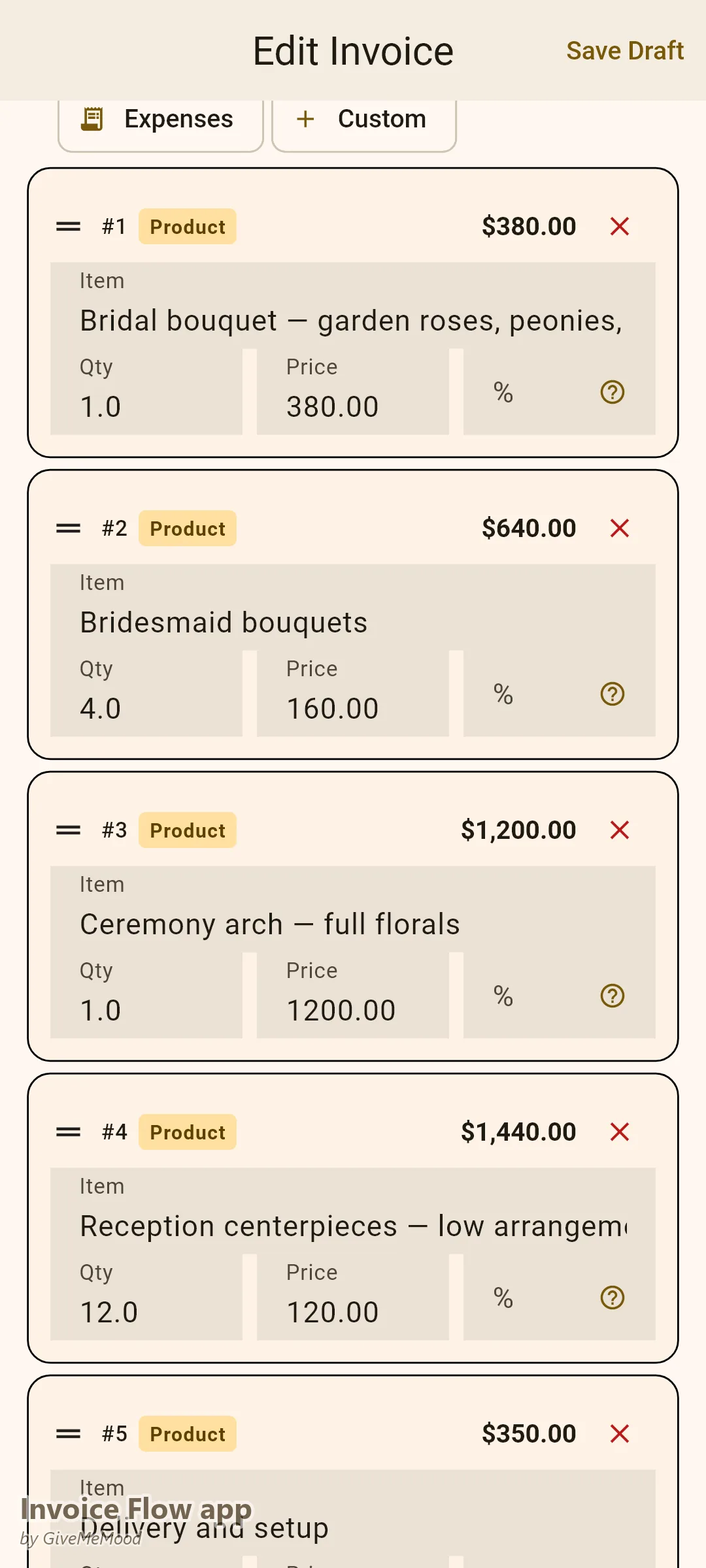
I found InvoiceFlow through a recommendation from a photographer friend who had been using it for her wedding bookings. She described the deposit feature. I downloaded it that evening and set up my floral business from scratch: consultation fees, wedding packages, corporate arrangement pricing, event installation labor rates, delivery fees, rental item deposits.
The setup took about two hours. It was the best two hours I have invested in my business infrastructure.
Wedding Bookings: The Deposit-First Approach
The single most impactful change I made was implementing a deposit invoice at every wedding consultation. The consultation itself changed very little — I still meet with couples, look at their venue photos, discuss their vision, work through their color palette and budget. But the consultation now ends with me pulling out my phone and sending a deposit invoice before I reach for my portfolio bag.
The deposit is 30% of the total quoted package. I send it while the couple is still at the table. I explain that it secures their date in my calendar and that the balance comes due six weeks before the wedding.
The first time I did this, the couple paid within the hour. The second time, a couple asked if they could pay later in the week. I said yes, but explained that the date would remain open until the deposit was received. They paid the next morning.
What I noticed within the first two months was that the couples who were truly committed to hiring me paid the deposit quickly. The couples who were still “shopping around” either paid slowly or did not pay at all — which was useful information. I was no longer giving those couples hours of my design attention and proposal work while they continued evaluating other florists. The deposit created a natural filter.
In the twelve months since I implemented the deposit system, I have had zero bridal bookings cancel after paying a deposit. The deposit is not the reason they are not cancelling — the reason they are not cancelling is that couples who pay a deposit have made a genuine commitment. The deposit is the mechanism that creates that commitment.
The Wedding Invoice: Every Line Documented
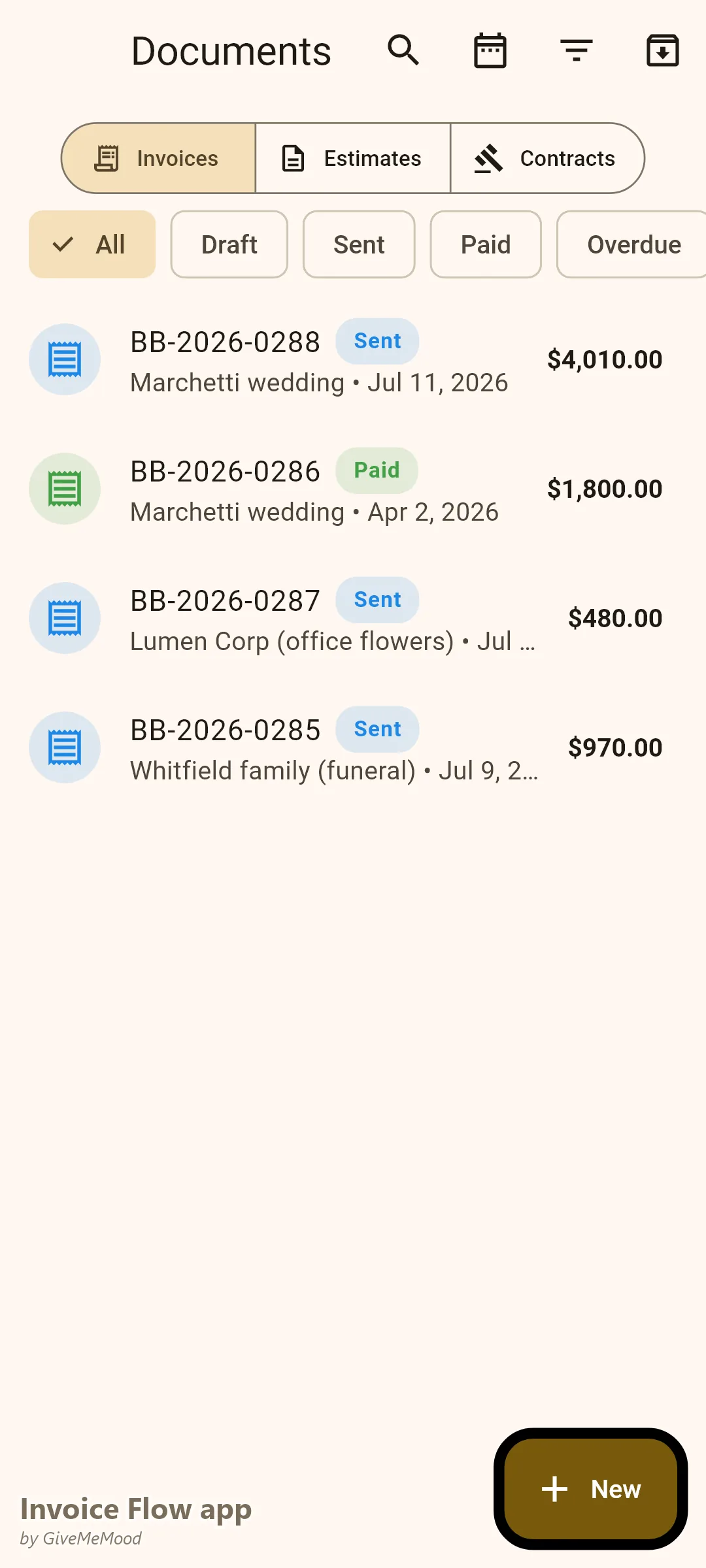
The full wedding invoice is the other document I have transformed. Before, I sent a single-line invoice: “Wedding Florals — [Name] Wedding: $6,200.” It covered everything. The couple knew their total but had no visibility into what it included.
Now my wedding invoices look like this: Bridal Bouquet — Garden Roses, Peonies, Dusty Miller: $420; Bridesmaid Bouquets ×4: $680; Boutonnières ×6: $180; Ceremony Arch — Full Florals, custom frame: $1,400; Reception Centerpieces ×14 — Low arrangements, mixed florals: $2,100; Head Table Garland — 16 feet: $580; Delivery to Venue: $150; Installation Labor — 4 hours: $280; Breakdown and Removal: $120. Total: $5,910.
Every line is visible. Every decision the couple made — to go with a larger arch, to add a head table garland, to have the florals removed at the end of the night rather than leave them — is documented with a price. There are no surprised faces at the final balance invoice, because the couple has been seeing the line items since the initial proposal.
I now have brides who share the invoice with their mothers and mothers-in-law, who use it as a planning reference, who add me to their wedding coordination spreadsheet by line item. The professional documentation has become part of the service experience.
Corporate Account Automation
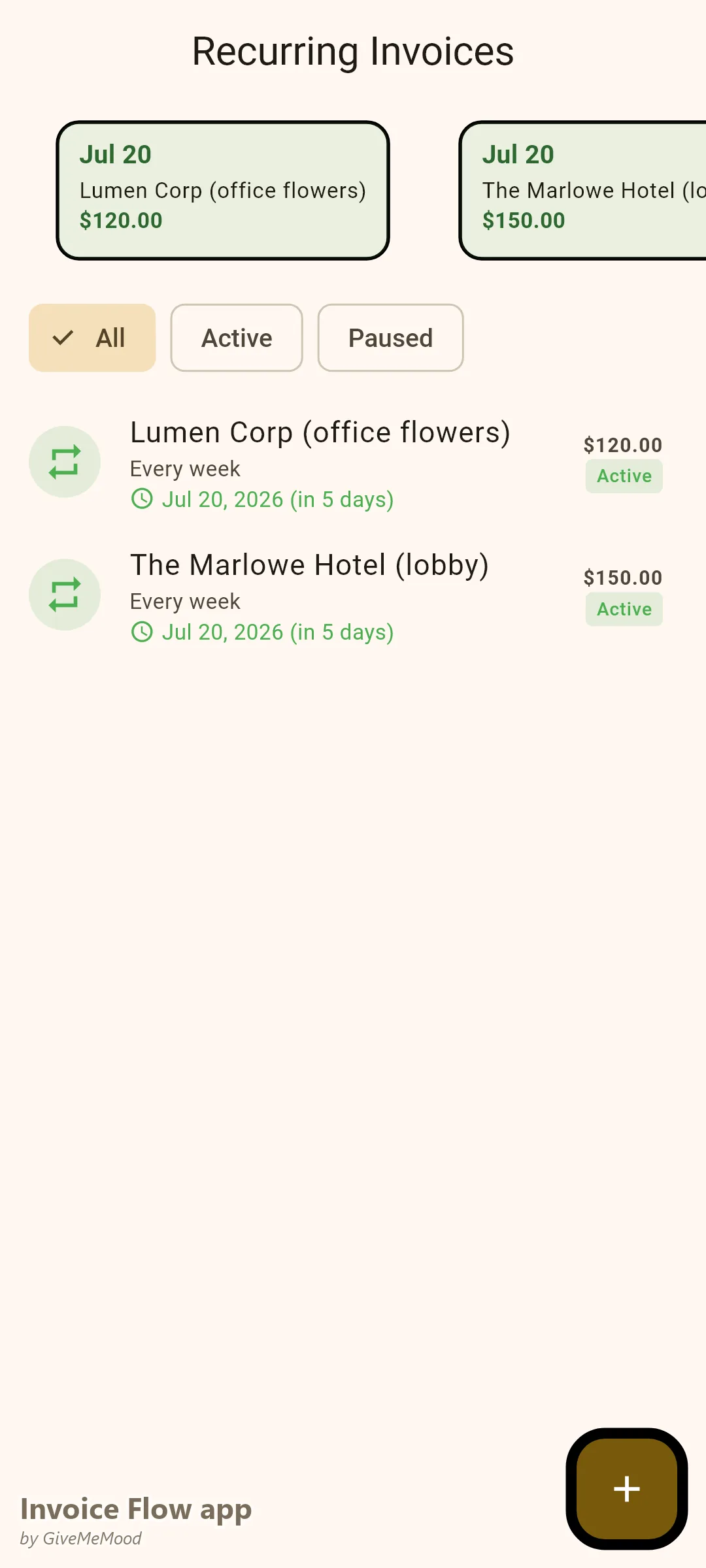
The eight corporate clients who had been billed manually are now on recurring invoices. Each client has a recurring invoice configured: the arrangement description, the delivery schedule, the price. The invoice goes out automatically at the start of each month.
I do not think about billing on Sunday mornings anymore.
More importantly, my corporate clients have told me the billing improved. One hotel account specifically mentioned that the consistent monthly invoice made it easier to process my account in their system. A restaurant group said they were able to get my vendor setup properly in their procurement software because I now had consistent invoice numbers and business documentation on every invoice.
The practical result is that my corporate income arrives reliably and on schedule. My average collection time on corporate invoices dropped from 38 days to 19 days after the switch to professional recurring billing.
Installation Labor: The Revenue I Was Giving Away
The installation labor billing change is the one I am most sheepish about, because it was the simplest fix and I had avoided it for years out of unfounded fear.
My standard event installation runs four to six hours for setup and two to three hours for breakdown. At my labor rate, this represents between $500 and $900 per event that I was absorbing silently. I convinced myself that clients would push back. I convinced myself it was “included.” I had never actually included it in a proposal — I had simply never charged for it.
When I started putting installation labor on invoices — “Installation Labor — 5 hours @ $65/hour: $325,” “Breakdown and Removal — 2 hours: $130” — not one client questioned it. Not one asked me to remove it. Two clients said something along the lines of “that seems very fair for the work involved.” I had been refusing to ask for this money for years because I had imagined a conversation that has never actually happened.
What My Business Looks Like Today
My business is in its third season with professional invoicing across all channels. I have added two new wedding bookings per season above my previous average — bookings I believe I am winning partly because the professional deposit invoice at the consultation signals a level of business maturity that some couples are specifically looking for. Not every bride wants the most creative florist. Some of them want the most professional one. The invoice is part of that signal.
My corporate revenue is stable, predictable, and collected on time. My installation labor is recovered on every event. My Sunday mornings are free.
My accountant looked at my financials at this year’s review and said the accounts receivable section was “completely different.” That is about the highest praise I can imagine receiving from an accountant.
For florists who are still running their billing informally — who are still doing Sunday manual billing cycles, still skipping the deposit at consultations, still absorbing installation labor because it feels awkward to charge for it — the fix is simpler than it looks from the outside. Download InvoiceFlow, spend a couple of hours setting up your services, and send the first deposit invoice at your next consultation.
The conversation you are afraid to have is mostly one you have invented. The professional invoice makes that conversation unnecessary.
Claire Dawson is a wedding and event florist based in Portland, Oregon. Her studio specializes in garden-style wedding florals and corporate account subscriptions for hospitality and office clients.