 EN
EN  العربية
  Български
  Čeština
  Dansk
Dansk  Deutsch
  Ελληνικά
  Español
  Suomi
Suomi  Français
  עברית
עברית  हिन्दी
  Bahasa Indonesia
  Italiano
  日本語
日本語  한국어
한국어  Bahasa Melayu
  Nederlands
  Norsk
Norsk  Polski
  Português
  Română
  Русский
  Svenska
  Kiswahili
  ไทย
ไทย  Türkçe
  Українська
  Tiếng Việt
  中文
中文 How I Went From Losing Thousands to Building a Profitable Makeup Artist Business
By Sofia Martinez, Freelance MUA & Bridal Specialist — Los Angeles, CA
I have been doing makeup professionally for nine years. I have worked on brides, on film sets, in advertising studios, and at editorial shoots for three fashion magazines. I have touched the faces of hundreds of clients and built a reputation that took years of early mornings, late wrap times, and weekends away from my family. And for the first four of those nine years, I was unknowingly giving away a significant portion of that hard work for free.
I am not talking about being underpriced on my day rate — although that was also a problem I had to fix. I am talking about something more basic and more embarrassing: I did not have a professional invoicing system. I collected money through Venmo, through bank transfers arranged over Instagram DM, through cash handed to me in parking lots after bridal mornings. I absorbed my kit fees into “the rate.” I added travel expenses to conversations after the fact and hoped clients would be understanding. I sent PayPal requests with messages like “Hi, here is the link for this weekend!” as my billing system.
The real cost of this approach only became clear to me after one particularly difficult year.
The Year I Decided Something Had to Change
In the spring of what turned out to be my most expensive year as a self-employed artist, I lost three bridal bookings in the month of June. Not because I wasn’t available. Not because my work wasn’t strong. Because three brides who had spent hours with me in consultation — who had seen my portfolio, discussed their vision, agreed on pricing — simply disappeared when it came time to commit financially. One of them booked a competitor. One got married at a city hall with friends doing her makeup. One I never heard from again.
I calculated what those three consultations had cost me in time: approximately 14 hours of my life, plus the opportunity cost of the dates I had been mentally holding. I had been holding them for people who had made no financial commitment whatsoever. Nothing. No deposit. No signed anything. A WhatsApp conversation and a verbal agreement.
Then came the film production job where the production company’s accounts payable department rejected my invoice — which was a PayPal request with a note — because they required a formal invoice with their purchase order number, a vendor reference, and a breakdown of my day rate, kit fee, and travel reimbursement. I had to figure out what a “proper invoice” looked like in 48 hours while on another job. I sent something I cobbled together in Google Docs. They paid it, but two months late, because it still didn’t match their system requirements exactly. I had been doing film work for three years at that point. Three years of late payments and rejected informal billing.
The wake-up moment was when I sat down and tried to calculate what I had actually earned that year versus what I had been quoted. The gap between what clients agreed to pay and what I had actually collected was significant. Kit fees I had mentioned casually but never invoiced. Travel fees I had “decided not to bring up” because it felt awkward. A day rate adjustment I had agreed to reduce verbally because I felt uncomfortable sending a corrected invoice after the fact. One bridal booking that paid me $800 for a six-person bridal party morning — including the bride — because I had only invoiced for “the bride’s makeup” and assumed the bridesmaid payments would be handled separately and informally, which they were not.
I told my partner about the number. He asked me what I was going to do about it. I told him I was going to find an invoice app and learn to use it before the next booking.
Finding InvoiceFlow and Learning to Bill Like a Business
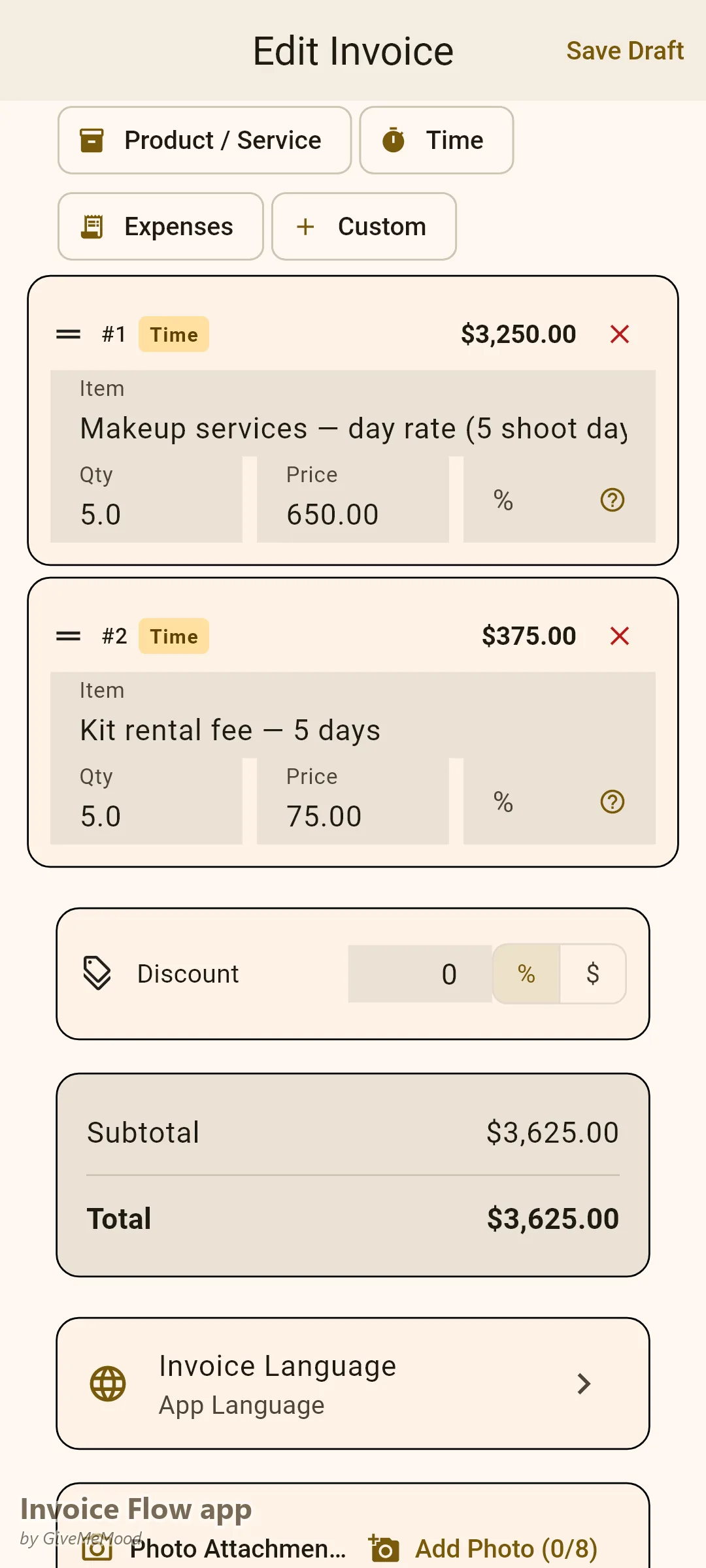
I did not need an enterprise accounting system. I am a solo artist. I carry my kit in one bag and my phone in my pocket. What I needed was something I could use on my phone, that would produce professional-looking invoices that I could share immediately, that would let me set up deposit billing, and that would not cost me $80 a month just to have.
I found InvoiceFlow in the Android app store. It was free to start. I downloaded it before my next bridal consultation.
What I did not expect was how much the act of setting up my services — naming them properly, giving them prices, deciding what would be a line item — would clarify my business thinking. When you have to type “Kit Fee” into a billing field and assign it a price, you stop treating it as a favor. You start treating it as a cost of doing business that you are professionally entitled to recover.
How I Restructured My Bridal Billing
The first change I made was implementing a deposit system for all bridal bookings. Before, I would have a consultation, send a “confirmation” text, and hope for the best. Now, the consultation ends and I pull out my phone. While the bride is still at the table, I create a deposit invoice — 35% of the full bridal package price — and send it directly to her email from the app.
The first time I did this, I was nervous. I thought she would find it pushy. She paid within two hours. The booking was secured. The date was blocked. I never had a “soft hold” conversation again.
My current bridal invoice structure looks like this: After consultation, a deposit invoice goes out. This secures the date and covers approximately my time investment in the consultation and any design work that follows. Four to six weeks before the wedding, I send the balance invoice: the remaining fee, a line item for early morning travel if applicable, a line item for any assistants I am bringing, and the final total. The couple has a clear picture of everything. There are no surprises.
For a typical six-person bridal party, my invoice reads: Bride — Full Glam Hair and Makeup: $380; Maid of Honor — Hair and Makeup: $280; Bridesmaids ×4 — Hair and Makeup: $260 each; Early Morning Call Time Supplement (before 6 AM): $75; On-Location Travel — Hotel, 22 miles round trip: $30; Parking: $15. Total: $1,460. Every line is documented. Every family member who reviews the invoice can see exactly what they are paying for. The professionalism of the invoice has become part of the value they are buying.
Getting Paid by Film and Production Clients
After I started using InvoiceFlow, my film and production billing changed completely. Production companies have formal accounting departments. They need formal invoices. They need purchase order numbers referenced. They need your rate, your kit fee, and your expenses on separate lines.
My standard production invoice now reads: Day Rate — 10-hour day: $800; Kit Fee: $150; Additional Hours — 2 hours overtime: $240; Travel — Studio to Location, mileage: $38. Total: $1,228. PO reference in the invoice notes. My business name, address, and tax ID as required.
The first fully professional invoice I sent to a production company — with all their required fields, properly formatted — was paid 19 days after submission. The previous informal billing from the same company had taken 62 days. Same client, same work. The difference was the documentation.
I now get specifically requested for repeat work on two advertising campaigns because the production coordinators have told me that dealing with my paperwork is easy. This is not a comment on my artistry. It is a comment on my professionalism. Both matter.
Kit Fees: The Line Item I Had Been Giving Away
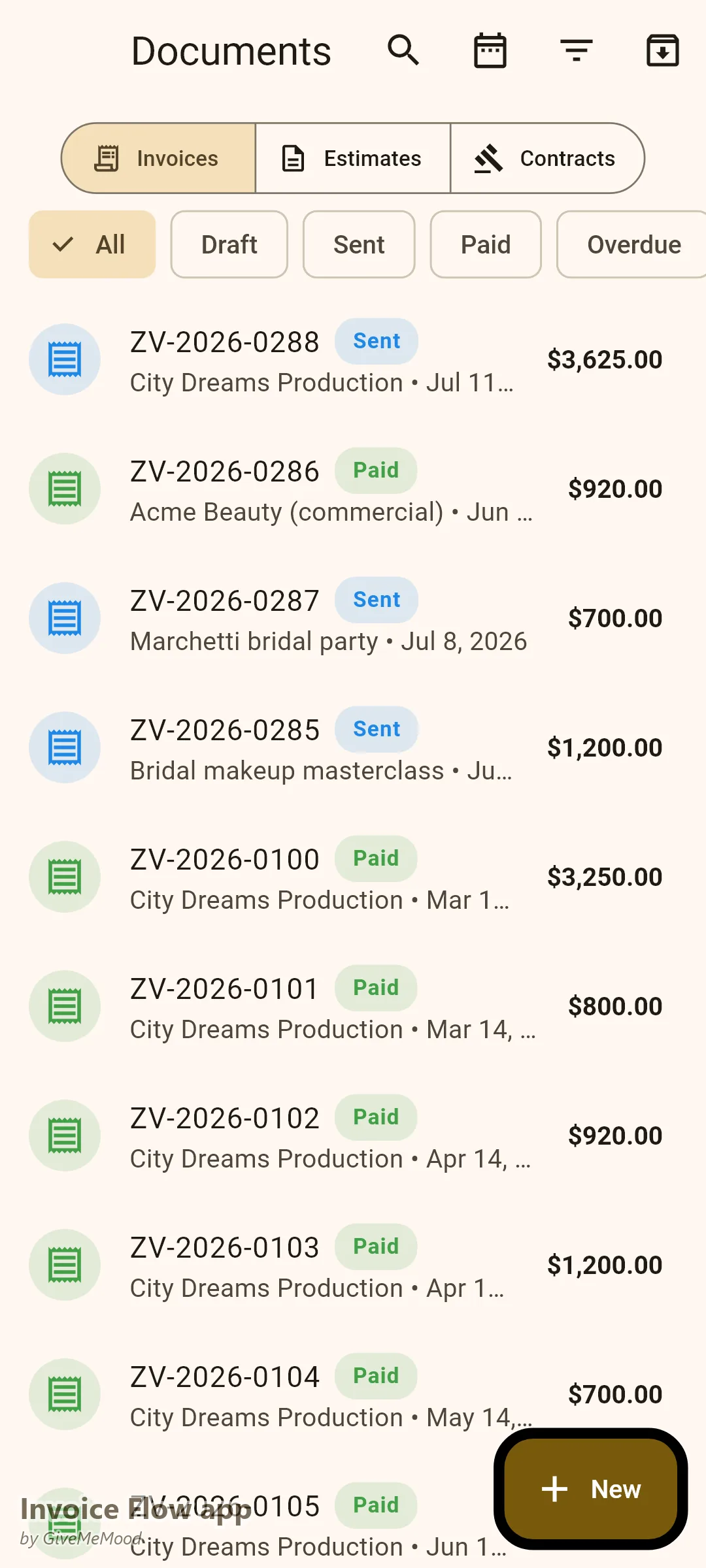
I want to talk about kit fees specifically, because I have spoken to many makeup artists who handle this the same way I used to handle it: by mentioning it in conversation and then not billing for it.
A professional makeup kit replacement cost runs between $800 and $2,000 per year for working MUAs, depending on the work type. Products get used. Products expire. Brushes wear. Specialty items for particular skin types or looks are purchased for specific jobs and become part of the kit. This is a cost of doing business. It belongs on the invoice.
My kit fee is now $150 for a full production day and $75 for a bridal morning. These numbers are not random. They reflect an honest calculation of my annual kit maintenance cost divided across my working days. I put them on every invoice. Not one client has ever questioned them. Not one.
The psychological shift required to bill for your kit fee is significant. You have to stop treating your kit as personal property that you happen to bring to work and start treating it as professional equipment that clients are partially financing through the fees you charge. That reframing helped me.
Travel Fees and Location Billing
On-location work is a core part of my business. I travel to hotels, private residences, venues, and studios. Before InvoiceFlow, I had a vague mental policy about charging travel fees but no consistent implementation. Sometimes I charged, sometimes I “let it go.” The result was that my effective hourly rate on location was lower than in studio, which is backwards — location work requires more from me, not less.
Now every invoice includes a travel line: the distance, the rate, and the total. On jobs over a certain distance, I add a parking line as well. These are not negotiation points. They are documented costs. The invoice makes them visible and professional.
The interesting thing about putting travel fees on invoices is that clients never argue. When you say “oh and I’ll need a little for gas” it sounds like you’re asking for a favor. When the invoice shows “On-Location Travel — 18 miles: $22.50” it is a business transaction. Same money. Completely different framing.
Tracking Income From Multiple Work Types
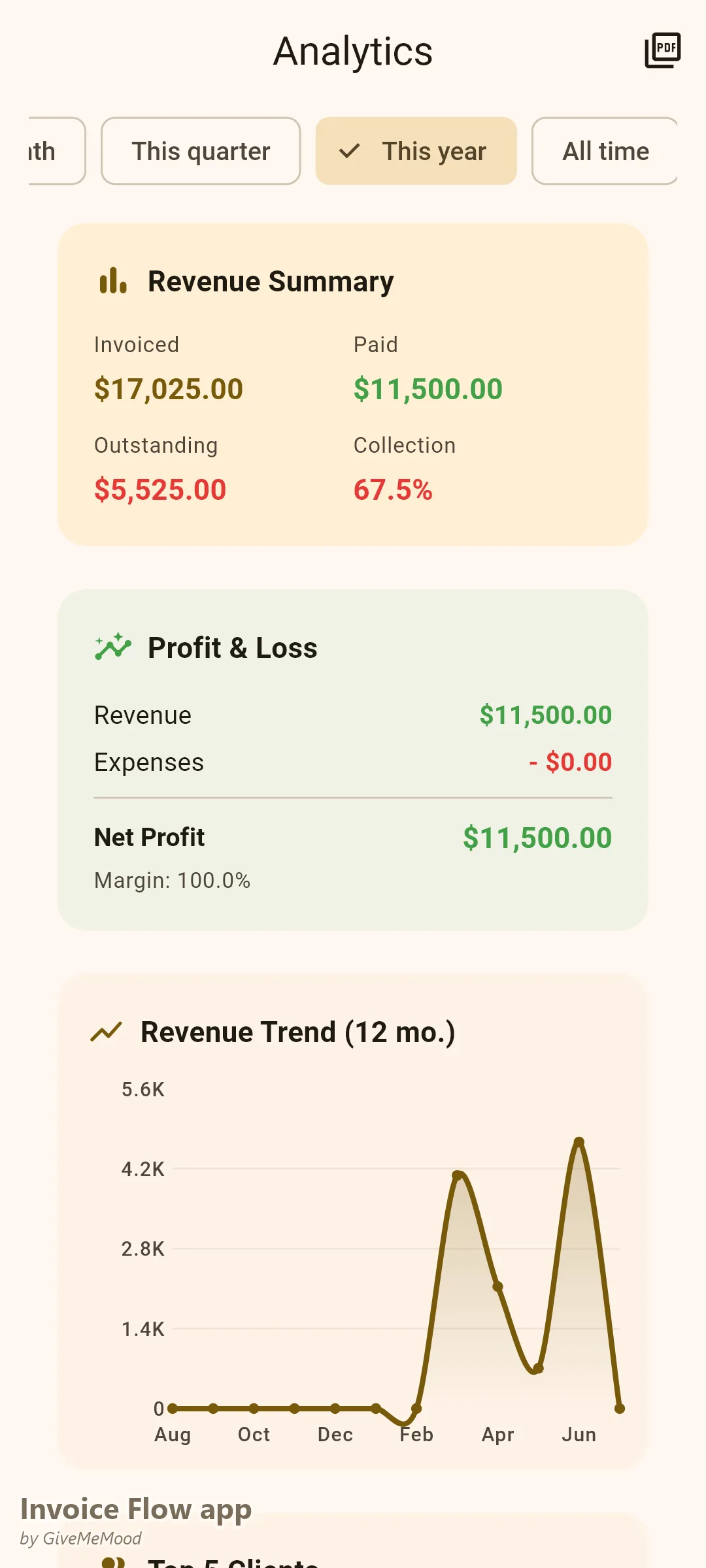
One thing InvoiceFlow gave me that I did not expect was clarity about where my income actually comes from. After a year of professional invoicing, I could see in the analytics: what percentage of my revenue was bridal work, what was film and production, what was editorial, what was education (I teach periodic masterclasses).
This visibility changed how I thought about marketing and booking. I could see that bridal work represented a much higher percentage of my income than I had thought, and that my editorial rates needed adjusting. I could see that my education workshops — which I had been running for years as informal passion-project income — were generating significant revenue that I had never properly tracked.
The Masterclass Revenue I Almost Left on the Table
Speaking of education: I want to mention this separately because it surprised me. I teach makeup masterclasses a few times a year. Before InvoiceFlow, enrollment was handled through Venmo and Instagram DM. People would say they were “definitely coming” and then not show up. Class sizes were unpredictable. I sometimes set up for 14 students and had 8 show up.
Now I invoice for masterclass enrollment: “Makeup Masterclass — Advanced Editorial Techniques, March 15 — Enrollment: $195.” Students receive a professional invoice. They have made a financial commitment. My last three masterclasses have had full enrollment with zero no-shows. The invoice is not just billing. It is a commitment mechanism.
The Results After Two Years of Professional Billing
I want to be specific about outcomes because vague success stories are not helpful.
In the two years since I moved to professional invoicing with InvoiceFlow:
My deposit-secured bridal cancellation rate dropped from what I estimate was 25–30% of soft holds to essentially zero. My average bridal booking value increased because the invoice made it easy to see and add line items I had previously omitted. My film production average payment time decreased from approximately 45 days to approximately 22 days. My kit fee recovery went from essentially zero to 100%. My travel fee recovery went from inconsistent to 100%. My masterclass enrollment reliability went from unpredictable to full enrollment on every class.
The total impact is not a small number. Professional invoicing is not administration. It is revenue recovery. The work was always worth what I should have been charging. I was just not capturing it.
What I Tell Other Makeup Artists
When newer MUAs ask me about billing, I tell them the same thing: the invoice is part of the service. It is the first document your client receives from you before the wedding. It is the document the production company files in their accounting system. It represents your business. It should look like a business document.
You are not doing your clients a favor by being informal. You are undermining the professionalism of the transaction. A bride who receives a formal deposit invoice from you at the consultation is a bride who has been treated as a valued client from the very first moment. She knows you are serious. She knows the date is secure. She knows what she is paying for.
Download InvoiceFlow. Set up your services. Price your kit fee. Calculate your travel rate. Send the deposit invoice at the consultation, before you leave the table. Your future self will thank you.
Sofia Martinez has been a professional makeup artist for nine years, working across bridal, film, editorial, and commercial markets. She is based in Los Angeles and offers makeup education workshops.