 EN
EN  العربية
  Български
  Čeština
  Dansk
Dansk  Deutsch
  Ελληνικά
  Español
  Suomi
Suomi  Français
  עברית
עברית  हिन्दी
  Bahasa Indonesia
  Italiano
  日本語
日本語  한국어
한국어  Bahasa Melayu
  Nederlands
  Norsk
Norsk  Polski
  Português
  Română
  Русский
  Svenska
  Kiswahili
  ไทย
ไทย  Türkçe
  Українська
  Tiếng Việt
  中文
中文 From Farm Stand to Restaurant Supplier: How I Finally Got Paid Like a Real Business
By Mark Chen, Vegetable Farmer — Hudson Valley, New York
I did not start farming to become a billing expert. I started farming because I wanted to grow food, see it go directly from my soil to people’s tables, and build something real with my hands. For the first five years, the financial side of the operation was something I managed almost accidentally — at the farmers market, people handed me cash. At the farm stand, people dropped bills in a box. My 55-member CSA paid via check or Venmo, and I kept a spreadsheet that I updated when I remembered.
This system worked until I started getting calls from restaurants.
When Restaurants Came Calling
The first restaurant call came from a chef at a farm-to-table place in town who had tasted my heirloom tomatoes at the farmers market and wanted to know if I could supply his kitchen. I said yes immediately. I was thrilled. A restaurant account meant predictable weekly volume, a premium price on specialty varieties, and a relationship that would grow over seasons.
What I was not prepared for was his accounts payable system. The restaurant did not pay cash. It did not pay Venmo. It paid invoices, on net-15 terms, through a formal accounting process that required a vendor number, an invoice number, the date of delivery, an itemized list of what was delivered with weights and unit prices, and my business address and tax information.
I sent him a spreadsheet. He was kind about it, but explained that their accounting system would not process it. He needed a proper invoice.
I spent an evening trying to figure out what a proper invoice looked like for a farm delivery. I found templates online. I built one in Google Docs. I emailed it with the wrong total because I had transposed two numbers. He replied with the correction. I sent a revised document. He processed it, but payment came 31 days later because the revised invoice reset the payment clock.
By the time the second restaurant reached out — another chef who had heard about my tomatoes from the first — I knew I needed a better system before I said yes to a second account. Two restaurant accounts billing through Google Docs would require more time per week than I was willing to spend on paperwork.
The CSA Billing Problem
The other pressure building at the same time was my CSA. I had grown it from 20 members to 55 over three seasons, which I was proud of. But 55 members meant 55 different payment situations. Some paid by check at the start of the season. Some paid weekly via Venmo. Some paid partially and then asked for adjustments. A few were perpetually behind.
Every week during the growing season I spent time chasing CSA payments that I should have spent in the fields. I had no automated system. I had a spreadsheet and a list of who owed what, which I updated manually, and which was wrong at least 30% of the time because I forgot to update it.
Late in my third CSA season, I realized I had two members who had not paid for three weeks and I had not noticed. I had delivered their shares every week because I assumed payment was coming. It was only when I reconciled my spreadsheet at the end of the month that I caught the gap. By that point, collecting it was awkward. I got part of it. I absorbed the rest.
Finding a System That Worked for a Farm
I found InvoiceFlow through a small farmers group online. Someone in the group mentioned using an invoice app for their restaurant accounts and their CSA subscription billing. I downloaded it that night.
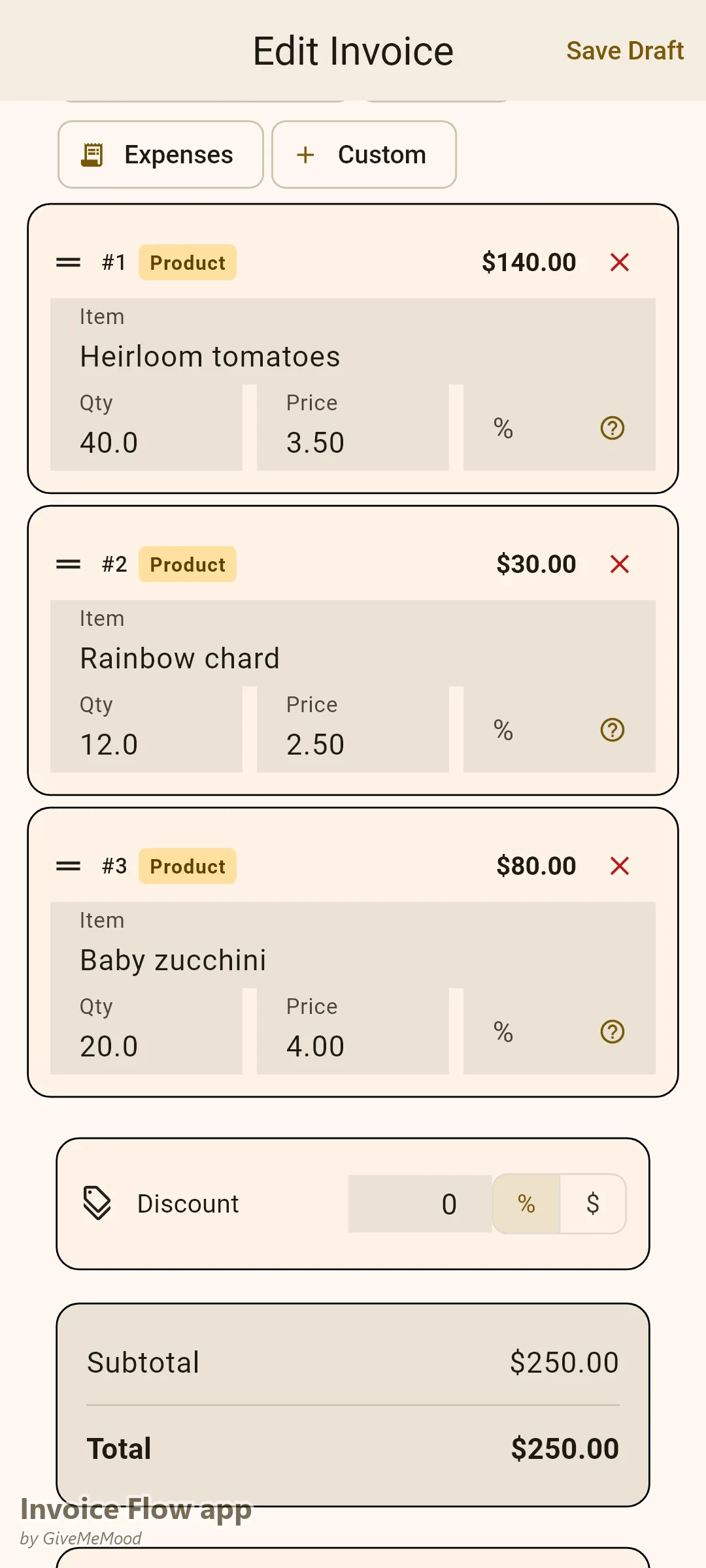
What I noticed first was how straightforward it was to set up produce items. I created entries for each of my varieties — Cherokee Purple Heirloom Tomatoes, Rainbow Chard, Baby Zucchini, Shishito Peppers — with a unit of measurement (pounds, bunches, units) and a price. I set up my farm name, business address, and bank details. I created a standard CSA share item at $28 per week.
I was ready to send professional invoices in about an hour.
Restaurant Billing: The Transformation
The first delivery invoice I sent to the original restaurant through InvoiceFlow was a different experience entirely. I showed up with the produce, unloaded it into their walk-in, and opened InvoiceFlow on my phone before I left the kitchen. I added the items: Cherokee Purple Heirloom Tomatoes — 28 lbs @ $3.75/lb: $105; Rainbow Chard — 8 bunches @ $2.50: $20; Shishito Peppers — 6 lbs @ $5.00/lb: $30; Baby Zucchini — 14 lbs @ $4.25/lb: $59.50; Delivery — Cold-chain delivery, refrigerated: $20. Total: $234.50. I added their vendor reference number in the notes field. I emailed the invoice to the accounts payable contact before I started my truck to drive home.
They processed it in three days and paid on day 12 — within their net-15 terms, which had never happened before. The chef messaged me to say their accounting department had specifically commented that my invoices were “easy to process.” That is not a compliment I ever expected to receive as a farmer, but it mattered enormously.
I now have four restaurant accounts. Three of them came to me through chef-to-chef referrals. I believe part of the reason those referrals converted was that chefs already knew my billing would not be a headache for their office.
Rebuilding the CSA Billing System
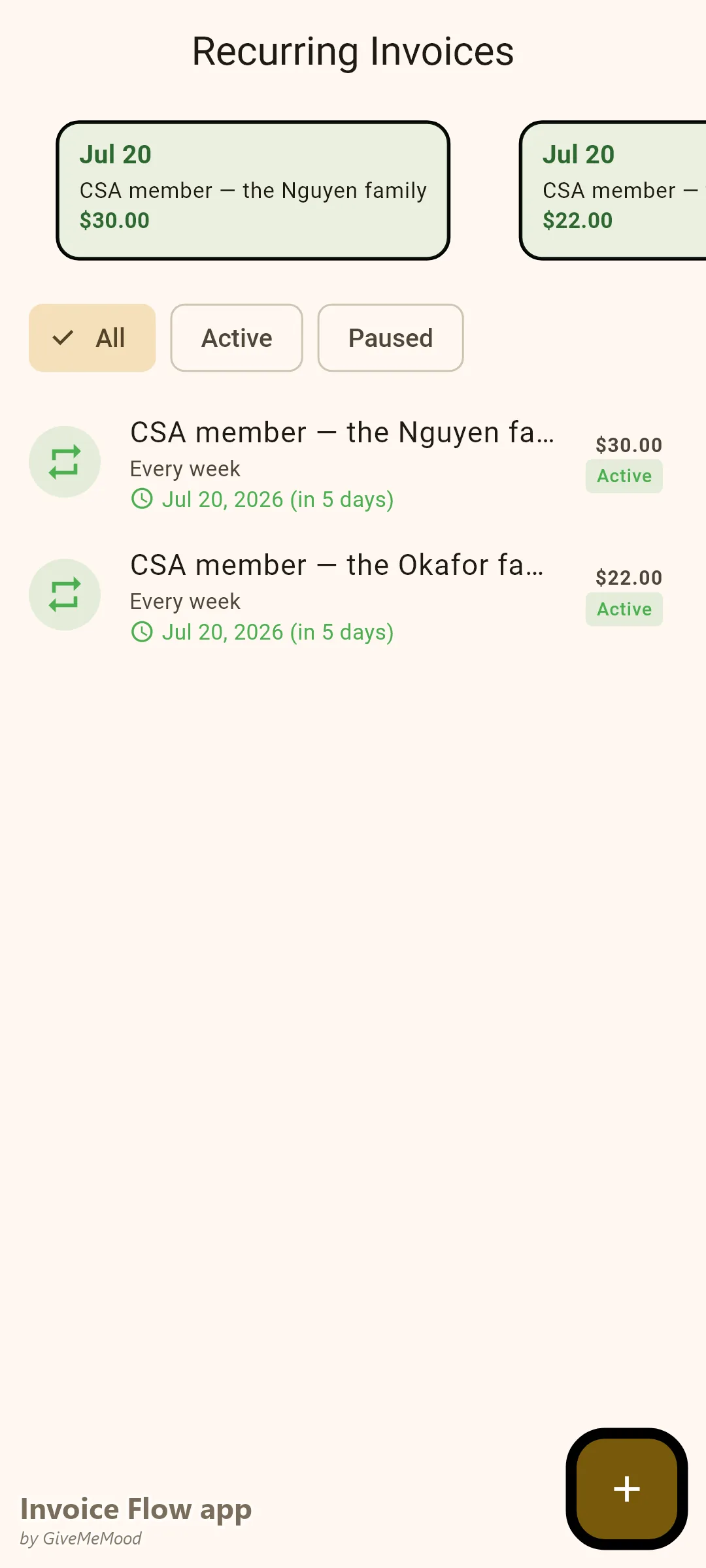
The CSA transformation was the change that saved me the most time per season. I set up recurring invoices for each of my 55 members: “Weekly CSA Share — Full Share, Hudson Valley Vegetable Farm, Week of [Date]: $28.” Each member receives an invoice at the same time each week. They pay through the payment link. I can see at a glance who has paid and who has not.
The first season with automated CSA billing, my payment collection rate for weekly shares went from something I could not accurately measure — because I was not tracking it properly — to clearly visible in the app. I could see every member’s outstanding balance in real time. Late payments became a simple, non-awkward follow-up: the invoice was there, it showed the outstanding amount, I just sent a reminder through the app.
I also set up season prepayment invoices for members who preferred to pay upfront. “Summer CSA — Full Share, 22 weeks, June through October: $616.” Half of my members now pay at season start. This gives me operating capital before the season begins, which I use for seed orders and soil amendments. The financial pressure of farming is partly about cash flow timing — prepaid CSAs improve that timing significantly.
The Wholesale Account I Almost Could Not Handle
Midway through my fourth season, a regional natural food cooperative contacted me about supplying them with certified organic mixed greens and specialty tomatoes on a weekly basis. This was a bigger account than any restaurant — larger weekly volumes, more formal procurement requirements, and a vendor onboarding process that required tax documentation and formal invoicing compliance.
I almost said no. I thought the administrative requirements would be overwhelming. But because I already had InvoiceFlow and understood what formal billing looked like, I said yes.
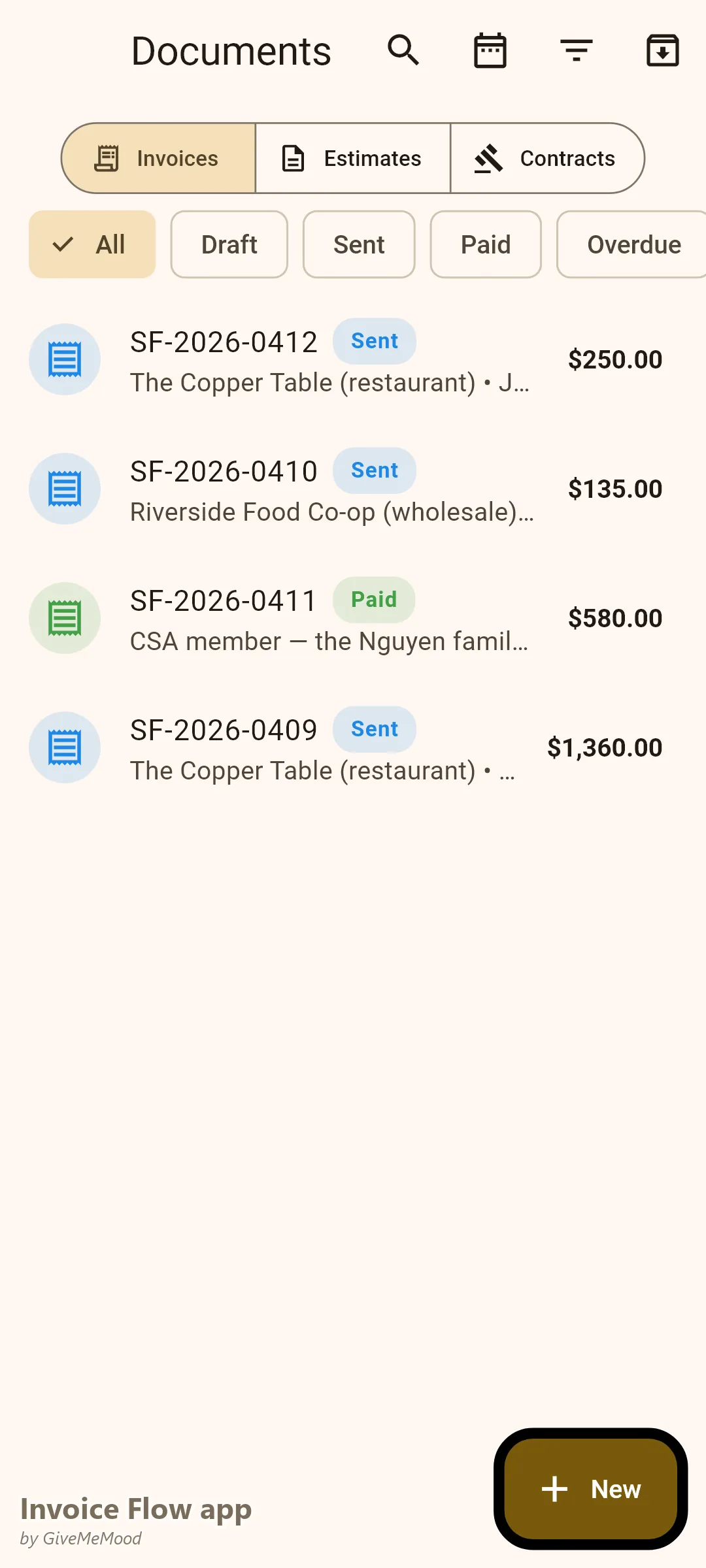
Their requirements were specific: each invoice needed my certified organic certification number, a lot reference for traceability, their purchase order number, my vendor ID in their system, and itemized weights with unit prices for each variety. The first time I set this up in InvoiceFlow — using the custom fields to add the lot number, certification number, and PO reference — it took about ten minutes. Every subsequent delivery invoice takes me about three minutes to generate on my phone at the end of the delivery.
The cooperative pays net-30. Having the invoice right is the difference between getting paid on day 30 and getting a call from their AP department two weeks later asking for documentation I should have included in the first place. I have received one such call in eight months of working with them. The other invoices have processed cleanly.
What Farm Income Tracking Actually Revealed
One thing InvoiceFlow gave me that I did not expect was clarity about where my money comes from. After one full season of professional invoicing across all channels, I could see in the analytics what I had never been able to see before: my income by source.
Restaurants: 42% of revenue. CSA members: 31%. Cooperative wholesale: 18%. Farmers market: 9%.
These numbers surprised me. I had always thought of the farmers market as the core of my business, because it was where I started and because it felt like the most visible part of my week. But it was actually the smallest revenue channel by a significant margin. The restaurant and wholesale channels — which felt more “paperwork” and less “farming” — were generating the majority of my income.
This changed how I thought about my time. The Saturday market requires six hours of my time for setup, selling, and breakdown. Restaurant deliveries require about thirty minutes per account per week. If I had known earlier how the revenue compared, I would have pursued restaurant and wholesale relationships more aggressively from the beginning.
The Small Detail That Made a Big Difference
There is one specific thing I want to mention for other direct-sale farmers who are considering switching to professional invoicing: the delivery note function.
When I deliver to restaurants, I can generate a delivery note from InvoiceFlow that goes with the produce. It is not the invoice — the invoice goes to the accounting department. The delivery note goes to the chef or the kitchen manager. It shows exactly what was in the delivery, with weights and prices, in a format that the kitchen can use when they receive and verify the order.
Before I had this, there was occasional confusion when the invoice arrived in accounting and the kitchen’s records of what was received did not match exactly. Now the delivery note is handed to the chef at the time of delivery. Any discrepancies are resolved on the spot. The invoice that follows matches what was received. No disputes. No delays.
Three Seasons In: What the Business Looks Like Now
My farm is in its sixth season. My CSA has grown to 70 members. I have four restaurant accounts, one cooperative wholesale account, and — starting next season — a contract with a local hotel for weekly breakfast produce deliveries. None of those last relationships would have been possible without professional invoicing. The hotel in particular made it clear during their vendor evaluation that they needed invoices with specific documentation fields, and that they would not work with vendors who could not provide them.
My Saturday market is still important to me. I enjoy the direct relationship with consumers. But it is no longer the center of my financial model. The professional billing side of my operation — the part I was most intimidated by when I started — turned out to be the thing that unlocked the growth I wanted.
If you are a farmer who is thinking about approaching restaurants or retail buyers, do the billing setup first. Spend an hour with InvoiceFlow before you make the call. The worst thing that can happen when you approach a restaurant is that they say yes and you are not ready to invoice them properly.
Mark Chen farms 40 acres of certified organic vegetables in the Hudson Valley, New York. He supplies restaurants, cooperatives, and direct consumers through a CSA program he runs from April through October.