 EN
EN  العربية
  Български
  Čeština
  Dansk
Dansk  Deutsch
  Ελληνικά
  Español
  Suomi
Suomi  Français
  עברית
עברית  हिन्दी
  Bahasa Indonesia
  Italiano
  日本語
日本語  한국어
한국어  Bahasa Melayu
  Nederlands
  Norsk
Norsk  Polski
  Português
  Română
  Русский
  Svenska
  Kiswahili
  ไทย
ไทย  Türkçe
  Українська
  Tiếng Việt
  中文
中文 InvoiceFlow for Art Sellers: The Complete Billing Guide
Billing for gallery consignment, custom commissions, direct sales, corporate procurement, and art fairs
Art sellers operate across billing models that most business invoicing tools aren’t designed for: gallery consignment settlements with artist-gallery splits and discount pre-approval clauses, multi-stage commission deposit invoices, direct sale invoices with certificate of authenticity references, corporate procurement with PO fields and copyright notices, and point-of-sale fair receipts. InvoiceFlow handles all of these from one Android app — with templates for each transaction type, deposit tracking for commissions, and the professional format that galleries, collectors, and corporate buyers expect.
Gallery Consignment Settlement Invoices
When your work is in a gallery on consignment, you get paid only when pieces sell. Monthly settlement invoices track what sold, the gallery’s commission, and your share.
Gallery Consignment Settlement — [Gallery Name] — [Month Year]:
Account Details:
- Gallery: [Name] | Consignment agreement date: [Date]
- Settlement period: [Start date] – [End date]
- Artist split: [N]% | Gallery commission: [N]%
Works Sold This Period:
- [Title] — [Medium, size] | Sold [Date] | Retail price: $[amount] × [N]% = $[artist amount]
- [Title] — [Medium, size] | Sold [Date] | Retail price: $[amount] × [N]% = $[artist amount]
- Total artist remittance: $[total]
Inventory Status:
- Works in gallery at period start: [N]
- Works sold: [N]
- Works returned (if any): [N]
- Works in gallery at period end: [N] (attached inventory list)
Payment Terms: Net-15 Discount policy: No discounting without written artist pre-approval. Unauthorized discounts will be deducted from gallery commission, not artist remittance.
Discount Pre-Approval Clause
This is the most important addition to any gallery consignment invoice. Without it, a gallery can reduce a price to close a sale and pass the discount proportionally to you — reducing your remittance without notice or approval.
With the clause, the gallery absorbs any unauthorized discount from their commission, not yours. Galleries that disagree with this policy are worth reconsidering.
Consignment Best Practices
- Request monthly settlements on a fixed date (first business day of the following month is standard)
- Keep a master inventory list of all consigned works with gallery, intake date, and agreed retail price
- Set a maximum consignment period (6–12 months) after which unsold works are returned
- Photograph all works before consigning with condition notes
Custom Commission Invoices
Custom commissions — portraits, site-specific works, series — require staged payments. The first payment protects you if the client cancels; subsequent payments protect you throughout production.
Art Commission — [Client Name] — Commission #[####] — [Date]:
Commission Details:
- Work: [Description — title, medium, dimensions, subject]
- Specifications: [Detailed requirements, reference images]
- Timeline: Estimate [Start] – [Completion date range]
- Delivery method: [Studio pickup / Shipped / Installed by artist]
- Certificate of authenticity: Included
Payment Schedule:
- Stage 1 — Deposit (50%, non-refundable, due at agreement): $[amount] Deposit due: [Date]
- Stage 2 — Progress payment (25%, due at draft/concept approval): $[amount] Progress payment due: Upon client approval of [sketch/photograph/in-progress view]
- Stage 3 — Balance (25%, due at delivery): $[amount] Balance due: At delivery/pickup/installation
Total commission fee: $[total]
Cancellation Policy:
- Deposit is non-refundable upon signing
- Cancellation after Stage 2 payment: 75% of total fee charged
- All work in progress and completed work on cancelled commissions remains the artist’s property and may be sold
When to Use Two vs. Three Stages
- Under $2,000: Two stages — 50% deposit, 50% balance at delivery
- $2,000–$5,000: Two stages or three stages depending on complexity and timeline
- Over $5,000: Three stages — deposit, mid-point, delivery
- Over $15,000: Consider four stages with more frequent progress payments
The stages protect you proportionally to the commitment. A $500 piece doesn’t need three invoices; a $15,000 corporate installation does.
Direct Art Sale Invoices
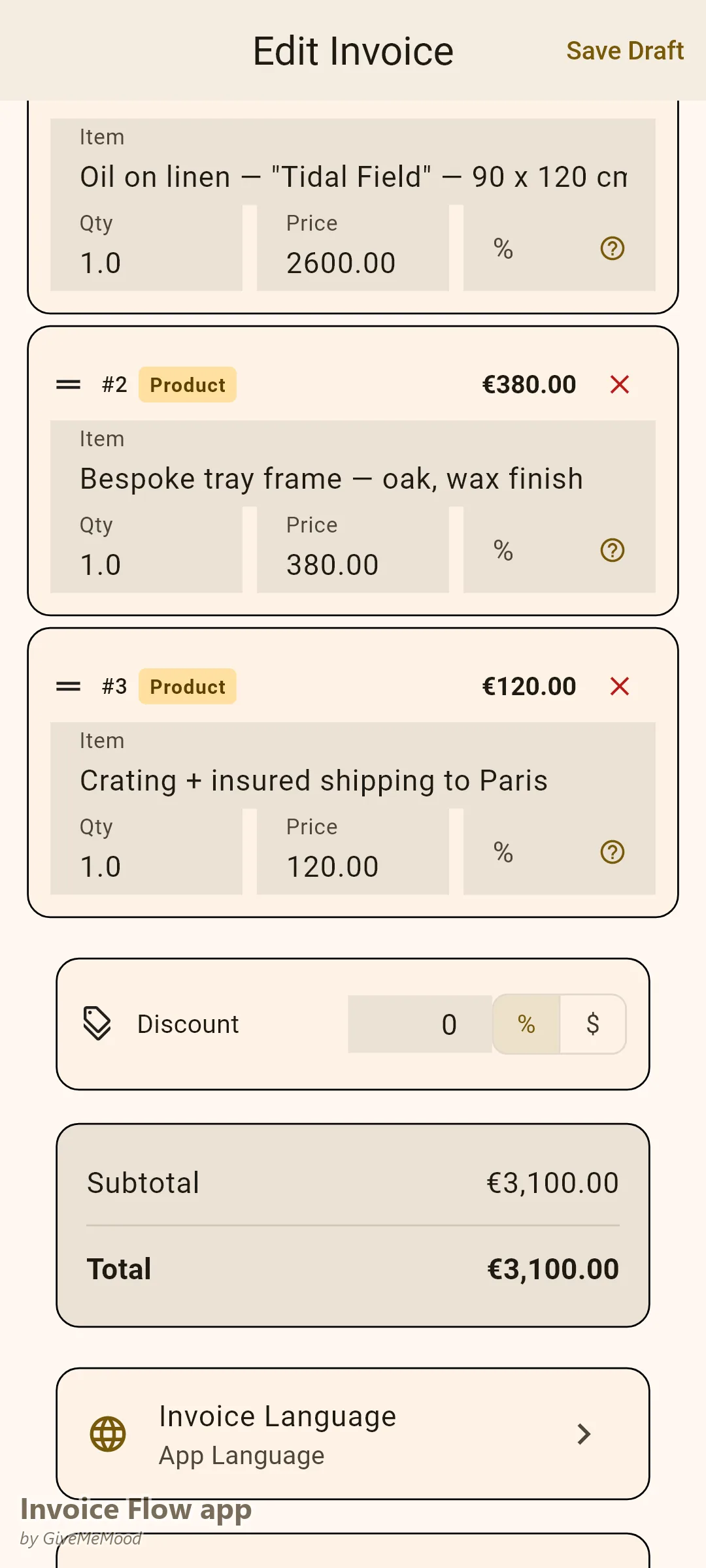
For sales from studio, art fairs, or your own website:
Art Sale — [Buyer Name] — [Date]:
- Work: [Title] | Medium: [Description] | Size: [W × H inches/cm] | Year: [Year]
- Condition: [New / As described]
- Sale price: $[amount]
- Shipping and packing (if applicable): $[amount]
- Insurance (if applicable): $[amount]
- Total: $[total]
- Payment: [Cash / Card / Check / Wire transfer]
- Certificate of authenticity: Included
- Provenance: [Prior exhibition history if relevant / Available on request]
Certificate of Authenticity Language
Include on every original art sale invoice: “Certificate of authenticity included. This document serves as a record of sale and provenance for the work listed above.”
This establishes both documents — the invoice and the certificate — as part of the provenance chain. Collectors, appraisers, and insurers will eventually need this.
Corporate Art Procurement Invoices
Design firms, developers, and corporations buying art for commercial spaces need professional format with PO reference and copyright documentation.
Corporate Art Procurement — [Company Name] — [Date]:
Buyer Details:
- Company: [Name] | Billing contact: [Name, title, email]
- Project: [Office build-out / Hotel lobby / Commercial development]
- PO Number: [PO-####]
Works:
- [Title] | [Medium, dimensions] | [Year] | Price: $[amount]
- [Title] | [Medium, dimensions] | [Year] | Price: $[amount]
- Art subtotal: $[total]
- Custom framing (if applicable): $[amount]
- Installation services: $[amount]
- Shipping and insurance: $[amount]
- Order total: $[total]
- Payment Terms: Net-30
Legal Notes:
- All works include certificate of authenticity
- Artist retains copyright in all works. Sale of original work does not convey reproduction rights
- Reproduction, digital distribution, or commercial use requires separate written license agreement
Why Corporate Buyers Need the Copyright Note
Corporate buyers frequently assume purchasing the physical work also gives them the rights to reproduce it. The most common scenario: a company wants to use the purchased painting in their marketing materials, website, or as a basis for branded merchandise. None of this is included in a sale.
If you don’t include the copyright note on the invoice, the first time this comes up is usually a conflict — not a question. Include it on every corporate sale.
Art Fair and Market Receipts
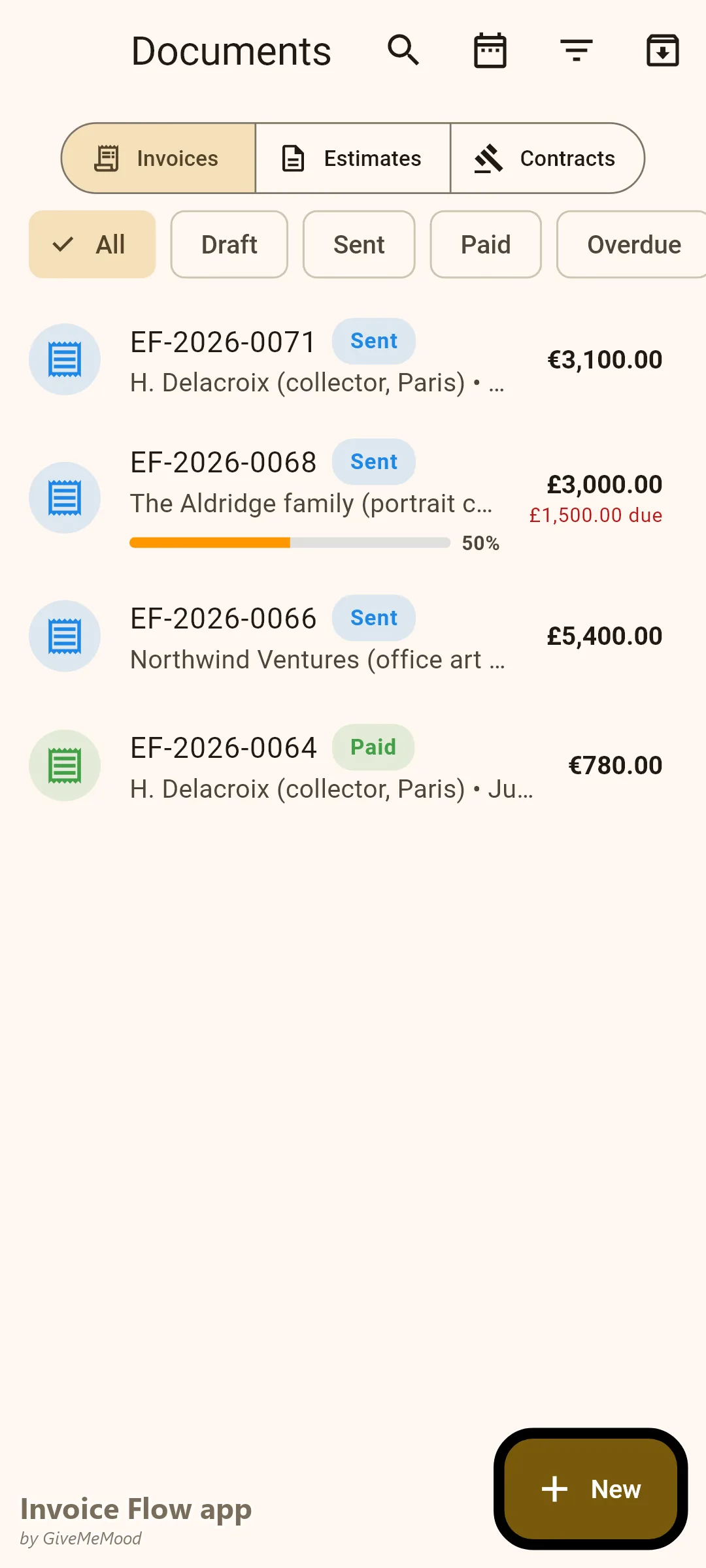
Art Fair Receipt — [Artist/Studio Name] — [Date]:
- Fair/event: [Name, city]
- Buyer: [Name] (optional, for collector records)
- Work: [Title] | [Medium, size] | [Year]: $[price]
- Print/reproduction (if applicable): [Title, edition number] $[price]
- Total: $[total]
- Payment: [Cash / Card]
- Certificate of authenticity: Included with original work
- Contact: [Studio website, email]
Send to the buyer’s email immediately. Many collectors use receipts for insurance scheduling.
Print, Limited Edition, and Reproduction Sales
If you sell prints or limited editions alongside originals:
Print Sale — [Buyer Name] — [Date]:
- Work: [Title] — [Edition type: Giclée print / Screen print / etc.]
- Edition: [Number]/[Total edition size] | Signed: [Yes / No]
- Paper/substrate: [Description]
- Size: [Dimensions]
- Price: $[amount]
- Note: This is edition [N] of [N] total. A certificate of authenticity documenting the edition is included.
Using InvoiceFlow for Art Seller Billing
Commission deposit tracking: When a client pays the Stage 1 deposit, InvoiceFlow records the payment and generates the Stage 2 progress payment invoice. Each stage references the same commission number.
Gallery consignment templates: Build a monthly settlement template with the item-level percentage calculation. Set a recurring invoice reminder on the first of each month for each gallery on consignment.
Copyright notes on corporate invoices: Pre-load the copyright and reproduction rights language in the Notes field of your corporate invoice template. It appears on every corporate invoice without requiring manual entry.
Certificate of authenticity reference: Add the certificate of authenticity note to your direct sale and corporate sale templates. It takes ten seconds and establishes documentation from the first invoice.
Fair receipts: Build a simple fair receipt template. At the fair, fill in the work title, size, medium, and price. Send to the buyer’s email before they leave your booth.
Pricing Transparency for Art Buyers
Consider including a brief framing note on invoice at the bottom for serious collector buyers:
“This work has been authenticated by [Artist name] as an original work. The sale includes a certificate of authenticity documenting medium, dimensions, year, and provenance. Questions: [contact].”
This adds formality that high-value collectors appreciate, and reduces questions after the sale.
Download InvoiceFlow. Build the commission invoice with staged payments. Build the gallery consignment settlement with the no-discount clause. The commission that starts with a signed deposit invoice is the commission that ends with full payment — and the documentation that makes your work collectible.
InvoiceFlow is a free Android invoicing app built for small business owners. Send professional invoices, track multi-stage commission payments, manage gallery consignment, and document corporate art sales — all from your phone.