 EN
EN  العربية
  Български
  Čeština
  Dansk
Dansk  Deutsch
  Ελληνικά
  Español
  Suomi
Suomi  Français
  עברית
עברית  हिन्दी
  Bahasa Indonesia
  Italiano
  日本語
日本語  한국어
한국어  Bahasa Melayu
  Nederlands
  Norsk
Norsk  Polski
  Português
  Română
  Русский
  Svenska
  Kiswahili
  ไทย
ไทย  Türkçe
  Українська
  Tiếng Việt
  中文
中文 The Gallery Commission That Changed How I Invoice My Art
By Marcus Delgado, Visual Artist — Santa Fe, NM
I’ve been making and selling art full-time since 2014 — primarily oil paintings and mixed-media works, priced between $400 and $4,800. Santa Fe has an active art market: galleries, collectors, design firms, corporate buyers, and a robust tourist trade.
For the first four years, I handled money informally. A painting sold through a gallery, I got a check from the gallery (minus their commission) whenever they got around to writing it. A collector bought direct from my studio, I wrote out a price on a piece of paper or texted a Venmo request. It worked loosely until it didn’t.
The breaking point was a corporate commission. A law firm in Albuquerque wanted a large-scale triptych for their new office — three panels, each 40” × 60”, oil on linen. We agreed on $12,500. I started work. Three months later, when I delivered, they told me the partner who commissioned the piece was no longer with the firm and they were disputing the agreement.
I had no signed contract, no deposit receipt, no invoice — just a few emails and a text exchange. After five months of back-and-forth, they paid $7,200. I lost $5,300 from an agreement I’d spent three months executing.
That was the last time I sold art without a proper invoice.
Rebuilding the Art Billing System
After the Albuquerque loss, I built a billing structure for every sale channel:
1. Gallery consignment settlement — monthly, tracking what sold and my percentage 2. Direct sale invoices — for collectors buying from studio or fairs 3. Custom commission invoices — deposit at agreement, balance at delivery 4. Corporate art procurement invoices — with PO fields and net-30 5. Art fair and print sale receipts — quick point-of-sale documentation
Gallery Consignment Settlement
Most galleries take 40–50% of the sale price. Monthly settlement invoices track what sold and what the gallery owes me.
Gallery Consignment Settlement — [Gallery Name] — [Month Year]:
- Settlement period: [Start date] – [End date]
- Consignment agreement: [Date]
- Artist split: [N]% to artist | [N]% to gallery
Works sold this period:
-
“Desert Dawn” — oil on canvas, 30×40 (sold [Date]): retail price $1,800 × 60% = $1,080
-
“Arroyo Series III” — mixed media, 24×36 (sold [Date]): retail price $2,400 × 60% = $1,440
-
“Mesa Light” — oil on panel, 18×24 (sold [Date]): retail price $950 × 60% = $570
-
Total artist remittance: $3,090
-
Works remaining in gallery: [N] pieces (attached inventory)
-
Payment Terms: Net-15
-
Note: Artist retains copyright to all works. Sale price is final; no discounting without artist pre-approval.
The “no discounting without artist pre-approval” note is something I added after a gallery sold one of my pieces at 20% off to close a deal without asking me. That reduced my payment by $360 on a $1,800 work. Now it’s on every consignment invoice.
Direct Sale Invoices
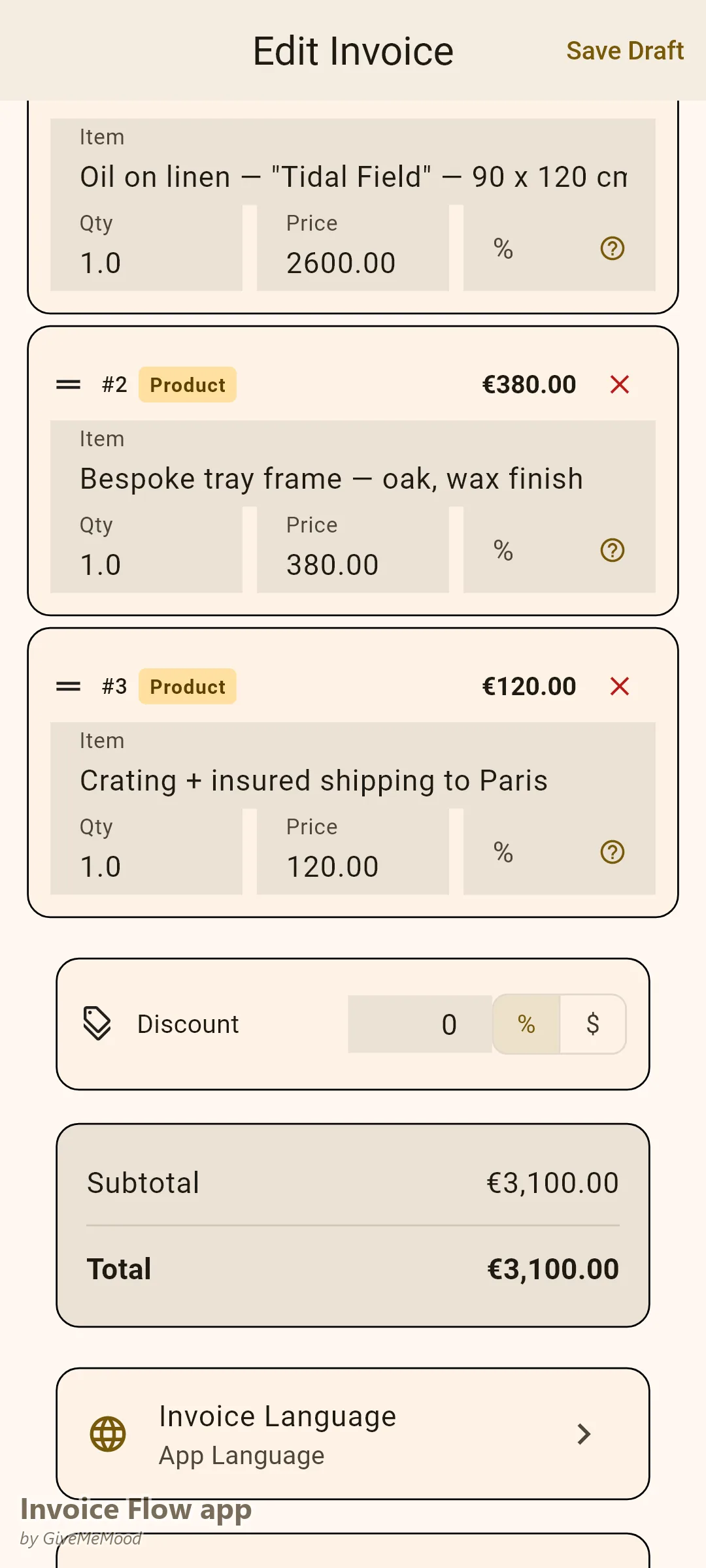
When collectors buy from my studio, art fairs, or online:
Art Sale — [Collector Name] — [Date]:
- Work: [Title] | Medium: [Oil on canvas / Mixed media / etc.]
- Size: [Dimensions] | Year: [Year]
- Sale price: $[amount]
- Shipping and insurance (if applicable): $[amount]
- Total: $[total]
- Payment: [Cash / Card / Check / Wire transfer]
- Certificate of authenticity: Included with sale
- Provenance statement: Available on request
The certificate of authenticity line matters — collectors who later resell or insure the work need documentation. Mentioning it on the invoice establishes the documentation standard.
Custom Commission Invoices
Custom commissions — portraits, site-specific works, corporate pieces — require a deposit structure. The Albuquerque experience made this non-negotiable.
Art Commission — [Client Name] — [Date]:
- Commission: [Description — e.g., triptych for corporate lobby, oil on linen, three panels 40”×60”]
- Subject/concept: [Description or brief]
- Timeline: Estimated completion [Date] — [Date range]
- Delivery: [Pickup at studio / Installation by artist / Shipped]
- Certificate of authenticity: Included
Commission fee: $[total]
- Deposit (50%, non-refundable, due at agreement): $[deposit]
- Progress payment (25%, due at client approval of draft): $[progress payment]
- Balance (25%, due at delivery): $[balance]
Cancellation: Deposit non-refundable. If cancelled after draft approval: 75% of total fee. All work on cancelled commissions remains property of the artist.
The three-stage payment structure — deposit, progress payment, balance — is what I’d had none of on the Albuquerque commission. Now every custom piece over $3,000 uses three stages.
Corporate Art Procurement Invoices
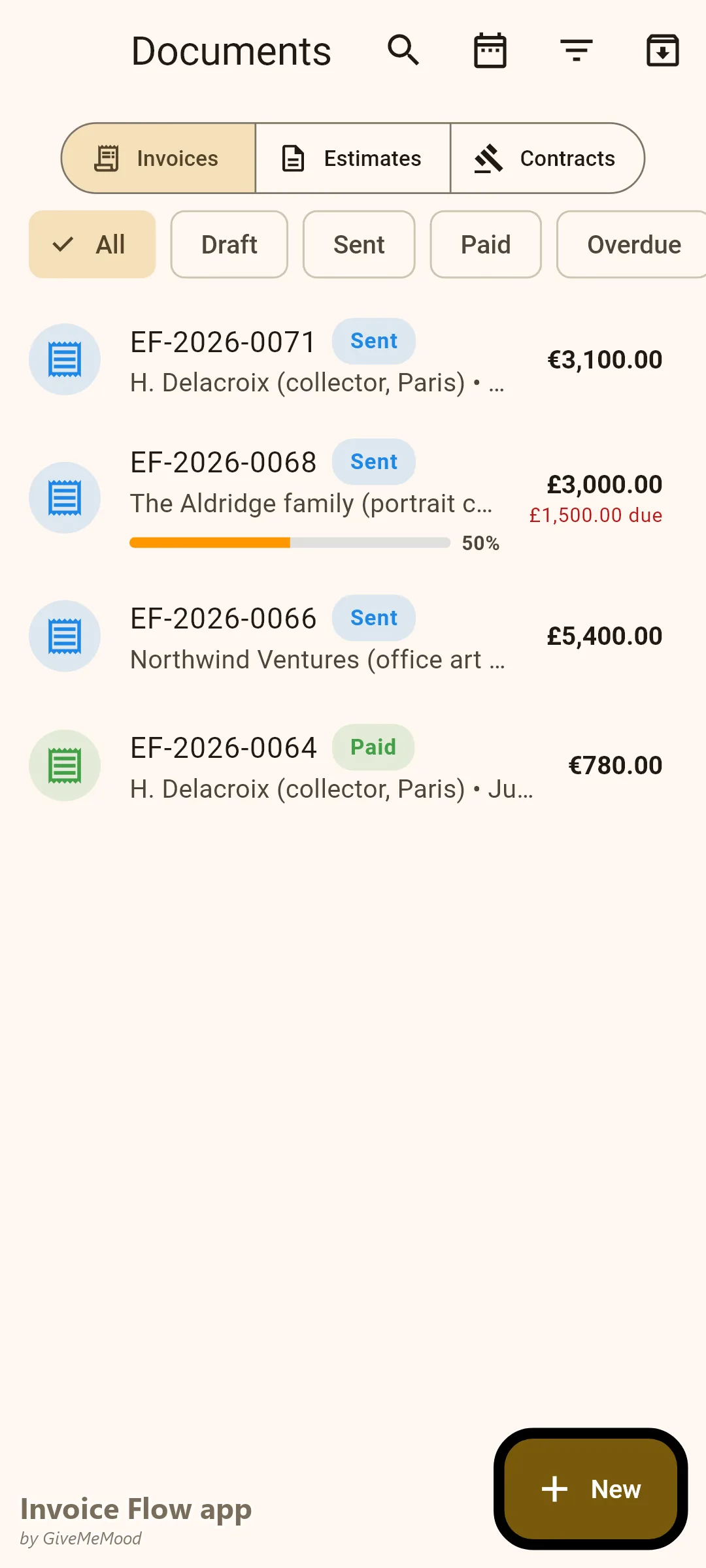
Design firms and corporate clients buying for offices, hotels, and commercial spaces need professional invoice format.
Corporate Art Procurement — [Company Name] — [Date]:
- Buyer: [Company name] | Contact: [Name, title]
- PO Number: [PO-####]
- Works:
- [Title] | [Medium, size] | [Year]: $[price]
- [Title] | [Medium, size] | [Year]: $[price]
- Art subtotal: $[total]
- Framing (if applicable): $[amount]
- Installation: $[amount]
- Shipping and insurance: $[amount]
- Order total: $[total]
- Payment Terms: Net-30
- Note: All works include certificate of authenticity. Artist retains copyright; reproduction rights not included.
The copyright and reproduction rights note is important for corporate buyers. When a company buys a painting for their lobby, they own the object — not the image. Some corporate buyers assume they can reproduce it in marketing materials. This note prevents that assumption.
Art Fair and Print Sale Receipts
Art fairs and markets generate retail transactions. Professional receipts are important for collectors, who use them for insurance and resale.
Art Sale Receipt — [Artist/Studio Name] — [Date]:
- Fair/event: [Name, location]
- Buyer: [Name]
- Work: [Title] | Medium: [Description] | Size: [Dimensions] | Year: [Year]
- Price: $[amount]
- Payment: [Cash / Card]
- Certificate of authenticity: [Included with work / Mailed to address on file]
The Business Ten Years In
Current revenue breakdown:
- Gallery consignment (3 galleries): approximately $4,800/month average
- Direct studio sales: approximately $2,600/month
- Custom commissions (1–2/month): approximately $3,400/month
- Corporate procurement: approximately $1,800/month
- Art fairs and prints: approximately $1,200/month
- Total monthly revenue: approximately $13,800/month
The $5,300 I lost on the Albuquerque commission was my most expensive education. InvoiceFlow paid for itself in the first commission where the client saw a deposit invoice and signed without question.
What InvoiceFlow Does for Art Sellers
Art seller billing spans gallery consignment settlements with discount pre-approval clauses, direct sale invoices with certificate of authenticity references, custom commission three-stage payment structures, corporate procurement with PO fields and copyright notes, and point-of-sale fair receipts. InvoiceFlow handles all of these from one Android app — templates for each transaction type, deposit tracking for commissions, and professional invoice format that serious collectors and corporate buyers expect.
Download InvoiceFlow. Build the commission invoice with the three-stage payment structure. Build the gallery consignment settlement with the discount pre-approval note. The custom commission that starts with a signed deposit invoice is the commission that ends with full payment.
Marcus Delgado is a visual artist based in Santa Fe, New Mexico, selling original oil paintings and mixed-media works through gallery consignment, direct studio sales, custom commissions, and corporate art procurement.